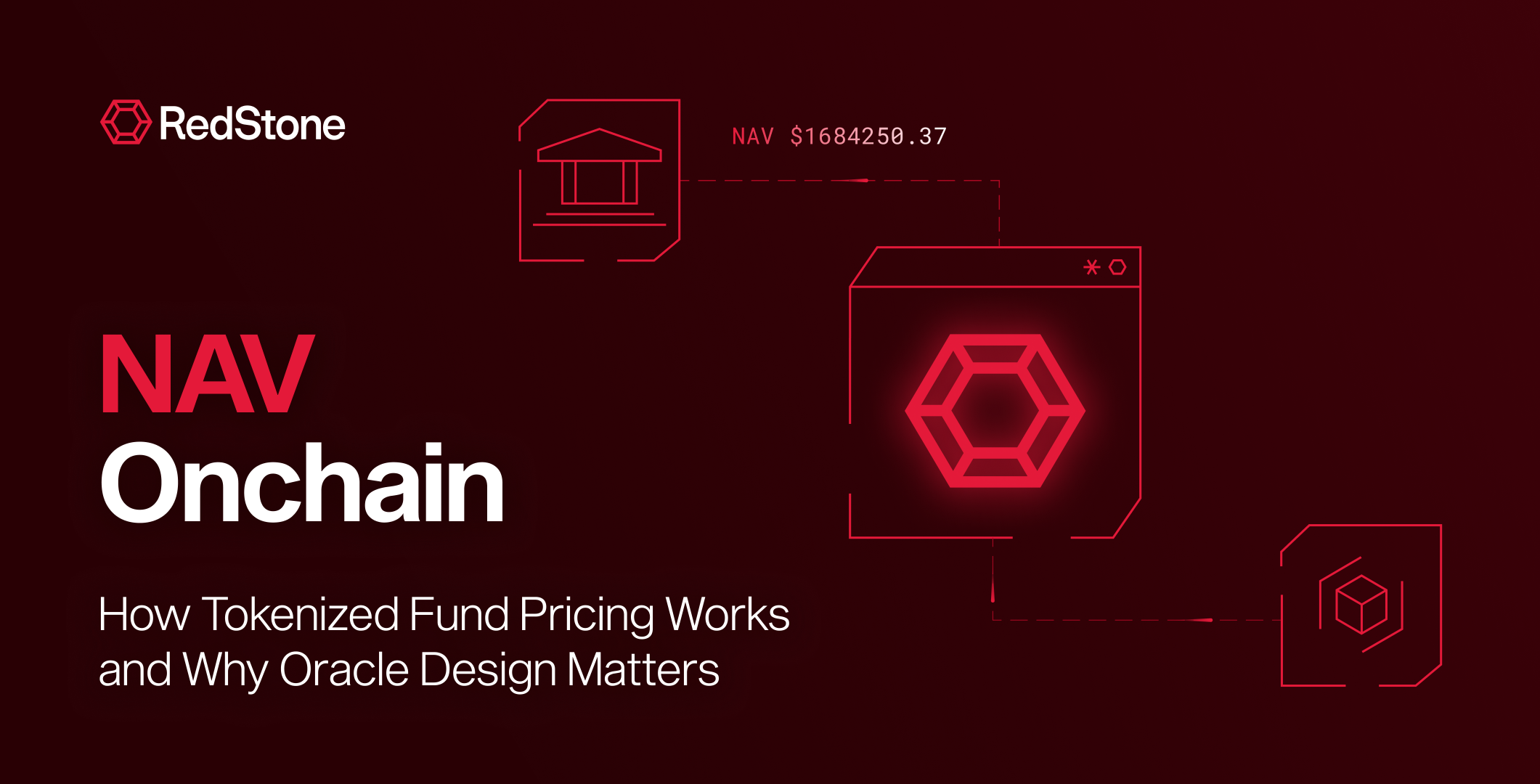
Bringing a fund onchain is not the hard part. Pricing it correctly is. Net Asset Value (NAV) is the heartbeat of any fund structure, and how that figure gets expressed onchain determines whether a tokenized fund is genuinely usable as DeFi collateral or just a digital record of an off-chain position. This is where oracle design for tokenized assets stops being a technical footnote and becomes a core product decision.
How NAV Differs From Standard Price Feeds
Most oracle infrastructures were built for market prices: liquid assets trading on exchanges, where the oracle’s job is to aggregate a price that already exists. NAV is a different kind of data. A fund’s NAV is calculated, not discovered. It is the output of a regulated process involving a fund administrator, an auditor, and in many cases a custodian. Most tokenized fund structures calculate NAV daily; some private credit vehicles do it weekly or monthly. Off-chain fund accounting also runs on T+1 settlement cycles, holiday calendars, and cutoff windows that do not translate to a 24/7 blockchain.
This creates an oracle problem that differs fundamentally from price feed design. The question is not how to aggregate many sources into a reliable median. The question is how to bring a single authoritative, off-chain calculated figure onchain in a way that is verifiable, tamper-resistant, and useful to protocols that need to price positions in real time.
How Leading Platforms Handle Tokenized Fund Pricing
The platforms covered in the recent Tokenization and RWA Standards Report have converged on a small number of approaches to tokenized fund pricing, each reflecting a different set of tradeoffs between accuracy, frequency, and operational complexity.
Daily NAV via regulated fund administrator. Spiko represents the clearest example of this model. Its NAV is calculated by CACEIS, a Crédit Agricole subsidiary acting as custodian and fund administrator, and brought onchain via oracle as a daily heartbeat. The result is that Spiko’s fund tokens accrue yield through a rising token price rather than discrete distributions. There are no dividend events, no rebase mechanics, just a token worth slightly more each day as the underlying T-bills accrue interest. The simplicity is deliberate: a single daily NAV update minimizes the surface area for errors or manipulation while preserving the regulatory integrity of the calculation.
Per-second continuous accrual. Superstate pushes frequency to its practical limit with a continuous oracle that updates yield accrual every second. The underlying NAV is still calculated daily by a third party, but the per-second accrual allows the token price to reflect yield in real time rather than in daily steps. For lending protocols that need to price collateral continuously, this granularity matters. It also eliminates the intraday pricing gaps that arise when a fund token holds a stale NAV between daily updates.
Epoch-based settlement pricing. Centrifuge takes a different approach suited to assets with less liquid underlying holdings. Rather than publishing a continuous NAV, its pool architecture batches deposit and redemption requests into epochs. At each epoch close, the pool manager approves orders at the current verified NAV, and shares are issued or revoked accordingly. The NAV itself is published onchain at epoch close, with full double-entry bookkeeping, typed accounts covering assets, equity, gains, losses, expenses, and liabilities, enforced at the smart contract level. This gives auditors and asset managers a transparent, verifiable accounting trail directly onchain rather than requiring reconciliation against off-chain records.
Hybrid exchange and AMM pricing. Securitize’s approach to tokenized equities illustrates how NAV-style pricing must adapt for assets that have a live market reference. During trading hours, the platform executes at the National Best Bid and Offer. After market close, it switches to AMM-style pricing for continuous secondary market availability. The oracle infrastructure has to support both modes cleanly, shifting its reference source depending on whether a live market price exists.
The Trusted Single Source Oracle
Private fund NAV data is authoritative and single-sourced by definition. The standard approach of aggregating multiple independent sources, which makes sense for market prices, does not apply here.
The Trusted Single Source Oracle, developed by RedStone, is built for exactly this case. It lets a regulated data provider (typically the fund administrator or transfer agent) publish verified NAV data on-chain in a cryptographically attested, traceable way. In practice, NAV feeds of this kind pair naturally with Proof of Reserve, which verifies that the holdings behind the NAV figure actually exist. On this architecture, Securitize selected RedStone as primary oracle for the BlackRock BUIDL fund, Apollo ACRED, Hamilton Lane, and KKR tokenized funds. Institutional-grade price feeds for regulated products are a different engineering problem from market data aggregation. They need an attestation model built for the single-source reality.
Why Oracle Design Affects DeFi Composability
The link between NAV feed design and DeFi utility is direct. On Morpho alone, tokenized RWAs account for roughly $550M in deposits, about 5% of the protocol’s $10.2B total. Every one of those positions is priced using some form of NAV feed.
A stale NAV feed forces conservative parameters and reduces capital efficiency. A feed that updates on a known schedule with strong attestation allows tighter parameters and better economics. The oracle is not a neutral relay. It is an active input into the risk architecture of every protocol that touches the asset.
The Open Problem: Frequency vs. Regulatory Reality
The honest tension in tokenized fund pricing is that DeFi protocols want continuous real-time data, while regulated fund structures produce NAV on a schedule set by legal and operational requirements. No platform has fully resolved it. Intraday interpolation gets closest for liquid vehicles, but it is an extrapolation of daily NAV rather than a genuinely continuous valuation. For private credit with monthly NAV, the gap is wider still.
The practical response has been to design vault and collateral structures that acknowledge the gap rather than paper over it with high-frequency feeds that carry false precision. Epoch-based settlement models and the ERC-7540 asynchronous vault standard both reflect this philosophy: build the settlement mechanics around the actual cadence of the underlying asset, and let the oracle feed match that cadence honestly.
For asset managers evaluating how to bring fund products onchain, the oracle is where regulatory reality meets DeFi composability. Getting that interface right is what determines how useful the resulting token actually is.
Key Takeaways
- NAV for tokenized funds cannot rely on spot price feeds. It needs scheduled updates aligned to fund accounting cycles, support for illiquid asset classes, and full audit-trail documentation.
- Three architectural patterns dominate onchain NAV feeds today: scheduled NAV updates from a regulated administrator, interpolated continuous pricing between NAV checkpoints, and epoch-based settlement for less liquid assets.
- The Trusted Single Source Oracle, co-developed by Securitize and RedStone, publishes authoritative single-sourced NAV with cryptographic attestation rather than multi-source aggregation.
- Securitize selected RedStone as primary oracle for BlackRock BUIDL, Apollo ACRED, Hamilton Lane, and KKR tokenized funds.
FAQ:
How is NAV calculated for a tokenized fund onchain?
NAV itself is calculated off-chain by a regulated fund administrator under standard fund accounting rules. The onchain component is the delivery layer: an oracle brings the verified figure onchain with cryptographic attestation, so downstream protocols can reference an authoritative, traceable value. Update cadence ranges from daily to monthly depending on the underlying asset class.
What oracle infrastructure does BlackRock’s BUIDL fund use?
The BlackRock USD Institutional Digital Liquidity Fund (BUIDL) is managed by BlackRock and issued by Securitize, which selected RedStone as its primary oracle provider. The same integration extends to Apollo ACRED, Hamilton Lane, and KKR tokenized fund products. The architecture uses the Trusted Single Source Oracle, designed for authoritative single-sourced NAV data rather than multi-source market aggregation.
What are the compliance requirements for onchain NAV pricing?
Onchain NAV feeds for regulated funds must source data from the authorized fund administrator or transfer agent, carry cryptographic proof of origin, and produce a traceable audit trail that a regulator or auditor can reconcile against off-chain records. Update frequency must match the fund’s legal NAV calculation cadence. Higher-frequency interpolation is acceptable only if clearly labeled and does not misrepresent the underlying valuation.