A price feed answers one question: what is this asset worth right now?
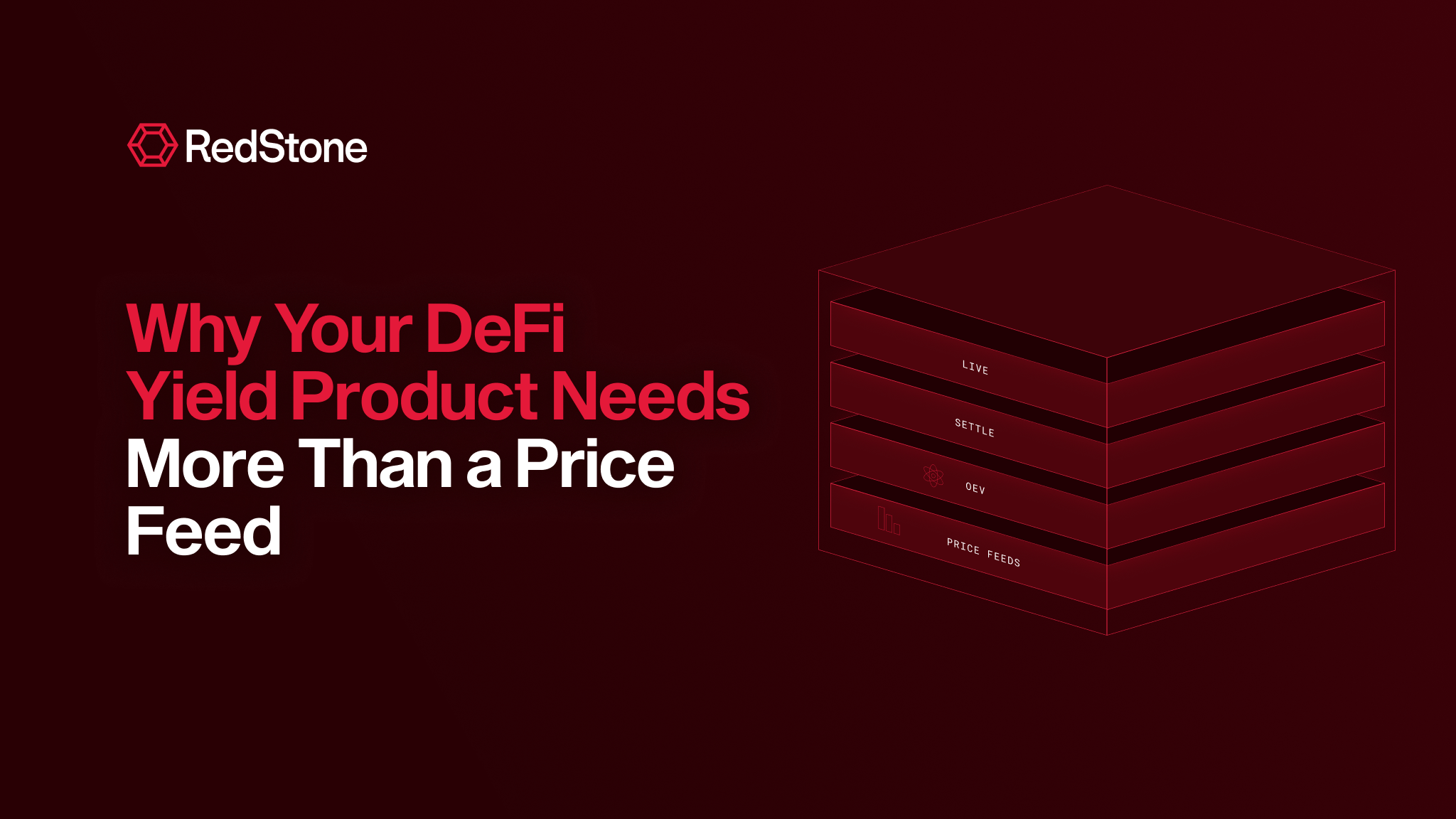
A yield product is going to face four. What is it worth, how do we verify the backing is real, what happens to the value during a liquidation, and how do we price the credit risk on the position itself. A product that has answered only the first one is shipping with a thermometer in a market that needs a weather model.
This is not an abstract complaint. It is the structural reason that yield-bearing collateral, LSTs, LRTs, principal tokens, and tokenized funds, has historically been the asset class that breaks lending markets when stress arrives. The oracle was never the bottleneck. The bottleneck was treating the oracle as a price feed when the product needed an intelligence layer.
Here is what a production-grade yield product actually requires from its data infrastructure.
1. A pricing methodology that fits how the asset actually prices
ETH has a market price. An LRT has a market price, an exchange rate adjusted for slashing risk, and a peg between them that can move under restaking-specific stress conditions. A principal token has a yield-stripped price that decomposes against a maturity curve. A tokenized Treasury fund has a NAV calculated daily by a regulated fund administrator under fund accounting rules. None of these are spot prices in the sense that an oracle aggregating CEX trades would understand.
A naive spot-aggregation feed for an LRT will price the panic during a depeg event when liquidity on the aggregated venues is shallow. The ezETH event in April 2024 is the canonical example. Feeds without manipulation safeguards chased the move down. Feeds with statistical outlier rejection and liquidity-aware aggregation, like RedStone’s Medianizer, identified the deviation as noise rather than price discovery and held the reference.
For yield-bearing assets, this is where RedStone’s Dynamic PT Oracle and the LST/LRT-aware methodologies live. For tokenized funds, the Trusted Single Source Oracle brings authoritative NAV onchain with cryptographic attestation, which is the architecture behind BlackRock’s BUIDL, Apollo ACRED, Hamilton Lane, and KKR tokenized fund integrations. The pattern is consistent: the asset dictates the methodology, not the other way around.
2. PoR – Verification that the backing actually exists
For anything tokenizing off-chain value, a wrapped asset, a tokenized fund, an LST backed by staked capital, a yield product backed by a credit portfolio, the next question after price is custody. A quarterly attestation signed by an auditor is a marketing artifact. A continuous, cryptographic Proof of Reserves feed is risk infrastructure.
The distinction matters most during the events when it matters most. A monthly attestation tells a curator what was true three weeks ago. A continuous PoR feed tells the protocol what is true right now, and lets the smart contract enforce a collateralization ratio in real time rather than relying on the next audit cycle to catch a divergence.
Lombard’s LBTC was the first Bitcoin LST to ship with continuous PoR. The data is public, the verification is cryptographic, and the dependency on trusted attestations is replaced by a feed that the protocol can act on.
3. OEV – Liquidation flow that funds the protocol instead of bleeding it
When a yield product is used as collateral and a position becomes liquidatable, the liquidation event itself is a value transfer. In a conventional architecture, that value transfer flows to MEV searchers who race to act on the price update. Liquidation bonuses across major lending protocols run 5% to 15% of the liquidated position. In most systems, every basis point of that leaks out of the protocol.
RedStone Atom restructures the flow. Oracle Extractable Value, the value created when an oracle update triggers a liquidation, is auctioned. Searchers compete for the right to act on the update, and the value generated by that competition returns to the protocol rather than leaving the system entirely.
Two things follow. The protocol captures revenue that previously escaped. And the auction structure makes liquidations more responsive to real market conditions, which reduces the window during which bad debt can accumulate. OEV redesigns how price updates and execution coordinate at the protocol layer rather than sitting as a feature on top of the oracle.
4. Risk intelligence that updates faster than a governance vote
Most DeFi credit infrastructure still runs on the pawnshop model. Lend against collateral, set a static LLTV by governance vote, hope the parameters survive the next stress event.
A yield product taking on lending exposure, whether as collateral or as a borrowed asset, needs continuous risk assessment. Credora’s risk ratings, now part of the RedStone stack, deliver quantitative DeFi risk scores that update with market conditions rather than with governance cycles. They are already integrated across Morpho and Spark markets.
For a yield product team, this is the layer that lets a protocol offer differentiated terms by credit profile rather than by blunt collateral ratios. The difference between a pawnshop and a bank is the existence of a credit score. DeFi just got one.
Key takeaways
- The asset chooses the methodology. LRTs, principal tokens, and tokenized funds each price differently, and the oracle has to match.
- For anything backed by off-chain value, continuous Proof of Reserves replaces periodic attestations.
- Liquidation flow is a revenue stream that most protocols give away to MEV. OEV recapture keeps it in the system.
- Static governance parameters are not risk management. Real-time risk ratings are.
- These are four sides of the same problem rather than four vendor categories, which is why the RedStone Stack integrates them into a single layer.
Frequently asked questions:
What oracle architecture should a new LRT or yield-bearing token use? Pricing should not depend on naive spot aggregation. The methodology needs to account for the redemption mechanism, slashing risk where applicable, and any peg constraints inherent to the asset’s design. A dedicated methodology for LSTs, LRTs, or principal tokens is the baseline. Continuous Proof of Reserves is required for any asset claiming backing by off-chain or wrapped collateral.
How does Oracle Extractable Value (OEV) actually work? When a price update triggers a liquidation, the resulting opportunity has measurable value. In a conventional setup, MEV searchers capture that value through latency arbitrage and the protocol receives nothing. OEV restructures the moment into an auction: searchers bid for the right to execute the liquidation, and the auction proceeds return to the protocol. The mechanism turns a leak in protocol economics into a revenue line.
What is the difference between a price feed and the RedStone Stack? A price feed delivers one signal: the market value of an asset. The RedStone Stack delivers three coordinated layers: deterministic market data with asset-specific methodologies, liquidation intelligence through OEV recapture, and quantified credit risk through Credora. The shift is from oracle-as-feed to oracle-as-intelligence layer.