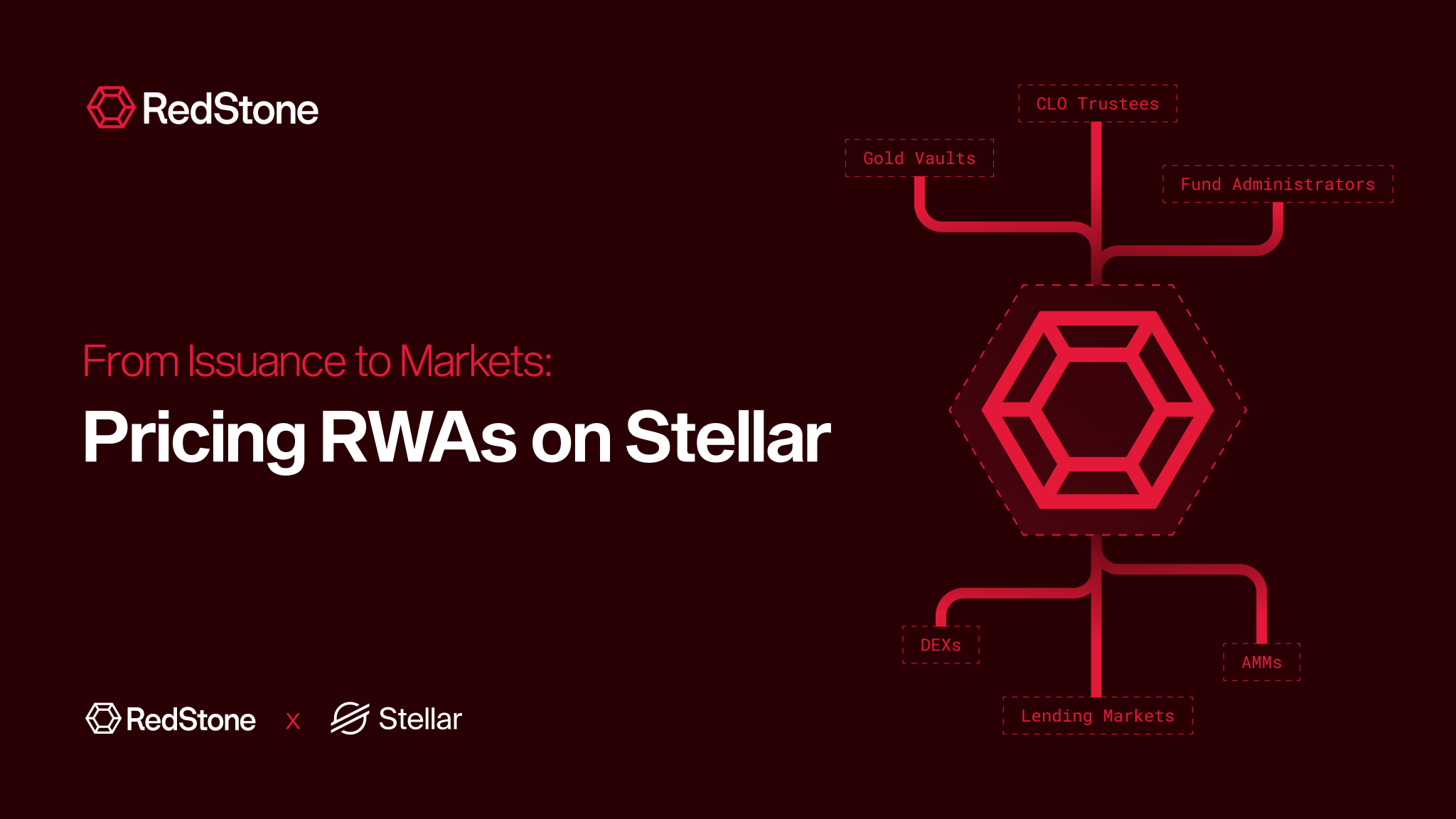
Stellar’s tokenized asset market has now passed $2 billion. Redstone’s enterprise-grade oracle infrastructure provides the data layer to support lending markets, decentralized exchanges, derivatives, and tokenized real-world assets.
TL;DR:
- Stellar’s RWA ecosystem has quadrupled in roughly a year to $2B+ in tokenized assets, while the broader RWA market grew from $6B to $31B between early 2025 and mid-2026.
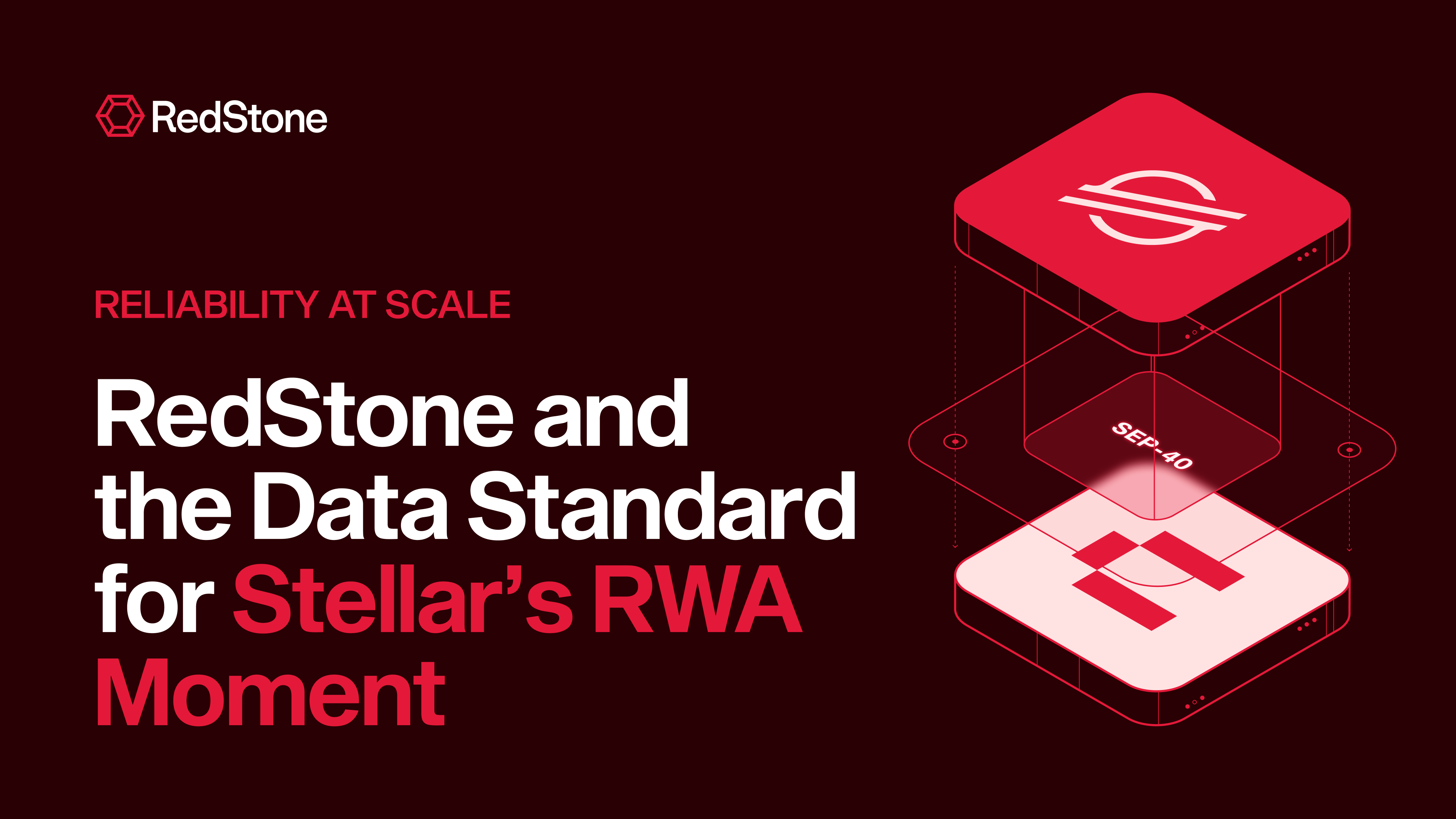
- RedStone has implemented the SEP-40 oracle standard on Stellar, providing a unified, high-frequency pricing interface for on-chain RWA assets across the ecosystem.
- Nine assets are now live under SEP-40, including USDC, EURC, XLM, PYUSD, and tokenized sovereign debt instruments from Etherfuse and Solv’s Bitcoin products.
- SEP-40 solves a structural fragmentation problem on Stellar, allowing any protocol to consume oracle data through a single standard interface without custom integration work.
- RedStone has secured $6B+ across 110+ chains with zero mispricing events, now bringing that same infrastructure to Stellar’s expanding RWA pipeline across nine live assets and more in progress.
Issuance Was the Easy Part
Franklin Templeton launched FOBXX on Stellar in 2021, marking the first regulated tokenized fund on a public blockchain. At the time, this served as a proof of concept. Since then, WisdomTree, Ondo, Paxos, and Société Générale Forge have all built or explored a presence on the network. The list kept growing because Stellar is well-suited for this purpose: it offers low fees, fast settlement, a native KYC framework, and a protocol design that treats asset issuance as a core feature rather than an afterthought.
The results are legible in the numbers. Stellar’s RWA ecosystem has surpassed $2 billion in tokenized asset value, a quadrupling in roughly a year, while the broader market grew from $6 billion to over $31 billion between early 2025 and mid-2026. Issuers found their footing.
The real challenge comes after issuance. Protocols need to price these assets, lend against them, and liquidate them when required.
That process does not work the same way for a tokenized private credit instrument as it does for ETH. The answer is a shared data standard that every protocol on the network can rely on without building custom infrastructure from scratch.
What SEP-40 Actually Solves
SEP-40 is Stellar’s standard interface for oracle consumers, a specification that defines how smart contracts request price data, regardless of which oracle provides it.
This is especially important on Stellar. Soroban’s cross-contract call model makes non-standard oracle integrations expensive. Every custom adapter adds gas costs and complexity to each protocol that uses it. Without a shared interface, every new oracle integration requires custom work on both sides, fragmenting the ecosystem.
SEP-40 solves this at a structural level. A protocol using SEP-40-compliant data can switch oracle providers without changing its own logic. The interface defines how feeds show their base asset, supported assets, decimal precision, and resolution. Consumer contracts request prices via last price, point-in-time price, or multi-record price calls for TWAP calculations. Each PriceData record includes a timestamp for staleness checks on the consumer side.
RedStone’s implementation of SEP-40 is now in production across the RWA asset set on Stellar.
The following assets are live under the standard:
| Asset | Issuer | Status |
| XLM | Stellar | Live |
| USDC | Circle | Live |
| EURC | Circle | Live |
| PYUSD | Sentora/PayPal | Live |
| CETES | Etherfuse | Live |
| USTRY | Etherfuse | Live |
| TESOURO | Etherfuse | Live |
| SolvBTC | Solv | Live |
| xSolvBTC | Solv | Live |
| USST | STBL | In Progress |
Why RWA Collateral Requires a Different Oracle Posture
Lending against ETH is a pricing problem. The asset trades continuously on dozens of venues, has deep liquidity, and can be liquidated reliably at market. The oracle’s job is to aggregate that price quickly and accurately.
Lending against tokenized private credit is not mainly a pricing problem. The instrument might not trade at all. Its value depends on the underlying credit quality, the interest rate environment, the issuer’s redemption conditions, and structural risk factors that are not represented on-chain unless someone builds them in. A price feed showing yesterday’s NAV is not the same as one that reflects current credit risk.
RedStone’s SEP-40 price feeds address this directly by providing high-frequency, verifiable collateral pricing through a standard interface that works across all protocols in the Stellar ecosystem.
What Is Now in Place
Stellar has always had a strong case for institutional issuance of RWA. However, what was missing was the DeFi infrastructure needed to turn that issuance into active, liquid markets that institutional capital can actually use.
RedStone’s SEP-40 implementation delivers the pricing layer by offering a standard, interoperable, high-frequency data infrastructure that works across all protocols in the Stellar ecosystem without needing custom adapters. Nine assets are live across Stellar’s key asset classes, from stablecoins and sovereign debt instruments to Bitcoin products.
The RWA pipeline on Stellar has quadrupled over the past year. The infrastructure that turns issued assets into usable DeFi collateral is now live.
About RedStone
RedStone is the data layer for institutional DeFi, delivering secure, low-latency price feeds for digital assets, RWAs, stablecoins, LSTs, LRTs, and Bitcoin LSTs across 110+ chains. Trusted by 200+ clients, including Securitize, Morpho, Pendle, Spark, Ether.fi, Ethena, Lombard, Venus, and Compound, RedStone powers lending, stablecoins, perpetuals, and tokenized asset markets with a custom pricing infrastructure built for complex onchain systems. RedStone is the primary oracle for tokenized products, including BlackRock’s BUIDL, Apollo ACRED, and Hamilton Lane SCOPE. Zero mispricing events. 100% uptime.
The Stellar Network
The Stellar network is a decentralized, fast, scalable, and uniquely sustainable blockchain built for financial products and services. It offers builders smart contracts functionality and a protocol optimized for payments, with a design intended to keep fees low and to provide transaction speeds that can scale with increased adoption. Financial institutions and innovators worldwide issue assets and settle payments on the Stellar network, which has processed billions of operations with millions of accounts since the network was first launched.