Morpho launching on Kaia means isolated DeFi lending is now plugged into a network reaching 250M+ users across Asia. RedStone is the oracle layer powering those markets.
TL;DR:
- Morpho, a lending protocol with $11B+ in deposits, has launched natively on Kaia, Asia’s leading super-app blockchain.
- Kaia reaches 250M+ users through Kakao and LINE, has processed 616M+ transactions, and serves 88.9M+ active addresses.
- Morpho’s first isolated lending markets on Kaia, wETH/USDT, wBTC (BTC.b)/USDT, KAIA/USDT, are all powered by RedStone’s high-frequency, resilient oracle feeds.
- KB Kookmin Bank, South Korea’s largest bank, has already tested KRW stablecoin integration on Kaia for offline payments and global remittances, proving this is live, institutional-grade infrastructure.
- RedStone underpins this stack as the institutional data layer, delivering fast, tamper-resistant pricing across 110+ chains, serving 200+ clients, and maintaining a track record of zero mispricing events and 100% uptime.
Asia’s Onchain Moment Has Already Arrived
There is a version of the story where onchain finance in Asia remains a future-tense ambition, a market that is perpetually “coming soon.” That version is no longer accurate.
Kaia is a Layer 1 blockchain created from the merger of Kakao’s Klaytn and LINE’s Finschia. It operates within two of the most popular super apps in East and Southeast Asia, has processed over 616 million transactions, and serves more than 88.9 million active addresses. KB Kookmin Bank, South Korea’s largest, has successfully tested KRW stablecoin integration on Kaia for offline payments and global remittances.
Real institutions are already using this infrastructure for real financial activity.
To make the most of this opportunity, Kaia needs a reliable, institutional-grade data layer. That’s where RedStone comes in.
Morpho on Kaia: Lending Infrastructure for a New Region
Morpho, a lending protocol with over $11 billion in deposits, has launched natively on Kaia. This is a direct deployment, not a bridged or wrapped integration, and it is built to serve the growing stablecoin and RWA lending markets across APAC.
The first isolated markets live on Kaia are:
- wETH / USDT
- wBTC (BTC.b) / USDT
- KAIA / USDT
The KAIA/USDT market is important for users, as they can now use KAIA as collateral to borrow USDT. This unlocks stablecoin liquidity without needing to sell their KAIA. For protocols like SuperEarn that aggregate yield on Kaia, Morpho’s native deployment also removes bridge risk and cross-chain delays that previously reduced yield margins.
Morpho’s design uses isolated markets instead of shared liquidity pools. Each lending pair has its own collateral, loan asset, and risk settings. If one market fails, it does not affect the others. This setup is intentional, created to prevent the types of exploits that have affected older lending protocols. For institutions in Asia, isolation is not just a feature but a requirement.
Feather manages these initial markets by adjusting Liquidation Loan-to-Value ratios, supply caps, and asset screening. This helps optimize yields while maintaining insolvency protections. The curation layer is always active and responsive.
Why Oracle Infrastructure Is the Critical Variable
In lending protocols, the oracle is essential. Why? When a borrower’s collateral nears the liquidation threshold, the protocol acts immediately based on the price it receives. If that price is outdated, manipulated, or missing, two problems can occur: a healthy position might be liquidated prematurely, or a risky position might avoid liquidation and cause a loss for the protocol. In volatile markets, milliseconds and methodology become part of the protocol’s security model.
The stakes are high for Kaia’s markets. Here, stablecoins are not just for earning yield. They are used for real transactions, remittances, and institutional payments. USDT, IDRX, and JPYC move through Kaia to support real currency exchanges and offline payments across APAC. The price data for lending collateral must be more reliable than in systems built only for speculative DeFi.
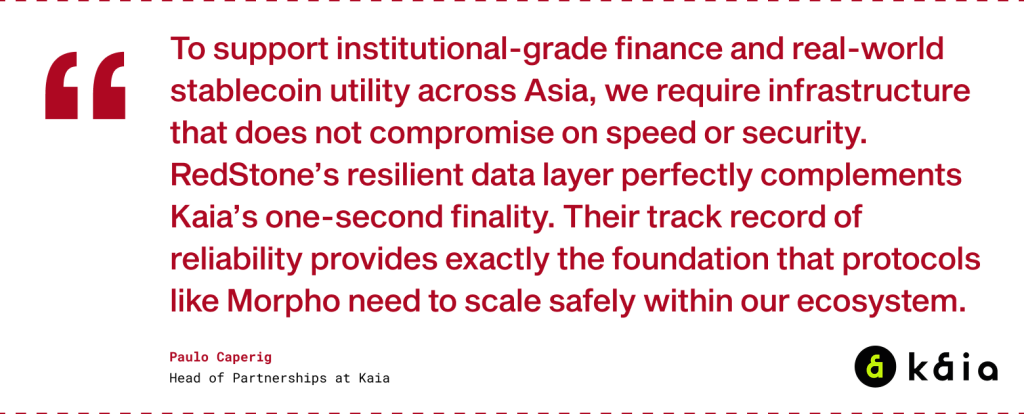
RedStone provides the oracle infrastructure for Morpho’s launch on Kaia, delivering fast, reliable price feeds so liquidations occur exactly when needed. Kaia’s one-second finality and low transaction costs make frequent oracle updates practical.
RedStone’s architecture was built for environments where latency, update frequency, and reliability directly affect market integrity.
A Commitment Backed by Presence
RedStone’s presence in Korea predates the recent institutional push into Asian onchain finance.
As South Korea became a major center for crypto, RedStone established a local presence by regularly attending Korea Blockchain Week, building a community, and launching early on Upbit’s Layer 2 testnet, before it became widely popular. Our COO and co-founder has spoken to Korean audiences on national TV. The Korean community can follow RedStone’s work on X, Telegram, and Discord in their own language.
This ongoing commitment is what makes the Kaia deployment important beyond just the technical integration. Asia’s onchain financial infrastructure is being built now, and the oracle layer must be ready before the market grows, not after.
Early infrastructure decisions tend to become ecosystem defaults. The oracle layer determines how liquidations execute, how collateral is priced, how risk propagates, and ultimately, which financial products can safely exist onchain.
Institutions and protocols that will move liquidity across APAC in the coming years are making their infrastructure choices now. RedStone is already integrated into the data layer these protocols rely on.
The Data Layer Behind APAC Lending Markets
Kaia’s design is simple and effective: one-second finality, gasless transactions, EVM compatibility, and native USDT. With Morpho’s isolated market setup and Feather’s active risk management, Kaia’s lending infrastructure is ready for large-scale financial activity.
RedStone delivers the price data that makes all of this work: high-frequency feeds, verified, tamper-resistant data, and overall, an oracle infrastructure that matches the performance characteristics of the chain it serves.
Asia doesn’t need another proof-of-concept for onchain finance. It needs infrastructure capable of supporting real transaction volume, real collateral movement, and real financial coordination at scale.
That requires reliable execution environments, resilient lending systems, and oracle infrastructure designed for continuous markets.
About RedStone
RedStone is the data layer for institutional DeFi, delivering secure, low-latency price feeds for digital assets, RWAs, stablecoins, LSTs, LRTs, and Bitcoin LSTs across 110+ chains. Trusted by 200+ clients, including Securitize, Morpho, Pendle, Spark, Ether.fi, Ethena, Lombard, Venus, and Compound, RedStone powers lending, stablecoins, perpetuals, and tokenized asset markets with a custom pricing infrastructure built for complex onchain systems. RedStone is the primary oracle for tokenized products, including BlackRock’s BUIDL, Apollo ACRED, and Hamilton Lane SCOPE. Zero mispricing events. 100% uptime.
About Kaia
Kaia is an EVM-compatible Layer 1 blockchain built for stablecoin settlement and onchain finance across Asia, enabling remittances, payments, FX, yield, and tokenized assets on a single high-speed network.
Forged through the merger of Klaytn and Finschia, Kaia brings together the ecosystems of Kakao and LINE, with deep roots across APAC. With native USDT, 1-second finality, and gasless transactions, Kaia enables stablecoin settlement at scale. Liquidity flows into onchain finance and capital markets on Kaia through consumer platforms like LINE.