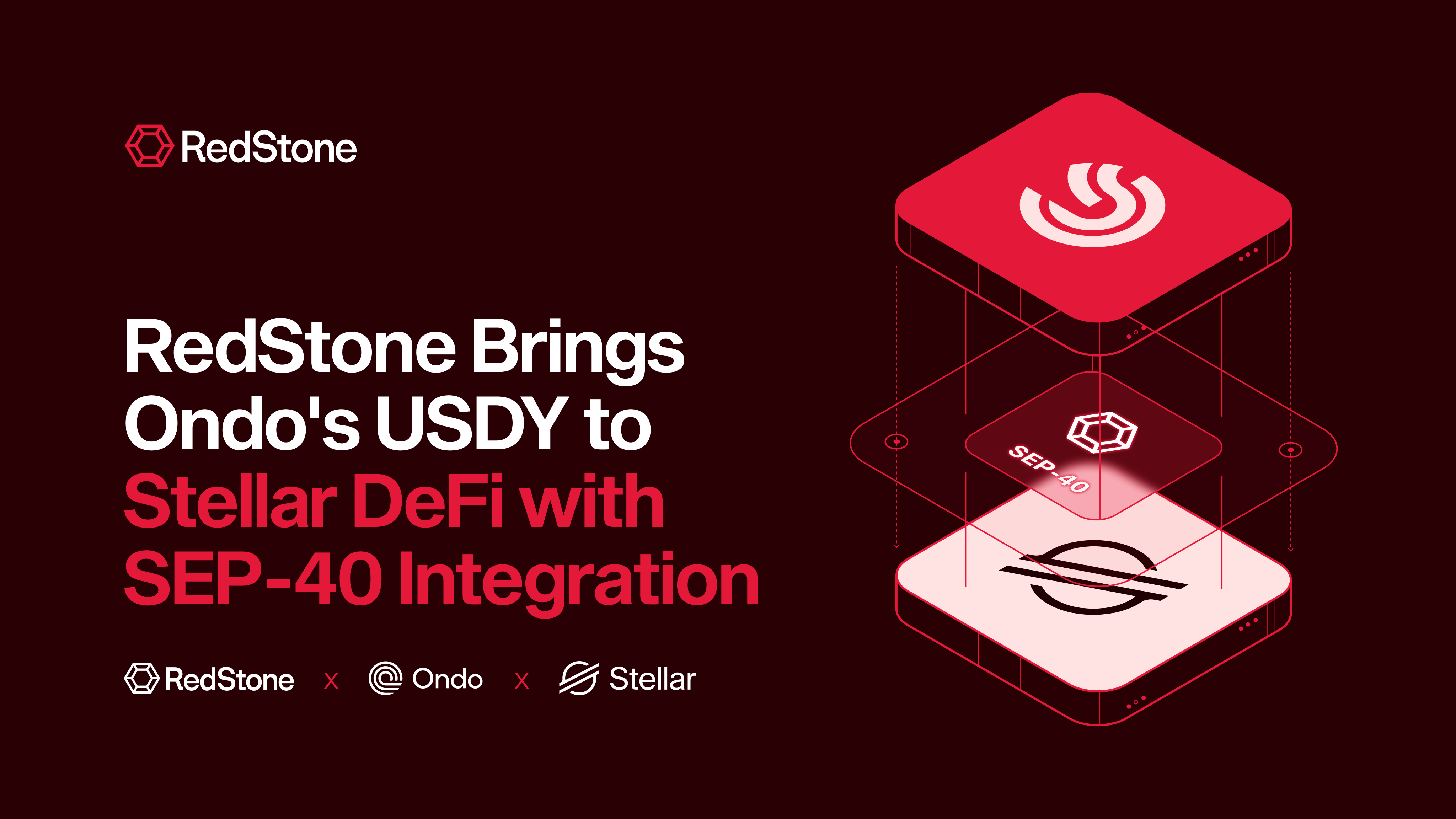
USDY is now priced on Stellar. RedStone is providing the price feed and SEP-40 support that allows Ondo’s flagship yieldcoin to become eligible for use as collateral across Stellar’s lending ecosystem.
TL;DR:
- USDY is one of the larger yield-bearing dollar tokens in DeFi by circulating value, backed by short-term U.S. Treasuries and U.S. bank demand deposits with a market capitalization of over $2.1 billion across all chains
- RedStone is providing the USDY/USD price feed and SEP-40 contract support on Stellar
- Stellar’s tokenized RWA value has reached approximately $2.96 billion , with USDY now among the highest-profile assets in the SEP-40 pipeline alongside sovereign debt instruments, tokenized fund products, and stablecoins
- SEP-40 is Stellar’s unified oracle standard, giving any protocol on the network a single interface to consume price data and list assets as collateral on lending protocols like Blend and Templar
USDY/USD Price Feed and SEP-40 Contract Support on Stellar
RedStone now provides a USDY/USD price feed and SEP-40 contract support for USDY, Ondo Finance’s tokenized Treasury-backed asset, on the Stellar network.
USDY is Ondo’s yield-bearing dollar token, backed by short-term U.S. Treasuries and U.S. bank demand deposits, and available to investors outside the U.S. With a circulating supply of approximately 1.9 billion tokens and a market cap of over $2.1 billion, it is one of the larger tokenized yield-bearing assets in the RWA category by circulating value. It is designed to support onchain savings, treasury management, cross-border payments, and DeFi collateral use cases.
The price feed handles continuously updated, verifiable pricing for the asset. The SEP-40 component is what makes it usable. SEP-40 is Stellar’s unified oracle standard, a shared interface that allows any protocol on the network to consume price data without building custom integration work from scratch.
For USDY to be listed on Stellar’s lending protocols, it needs to be priced through a SEP-40-compliant contract. Without it, the asset can exist on the network but cannot function as collateral.
From Tokenized Asset to DeFi Collateral
Stellar’s RWA ecosystem has reached approximately $2.96 billion in tokenized asset value, growing roughly three times from early 2025. The network has a long track record in asset issuance: Franklin Templeton launched one of the first regulated tokenized funds on a public blockchain on Stellar in 2021, and the list of issuers has grown steadily since.
Issuance is not the same as utility. An asset that sits on a network but cannot be lent against or liquidated can’t function as DeFi collateral. The SEP-40 integration closes that gap.
With USDY priced and SEP-40-enabled, it becomes eligible for listing on Blend and Templar, Stellar’s primary lending protocols. Where supported, users can post USDY as collateral and borrow against it, which carries risk, including liquidation if the collateral value declines. For Stellar’s institutional user base, that reflects a different use case from holding a non-yield-bearing stablecoin.
The SEP-40 Pipeline
RedStone has been building out SEP-40 infrastructure on Stellar throughout 2026. Earlier this year, RedStone launched SEP-40 feeds for multiple assets across Stellar’s ecosystem: USDC, EURC, XLM, PYUSD, tokenized sovereign debt instruments from Etherfuse, and Bitcoin products from Solv.
Last week, four more assets joined the standard, all issued by Centrifuge on Stellar. JTRSY and JAAA are tokenized representations of institutional fund products, and deJTRSY and deJAAA are their onchain wrappers, built to make that underlying exposure usable across DeFi applications including trading, liquidity provision, and collateral.
SEP-40 gives every protocol on Stellar a single interface to pull pricing without custom integration work, turning a static token into something that can be lent against and used as collateral. RedStone is the infrastructure behind it.
USDY and the Case for RWA Composability on Stellar
Stellar’s RWA ecosystem has been growing steadily and its asset roster includes some of the most recognized names in institutional DeFi. USDY joining the SEP-40 pipeline is part of that progression.
USDY is one of the larger yield-bearing assets in DeFi by circulating value, and it is now priced and SEP-40-enabled on a network with a growing base of institutional tokenized assets.
For protocols like Blend and Templar, that means more collateral options to build lending markets around. For the RWA category more broadly, it’s another data point in the case that tokenized assets can do more than sit on a balance sheet.
FAQ
What is SEP-40 and why does it exist?
SEP-40 is Stellar’s native oracle standard, a unified interface that lets any application on the network consume price data in the same way, without building custom adapters for each asset. Before SEP-40, protocols had to integrate price feeds individually for each token they wanted to support. The standard exists because Stellar’s RWA asset base was growing faster than the infrastructure to make those assets usable in DeFi.
Why does USDY need a price feed if it’s backed by U.S. Treasuries?
USDY isn’t pegged to $1. It’s a yield-bearing token whose price accrues over time as the underlying Treasury yield is earned, and currently trades above $1.00. Lending protocols need to know the current value of any asset posted as collateral to calculate borrowing limits and trigger liquidations when necessary. A static assumption of $1 would be inaccurate and create risk for the protocol.
What’s the difference between the price feed and the SEP-40 contract?
The price feed is the data layer: it provides a continuously updated USDY/USD price that reflects the current accrued value of the token. The SEP-40 contract is the interface layer: it makes that price data consumable by any Stellar protocol in a standardized format. Both are required. The feed without the SEP-40 wrapper wouldn’t be readable by Blend or Templar without custom integration work on their end.
Is USDY already live on Blend and Templar?
The price feed and SEP-40 contract support are what make listing possible. Whether and when individual protocols choose to list USDY as a collateral asset is their decision. RedStone’s role is to provide the pricing infrastructure that enables it.
Disclaimer: This content is provided for general informational purposes only and does not constitute investment, financial, legal, tax, or other professional advice, nor does it constitute an offer to sell or a solicitation of an offer to buy any security, digital asset, or other financial product. USDY is a product of Ondo Finance, offered only to eligible non-U.S. persons under Ondo’s terms; it is not a stablecoin, is not FDIC insured, has no bank guarantee, and may lose value. SDF is not the issuer, sponsor, adviser, distributor, custodian, or broker-dealer for USDY, does not operate or control the Stellar network, and does not control or endorse any third-party project referenced herein. Using digital assets as collateral and borrowing against them involves substantial risk, including liquidation and loss in excess of amounts posted; past performance is not indicative of future results. Use of or participation in any third-party product or service referenced herein is at your own risk.