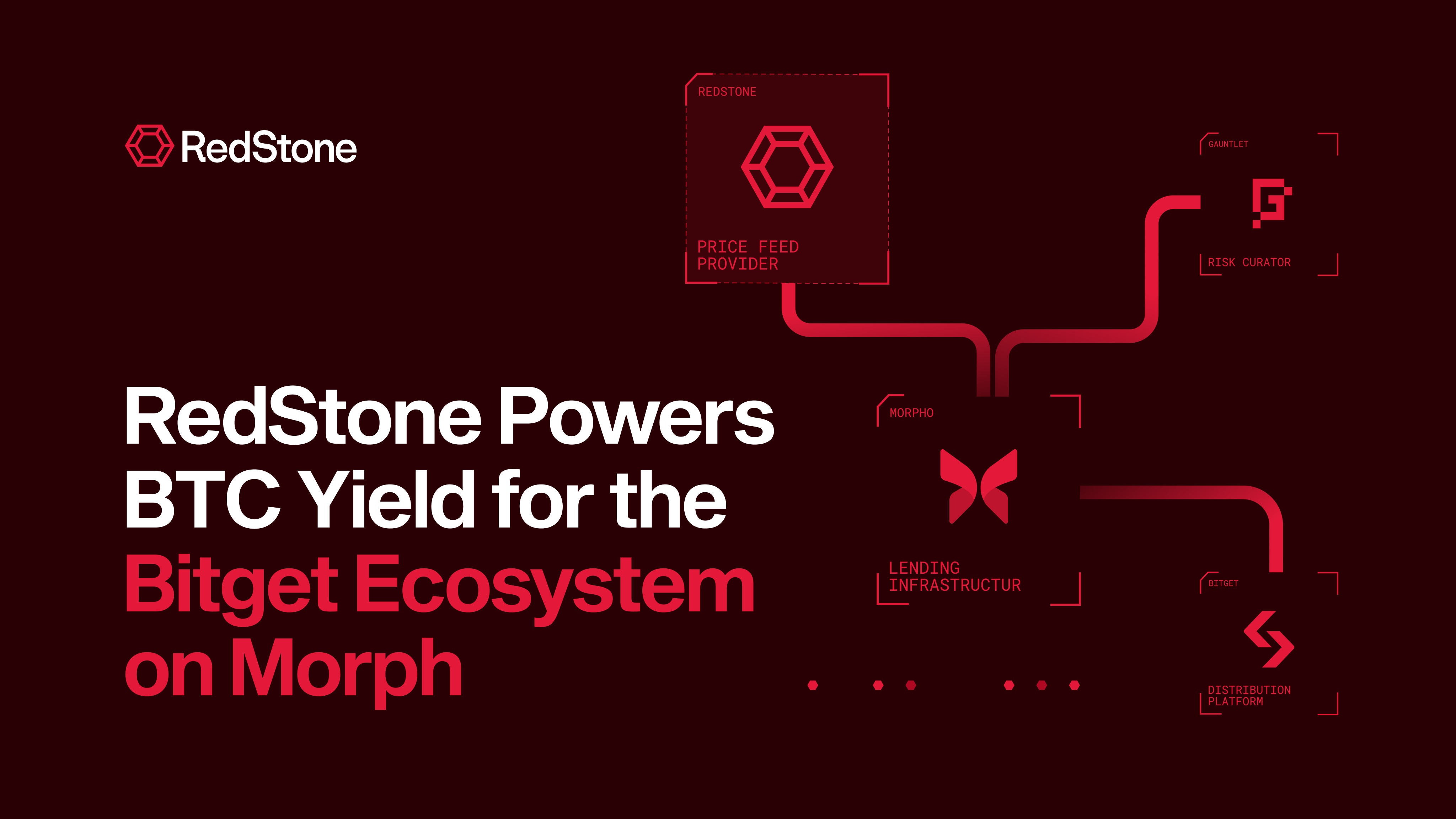
RedStone now powers Bitget’s new BTC strategy vault, built by Gauntlet on Aera and leveraging Morpho’s lending markets. The vault is live on the Morph blockchain and brings BTC yield to Bitget’s 125+ million users.
TL;DR:
- RedStone powers a new BTC strategy vault, built by Gauntlet on Aera, leveraging Morpho. It’s reached through the Bitget app and wallet.
- The vault opens with 3% BTC and 18% USDC APY, with BTC as the collateral at launch and BGB to follow.
- RedStone provides the USD price feeds the vault runs on, starting with BTC-USD, already live on Morph. A BGB feed follows with the second collateral.
- RedStone Atom is being enabled for the vault, set to recapture the value that leaks out of liquidations and return it to the market.
- Gauntlet, one of the largest risk curators on Morpho, chose RedStone as the oracle for the vault.
Bringing BTC Yield to the Bitget Ecosystem
Bitget’s new BTC strategy is a Gauntlet Aera vault, live on the Morph chain and reaching more than 125 million users through the Bitget app and wallet. Gauntlet built the strategy on top of Morpho’s lending markets and chose RedStone as the data layer that powers it.
Morph is an Ethereum L2 and the settlement layer for the Bitget ecosystem, with BGB as its native gas and governance token. BGB has a $1.2 billion market cap at the time of writing, which puts it around the 50 largest crypto assets.
Bitget users can deposit BTC and earn yield on it. Underneath, the deposited BTC serves as collateral, USDC is borrowed against it, and Gauntlet’s strategy returns the net yield to the depositor.
When users deposit BTC, the asset is converted to bgBTC, or Bitget Wrapped Bitcoin, allowing it to move to the Morph network and to be used as collateral. To the user it’s just BTC earning yield. The wrapping happens in the background.
The vault has launched with 3% BTC and 18% USDC APY. BTC is the first collateral option and BGB planned to follow shortly after.
RedStone Atom Recaptures Value at Liquidation
When an oracle posts a new price that triggers a liquidation, the protocol pays a bonus to whoever closes out the bad loan, usually 5 to 15% of the position, and bots race each other to claim it the moment the price update lands. Today that bonus usually goes to whichever bot liquidates the position and not to the protocol that paid for the oracle or the users who took on the risk. This is known as Oracle Extractable Value (OEV), and it has cost DeFi protocols more than $500 million to date.
RedStone Atom changes that. The moment a price move would trigger a liquidation, Atom opens a sealed-bid auction that lasts under 300 milliseconds, where liquidators compete to execute it. The price update, auction and settlement all take place in a single atomic transaction. Most of the value that used to leak to bots now goes back to the protocol, while the winning liquidator keeps the rest. RedStone Atom is live on the Bitget BTC strategy vault.
Liquidations route through Gauntlet’s existing liquidator network, and the feed updates the when the price moves by 0.5%.
Why Gauntlet Chose RedStone
Gauntlet, one of the largest risk curators on Morpho, chose RedStone as the data layer powering the BTC strategy vault. On Morpho, a market’s oracle is fixed at deployment and can’t be changed.
As the curator, Gauntlet sets the loan-to-value limits, the liquidation thresholds, and the supply caps that decide how much can be borrowed against each asset and when a position should be liquidated. Reliable pricing data allows the LTVs to hold and the liquidations to land at the right moment.
BGB is harder to price than standard collateral. Almost all of its liquidity sits on Bitget’s own exchange, so a feed leaning on a single venue is a serious risk. RedStone prices BGB from multiple independent sources so no single venue can move it, which is what lets Gauntlet set risk parameters against it at all.
The Bigger Picture: PayFi and Beyond
Beyond yield, the vault creates a path to PayFi partners and crypto card providers, distributed through Bitget’s app and wallet
For now, it makes BTC yield available for millions of Bitget users, with RedStone as the data layer underneath. The same infrastructure trusted across 110+ chains and 200+ protocols now prices a vault that reaches people who wouldn’t otherwise interact with a DeFi protocol directly.
Frequently Asked Questions
What happens to my BTC if a liquidation goes wrong or the oracle fails?
Morpho markets are isolated, so a problem in one market can’t spread to another. The vault only liquidates a position when the collateral price crosses the threshold Gauntlet set, and if RedStone’s Atom auction produces no valid bid, the system falls back to a standard price push that anyone can act on. Liquidation still happens; it just reverts to the normal path rather than stalling.
Is my Bitcoin actually leaving Bitget?
Your BTC is converted to bgBTC (Bitget Wrapped Bitcoin) so it can move onto Morph and function as collateral. It stays within the Bitget ecosystem the whole time, and the wrapping and onchain movement happen in the background. You interact with it as BTC in the app.
Why does BGB need a new price feed when it’s already a major token?
Market cap and liquidity are different things. BGB is a top-50 asset by market cap, but most of its trading happens on Bitget’s own exchange, so there aren’t enough deep, independent venues to price it safely by default. RedStone builds the feed from multiple independent sources so no single venue, including Bitget, can move the price the vault liquidates against.
If Gauntlet picks the oracle, can it switch to a cheaper one later?
No. On Morpho, a market’s oracle is set when the market is deployed and cannot be changed afterward. Whatever oracle a vault launches with is the one it runs on for good, which is why the choice carries weight and why Gauntlet weighs it carefully.