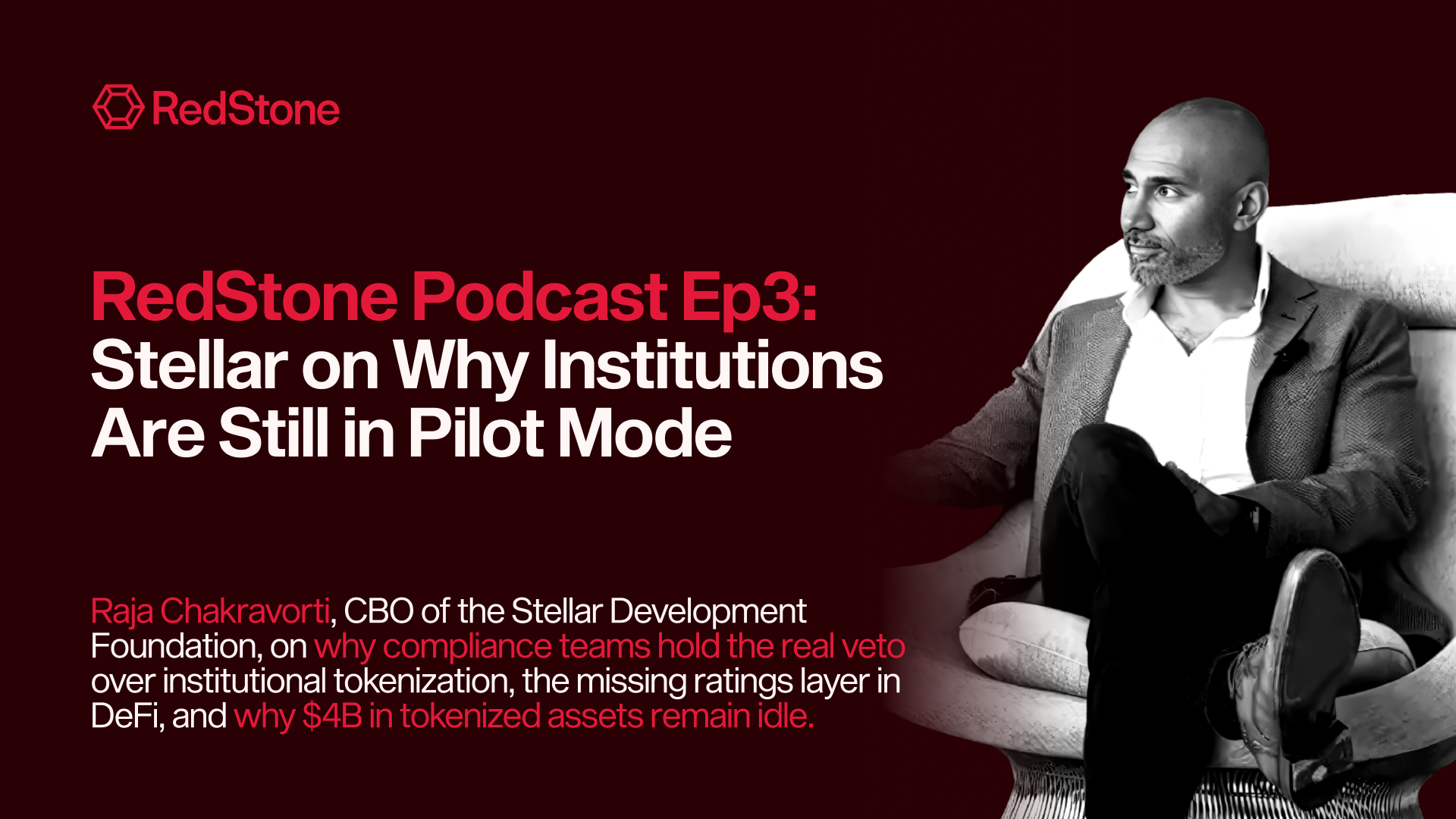
Every week, we sit down with the people building institutional finance onchain. Five minutes, no padding. Raja Chakravorti, Chief Business Officer at the Stellar Development Foundation, oversees partnerships and investment activity, with a background in structured finance at Goldman Sachs and JPMorgan.
Raja Chakravorti is one of the people responsible for the Stellar network’s push onto the institutional stage. Since January, the network has gone from under $900 million to nearly $4 billion in tokenized assets, most of it from regulated issuers like Franklin Templeton, Ondo, and Spiko running products worth hundreds of millions each.
The network’s partnership with DTCC, announced in May 2026, is expected to bring tokenized versions of DTC-held securities onto Stellar within the first half of 2027, enabled by an SEC no-action letter issued in December 2025.
So, when Raja talks about what slows institutions down, he does so from his experience sitting across the table from the risk committees and compliance teams who decide whether a tokenized product gets a green light or gets shelved.
The Silent Veto: Risk and Compliance
There are a lot of theories about what slows institutional adoption. According to Raja, the veto is coming from risk and compliance teams. They approve every new product before the institution can offer it to clients, and a tokenized asset on a public blockchain introduces risk categories most of them have never had to evaluate.
Is there a way to freeze the tokenized asset in case of movement to an undesired wallet? Can it be clawed back in case of a sanctioned party gaining control? For a significant manager, the answer has to be yes. Stellar has spent years building those controls directly into its protocol. On the data side, that same institutional push is what led to Stellar adopting a standardized oracle infrastructure for pricing the assets flowing onto the network.
Privacy sits right next to those controls. A wealth manager has a fiduciary obligation to ensure client activity stays confidential. Public blockchains make everything auditable, which is useful, but it also means someone could reconstruct a client’s entire portfolio and transaction history if the right protections are not in place. For Raja, privacy is a precondition, and if the risk it introduces is not eliminated, the conversation about tokenization does not get very far.
“The silent veto within a financial institution comes from risk and compliance teams.”
The Ratings Gap
These teams run on ratings. A fund that carries one from a traditional agency loses it the moment it enters a DeFi lending protocol. On Stellar, no rating system covers the lending protocols yet. The person assessing a tokenized Treasury bill inside a lending vault has no standardized way to judge the risk sitting underneath it.
Raja describes this whole space as “super nascent” and a massive opportunity area. A risk rating system that works across onchain protocols would give institutional allocators something they do not have today: a way to compare where to put tokenized capital that looks anything like the ratings they already rely on.
In 2025, RedStone acquired Credora to solve this very issue. Credora by RedStone rates DeFi vaults and yield strategies, and is already live on Morpho and Spark, where rated vaults have grown up to 25% faster than unrated ones. Our Tokenization & RWA Standards Report 2026 co-authored by Credora, Gauntlet, and Dune, maps out the credit risk layer required for Raja’s vision.
“There’s not a good sense for people to be able to understand what is a good asset, what is a bad asset, what is a good DeFi protocol, what is not.”
Scratching the Surface
All of what Raja mentioned (asset controls, privacy, risk signals) are needed in order to get institutional investors comfortable enough to show up in secondary markets. Most institutions are still running pilots, trying to prove value internally before doing anything at scale. Closing that gap depends on solving these requirements, and for all the progress Stellar has made, Raja sees institutional tokenization as barely getting started.
“We are just scratching the surface of what it really means.”
Frequently Asked Questions
What are asset controls, and why do institutions require them?
Features built into a blockchain that let an issuer freeze or claw back a tokenized asset if it moves to the wrong hands, such as a sanctioned entity.
Why do tokenized assets lose their credit ratings in DeFi?
Traditional rating agencies assess the asset itself, not the protocol it sits in. Once a rated fund is deposited into a DeFi lending pool, the additional protocol risk is unrated, leaving investors with no standardized way to evaluate the full exposure. On Stellar, this shows up concretely: billions in assets are onchain, but only a fraction have been brought to the network’s DeFi ecosystem. With risk intelligence in place, the percentage of assets being put to work as collateral in lending markets.
What does Raja mean by “distribution is the unlock”?
That tokenizing an asset does not automatically attract buyers or create a liquid secondary market. The real challenge is building enough institutional comfort (controls, privacy, risk ratings) that investors actually show up and trade.
How far along is institutional tokenization on Stellar?
The Stellar network’s tokenized real-world assets have grown roughly fourfold in 2026 to nearly $4 billion, with individual products from Franklin Templeton, Ondo, Spiko, and VuMe each holding hundreds of millions. RedStone provides 55 SEP-40 price feeds across the network. Raja frames it as real progress, but still the very early stages.
How far along is institutional tokenization on Stellar?
The Stellar network’s tokenized real-world assets have grown roughly fourfold in 2026 to nearly $4 billion, with individual products from Franklin Templeton, Ondo, Spiko, and VuMe each holding hundreds of millions. RedStone provides 55 SEP-40 price feeds across the network. Raja frames it as real progress, but still the very early stages.
About RedStone
RedStone is the data layer for institutional onchain finance, delivering secure, low-latency price feeds for digital assets, RWAs, stablecoins, LSTs, LRTs, and Bitcoin LSTs across 110+ chains. Trusted by 200+ clients, including Securitize, Morpho, Pendle, Spark, Ether.fi, Ethena, Lombard, Venus, and Compound, RedStone powers lending, stablecoins, perpetuals, and tokenized asset markets with custom pricing infrastructure built for complex onchain systems. RedStone provides data for tokenized products including BlackRock’s BUIDL, Apollo ACRED, and Hamilton Lane SCOPE. Zero mispricing events. 100% uptime. Learn more at redstone.finance.
About Stellar Development Foundation
Stellar is a decentralized, fast, scalable, and uniquely sustainable network for financial products and services. It is both a cross-currency transaction system and a platform for digital asset issuance, designed to connect the world’s financial infrastructure. Financial institutions worldwide issue assets and settle payments on the Stellar network. The Stellar Development Foundation (SDF) is a non-profit organization founded in 2014 that supports the development and growth of Stellar, an open-source network that connects the world’s financial infrastructure. For more information, visit stellar.org.