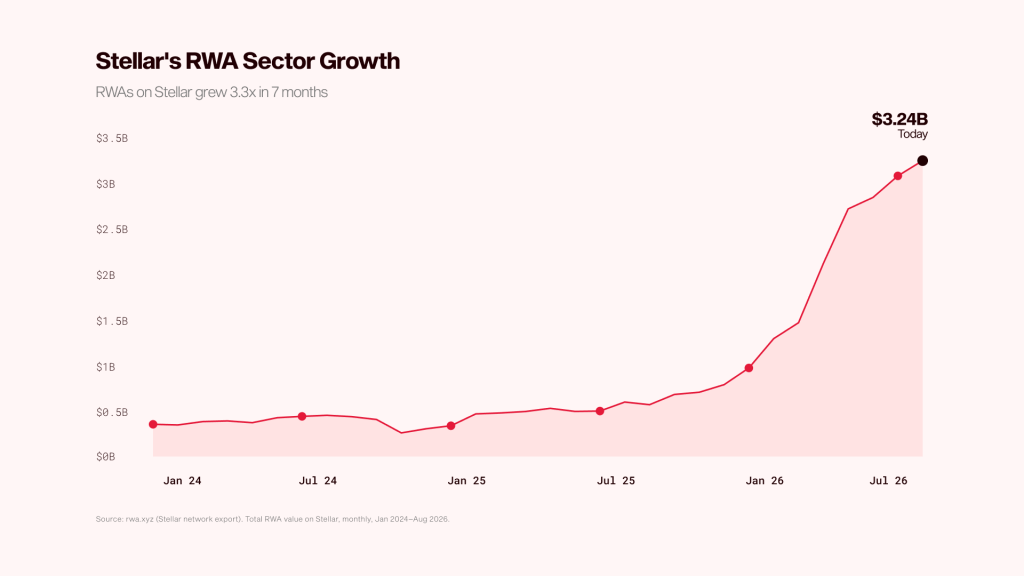
Stellar has quietly established itself as one of the leaders in the onchain RWA space. Opening the year at just under $800M, the network’s RWA sector recently climbed past the $3B mark in July, effectively quadrupling within the space of just 7 months. The next challenge lies in making this value composable in Stellar’s DeFi ecosystem, and that’s exactly where RedStone comes into play.
TL;DR
- Stellar’s RWA sector has quadrupled over 7 months as VuMe Bond 2030, Ondo’s $USDY, and two major Spiko funds launched on the network.
- By contrast, Stellar’s DeFi TVL is only at $259M at the time of writing, and RWAs share in that is negligible.
- Behind the mismatch is the challenge of pricing RWAs. To be accepted by vault curators, an asset needs 24/7 pricing; with crypto tokens, the price stems from 24/7 trading on high-liquidity venues, but the same doesn’t apply to RWAs.
- The infrastructure that will resolve this challenge is already in motion. Stellar has implemented its SEP-40 standard to unlock a universal price data interface for all builders on the network, and RedStone’s flexible data layer is bringing composability to 10 RWAs on Stellar.
Here Come the Giants
Few other networks have seen their RWA sector grow as fast as Stellar did this year. Starting January at around $785M, the network’s real-world asset space passed the $3B mark for total onchain value in early July, which makes for almost x4 growth within the space of just seven months. This spike was largely driven by the expansion and launches of several major RWAs on the network.
Spiko’s T-Bill Money Market Fund is a regulated, short-term investment product offered through Spiko that invests cash in secure government debt, such as core Eurozone, US, or UK Treasury bills. It expanded on Stellar in October 2025 and grew from $130M in early January to just under $500M in the first half of the year, holding $536M in total onchain value at its peak over the period.
Ondo’s $USDY, a yieldcoin backed by a portfolio of short-term US Treasuries and bank demand deposits, expanded to Stellar in September 2025. Opening the year at just over $1M, it grew to $534M+ at the time of writing.
The VuMe Bond 2030 is a tokenized real-world corporate credit asset issued under Luxembourg securitization rules that launched on Stellar in February and has since then reached $500M in total asset value.
Going live on Stellar in early March, the Overnight Swap Fund is a tokenized, French-regulated UCITS cash-management product created by Amundi and Spiko that delivers stable overnight yields through fully collateralized total return swaps. At the time of writing, it has $951M worth of total onchain value, making for the most explosive growth among the four assets listed here.
With its low fees (an average of around $0.00032 at the time of writing), fast 3-5 second settlement, and a native framework for KYC comprising such standards as SEP-12 (an API for KYC exchanges), SEP-24 (a secure web view for KYC checks during transactions) and SEP-9 (KYC data standard), Stellar was designed from the ground up with institutional use in mind. Its RWA sector dates back all the way to 2021, with Franklin Templeton choosing Stellar to launch FOBXX (token BENJI), the world’s first US-registered tokenized mutual fund, currently at $460M in tokenized value on Stellar.
“Listing a real-world asset as collateral works best if we can price it reliably around the clock. Reliable 24/7 pricing can be challenging with RWAs, and it is what SEP-40 feeds from providers like RedStone solve for us. It is what lets us accept real-world collateral in our markets and open up borrowing against it on Stellar.” — Royal Fool, pseudonymous co-founder and CEO, Templar Protocol.
“Stellar’s RWA growth this year reflects issuance, execution, and pricing infrastructure maturing together. When regulated financial institutions evaluate a network for tokenizing custodied assets, they need every layer of that stack to support institutional volume. That’s the stage Stellar is at now.” — Raja Chakravorti, Chief Business Officer, Stellar Development Foundation
“Stablecoins unlocked global access to the U.S. dollar. With USDY, we’re taking the next step by bringing U.S. Treasuries onchain in a form that combines stability, liquidity, and yield. Launching USDY on Stellar extends these benefits to one of the world’s most established payment-focused blockchain networks.” — Ian De Bode, CEO of Ondo Finance

Issuance Doesn’t Mean Composability
Stellar’s RWA track record is replete with some of the top names in finance, showing major traction and explosive growth. The network has issuance figured out, as is very much testified by this year’s first two quarters. However, issuance is only one part of the story.
The ultimate promise of tokenization is making real-world assets as composable and liquid as other onchain assets, enabling institutions and individuals to freely trade them 24/7 on decentralized exchanges, borrow against them peer-to-peer, and use them in composite yield strategies.
Stellar’s DeFi TVL is currently at $259.13M. RWAs only make a fraction of that: across Blend, Stellar’s largest lending protocol with a TVL of $127M, the pools accepting RWAs total to just above $2M in TVL. Templar Protocol’s app currently lets you borrow against deJAAA, deJTRSY, CETES, and USTRY, leveraging RedStone’s price feeds for all of those, but its entire Stellar TVL is at $8.4M. In other words, even at a glance, the RWA utilization in Stellar DeFi is exceedingly low.
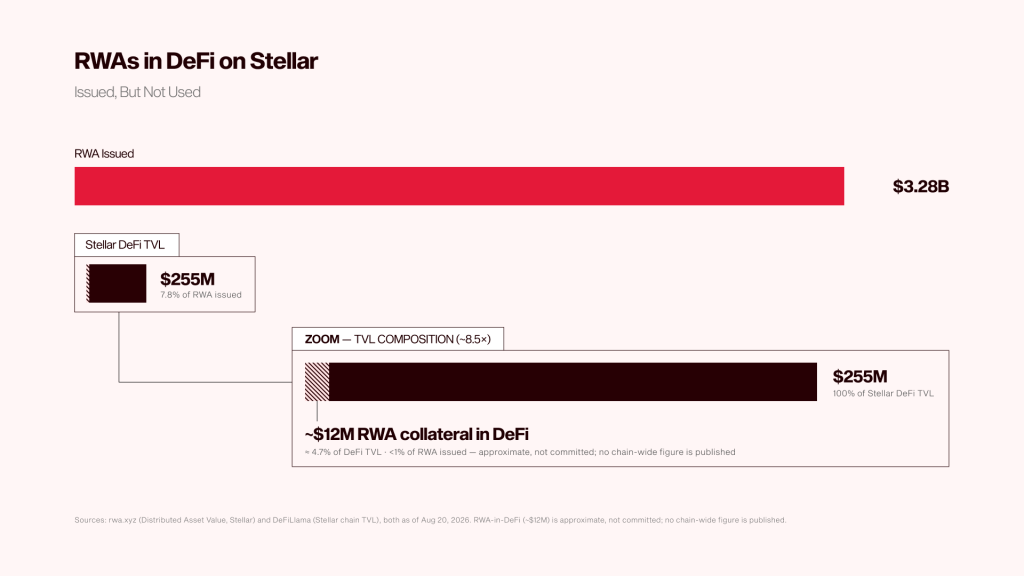
Bringing the RWAs to DeFi is the next big chapter for the Stellar ecosystem, one that to a large extent comes down to a singular variable: the price. A DEX backend must know what an asset costs to make it tradeable. A lending protocol must continuously price the asset to keep track of the borrowers’ Loan-to-Value ratios. Across the board, a defensible price delivered around the clock is simply a non-negotiable for an asset to become DeFi-ready. And therein, lies the next challenge: RWA prices work differently from what the DeFi space and its underlying infrastructure are used to.
“Our work at Centrifuge is bringing institutional funds like Janus Henderson’s Treasury and AAA CLO strategies onchain and making them composable through our deRWA tokens. Tokenizing them is what puts these assets within reach of DeFi; reliable, standardized pricing on Stellar by RedStone is what lets protocols actually use them as collateral. That combination is what expands a regulated fund into a productive onchain asset.” — Martin Quensel, founder of Anemoy, co-founder of Centrifuge.
Continuous Markets Meet Intermittent Real-World Trading
Pricing most crypto tokens, at least those that trade with enough liquidity and market depth, like BTC, ETH, or XLM, is relatively easy. The platforms they trade on operate 24/7, the liquidity runs deep, so the algorithm for getting a quote is quite straightforward. You aggregate the prices across the main markets, assigning them weights if needed, and convert those into the final figure. Case closed.
With RWAs, the picture is quite different. Most of them do not necessarily trade around the clock, instead following a dedicated time window. Some blue-chip stocks may be available 23/5, for example, while others would only trade in the open hours of their dedicated market. For more exotic assets, such as government debt, which is what Etherfuse’s CETES (Mexico) and TESOURO (Brazil) focus on, there is no continuous trading, a spot price only exists while the home market is open.
Additionally, RWAs may not necessarily depend on the trading as such in terms of their value. This, for example, applies to a tokenized money market fund such as BENJI or Spiko’s T-Bill Money Market Fund. Appraising it based on a momentary bout of market volatility makes no sense; instead, what’s driving its value are the assets in its portfolio.
The reporting standards and channels of the TradFi world are also not necessarily immediately compatible with DeFi. Staying with the example of a tokenized fund, it’s not uncommon for the fund’s administrator to report its current standing as a text file dispatched over email. Passing that data to an onchain smart contract with the appropriate cryptographic validation would obviously require additional steps. You don’t send Bitcoin by mail, after all.
Finally, a defensible and level-headed price for an RWA may depend on a variety of other factors that the data pipeline must account for. Corporate debt, for example, which is the focus of VuMe Bond 2030, comes with the risk grade, maturity date, and settlement terms, which all guide its price as a security.
All these peculiarities comprise a multi-layer challenge that spans across a variety of questions. How do you produce a defensible price? What sources do you take it from? How do you communicate it to the smart contract? This last one, Stellar has solved natively, setting up a unified standard for how smart contracts consume price data.
The Unified Price Data Interface on Stellar
SEP-0040 (Oracle Consumer Interface) is Stellar’s ecosystem proposal for standardizing how smart contracts on Soroban, Stellar’s smart contract platform, consume price feed data. Before its introduction, price data providers exposed bespoke interfaces, which could only be connected to via a custom adapter. This meant that adding a new price feed takes costly development hours. SEP-40 removes that friction by defining a single trait, PriceFeedTrait, that any compliant price data provider implements to enable standardized queries.
The interface’s core is comprised of a small set of functions: base() returns the denomination asset all prices are quoted against, assets() lists every asset the provider covers, decimals() gives the fixed-point precision (price divided by 10^decimals yields the real value), and resolution() states the uniform time interval, in seconds, between data points. For reading data, price() fetches a value at a specific timestamp, lastprice() returns the most recent reading, and prices() pulls the last N records. Every price is returned as a PriceData struct pairing a price and a timestamp, and an oracle can signal “no data available” without reverting the calling contract.
A deliberate design choice in SEP-40 is timestamp-based indexing rather than sequential round IDs. Because records are keyed to normalized timestamps at a fixed resolution, consumers can apply time-weighted averaging (TWAP) directly without first reconstructing a timeline from round numbers. The spec also treats contract addresses, decimals, and resolution as effectively immutable once deployed, and pushes several best practices onto consumers explicitly: check for staleness before trusting a price, pull from more than one provider where feasible, apply TWAP smoothing, and consider fronting oracle calls with a proxy contract for future flexibility.
In practice, SEP-40 has become the interface layer that Stellar-native DeFi protocols build against, with providers such as Reflector and RedStone implementing it to feed price data into lending markets and RWA platforms on Soroban.
RedStone: Powering RWAs on Stellar
RedStone joined Stellar in March this year, bringing its institutional-grade data infrastructure to the network amid its RWA boom. The initial deployment featured a push-model pipeline with an adapter that apps could import to start using RedStone data. Soon after the initial integration, RedStone adopted the SEP-40 standard, enabling any application on the network to consume its feeds.

As of today, RedStone provides a total of 47 price feeds on Stellar, including a wide array of RWAs, from AAA-grade corporate loan bundles to tokenized gold and sovereign debt. 18 of these feeds are SEP-40 compliant and can be integrated by any protocols on Stellar, such as Templar, Blend, and others.
| Issuer | Asset | Underlying |
| Centrifuge: onchain asset management protocol that tokenizes institutional credit and Treasury strategies (built with Janus Henderson’s Anemoy funds) into DeFi-usable “deRWA” tokens. | deJTRSY: Stellar-native wrapper for JTRSY. Current onchain supply: 7,365,000 tokens (~$7.6M at ~$1.03 NAV), 14 funded trustlines. RedStone feed | Short-term US Treasury bills/notes (via the underlying JTRSY fund) |
| deJAAA: Stellar-native wrapper for JAAA. Onchain supply: 7,310,484 tokens (~$7.6M at ~$1.04 NAV), 37 funded trustlines. RedStone feed | AAA-rated CLO (collateralized loan obligation) tranches (via the underlying JAAA fund) | |
| Etherfuse: LatAm-focused RWA issuer; tokenizes sovereign government debt as “Stablebonds” aimed at retail savers in emerging markets. | CETES: tokenized Mexican treasury certificates. RedStone feed | Mexican government treasury certificates (Cetes) |
| USTRY: tokenized short-term US Treasury bills. RedStone feed | US Treasury bills | |
| TESOURO: tokenized Brazilian government bonds. RedStone feed | Brazilian sovereign debt (Tesouro Direto) | |
| Ondo Finance: institutional tokenized-finance platform; USDY is its flagship yield-bearing note. | USDY: onchain supply: 467,502,182 tokens, 683 funded trustlines out of 2,663. One of the largest RWAs on Stellar by token count. RedStone feed | Short-term US Treasuries, bank deposits |
| Matrixdock: Matrixport’s digital-asset arm. | XAUm: an LBMA-accredited, Bureau Veritas-audited gold token. RedStone feed | Physical LBMA-accredited gold bullion (Brink’s/Malca-Amit custody) |
| Franklin Templeton: global asset manager (~$1.5T+ firmwide AUM). | BENJI: the token for the first US-registered money market fund to run on a public blockchain (Stellar, since 2021). RedStone feed | US government securities, cash, repurchase agreements |
| iBENJI: institutional share class (Franklin OnChain Institutional Liquidity Fund, $5M minimum), launched 2025. RedStone feed | US government securities, cash, repurchase agreements | |
| Paxos (PayPal): Paxos is a regulated blockchain infrastructure and tokenization company. | PYUSD: on-chain supply: 7,902,125 tokens (~$7.8M at ~$0.99), 954 funded trustlines. RedStone feed | USD cash and cash-equivalents (incl. short-term Treasuries) in regulated reserves |
The infrastructure carrying these has a wide footprint beyond Stellar, covering 1,300+ assets across more than 110 blockchains. RedStone secures $6B+ worth of assets for its 200 clients. Some of the flagship ecosystem assets include BUIDL, BlackRock’s $2.6B+ money market fund tokenized by Securitize and investing in T-Bills, repo agreements, and cash and cash equivalents, Apollo’s ACRED, a $115M+ tokenized feeder fund investing primarily in securities, and Hamilton Lane’s SCOPE, a $4M+ private credit fund.
“Stellar has proven its stability over years and drew in serious RWA issuers. But turning assets from Centrifuge, Spiko, Ondo and others into usable DeFi collateral comes down to one thing: reliable pricing that works around the clock for assets that were never designed to trade like tokens. As more of Stellar’s RWA base gets priced this way with RedStone, more of it becomes usable, and the flywheel effect of onchain utility kicks in. That’s exactly what we focus to enable.” — Marcin Kazmierczak, co-founder of RedStone.
The Infrastructure Layers Beyond the Price Data
A single price feed does not make institutional-grade RWA usable on its own. DeFi-usable RWAs need a full stack: issuance, execution and access, and data. RedStone’s SEP-40 feeds cover the data layer, described above. The issuance and execution layers determine whether a tokenized asset can be minted, held, and moved before a price ever touches it.
Issuance on Stellar splits into two paths. The classic path mints an asset from an issuer account, with holders opting in through a trustline. Regulated issuers layer SEP-8 (Regulated Assets) on top of that, which routes every transfer through an issuer-controlled approval server so compliance checks happen without a smart contract. WisdomTree used this approach to bring 13 tokenized funds and a gold token to Stellar through its WisdomTree Prime platform, with DTCC Digital Assets and Fireblocks handling custody and settlement.
The newer path is Soroban-native. Issuers deploy a Stellar Asset Contract (SAC), which implements the SEP-41 token interface and gives the asset the same programmability as any other smart contract token, including composability with Soroban DeFi protocols. Mercado Bitcoin has announced a $200M program to bring tokenized Latin American fixed income and equities to Stellar, though that issuance has not yet gone live as of this writing.
Execution and access is what keeps an issued asset reachable. Stellar’s validators run the Stellar Consensus Protocol, a federated Byzantine agreement model in which each validator picks its own quorum slices, the sets of other validators it trusts to confirm a transaction, rather than relying on stake-weighted voting or mining. That design lets Stellar close a ledger roughly every 5 seconds. Network safety and liveness rest on a small set of Tier-1 validator organizations, each running three geographically distributed full validators rather than one. Some of these Tier-1 validators include Franklin Templeton, Blockdaemon, MoneyGram, Figure, Range & more.
Separate from validators, RPC and node infrastructure let applications query data from and submit it to the network. Stellar splits this into Horizon, a REST API for classic operations like payments and trustlines, and Soroban RPC, a JSON-RPC interface for smart contract calls. Running either takes dedicated node infrastructure, which is why most builders and institutions use a third-party RPC provider, such as Alchemy, Validation Cloud, QuickNode, or Ankr, rather than operating their own nodes.
Data sits on top of both layers. Once an asset is issued and the network is reachable, RedStone’s SEP-40 feeds let that asset be priced, borrowed against, and traded like any other DeFi collateral.
Alchemy is one concrete example of how those two layers connect. It will run as one of Stellar’s Tier-1 validators while also operating the RPC endpoints and node services that builders and institutions use to reach the network. This gives it a working view of both the consensus layer and the access layer that most integrations depend on.
“Running both a validator and RPC infrastructure on Stellar gives us visibility into the network that most teams building on top of it don’t have. That’s useful for issuers moving real-world assets onto Stellar, because they need the execution layer to be reliable before pricing or trading ever becomes a question. Pairing that with a standardized data layer like RedStone’s is what lets those assets actually get used in DeFi.” — Guillaume Poncin, Chief Technology Officer at Alchemy.
The Next Milestone
Momentum like this tends to compound. Earlier in 2026, the Depository Trust and Clearing Corporation (DTCC) announced plans to tokenize DTC-custodied assets on Stellar starting in early 2027. DTCC is a clearing house behind most of the US stock trade; just last year, it processed $4.7 quadrillion in securities transactions, and custodies $114 trillion in assets. Just to put that into perspective, the combined market cap across all crypto assets at the time of writing stands at $2.17T, just under 2% of DTC’s AUC.
At this scale, moving even a fraction of institutional value onchain is already an achievement, and on the issuance side, Stellar is ready. Connecting that value with DeFi is the ultimate prize, though, since this is where tokenization brings its potential out to the fullest, turning RWAs into composable, smart assets that support 24/7 lending, trading, compound strategies, and so much more.
“Institutions come to Stellar because it was built for regulated financial products from day one. What turns that early interest into real adoption is the ecosystem around issuance: pricing, liquidity, and the DeFi rails. That’s the difference between value that sits on a network and value that moves. RedStone has been a key part of building that out with us, and we’re continuing to expand with new asset classes and DeFi launches.” — Raja Chakravorti, Chief Business Officer at Stellar Development Foundation.
The infrastructure for this onchain transition is coming together already. The execution layer is expanding and maturing. SEP-40 enables standardized pricing across Stellar’s growing RWA base; the price data providers, including RedStone, are developing advanced methodologies to accommodate a wide range of RWAs. This end-to-end ecosystem is what positions the network for institutional moves at this scale as they arrive.
Issuance put these assets onchain. Pricing is what puts them to work. Stellar solved the first half of that equation early, drawing in issuers like Franklin Templeton, Spiko, Ondo, and Centrifuge. RedStone’s SEP-40 feeds are building out the second half, one issuer, one asset class, one integration at a time. As more of Stellar’s RWA supply gets priced this way, more becomes possible for Stellar’s DeFi, and the value keeps compounding.