Choosing an oracle used to mean choosing a price feed. You picked a provider, wired up a feed, and the rest of the risk problem was yours. That worked when onchain markets were small and assets were a handful of liquid majors. It does not survive the market that exists now.
Tokenized real-world assets have crossed $31 billion onchain, up from roughly $6 billion a year earlier, and aggregate DeFi lending sits north of $40 billion in value locked. The collateral is no longer a dozen liquid tokens. It is restaking tokens, tokenized Treasuries, Bitcoin LSTs, and private credit, each with its own pricing behaviour and failure modes. A price feed reports a number. It says nothing about what happens to the position when that number moves.
The question a prospective client faces is no longer which feed is fastest. It is which layer covers the full lifecycle of a price: how the asset is valued, what happens at liquidation, and how the credit risk was quantified before the loan was made.
The cost of stitching it together yourself
Pricing, liquidation, and risk assessment have historically lived in separate places. The price comes from the oracle. Liquidation logic sits in the execution layer. Risk parameters are set by a governance vote, frozen until the next. Three systems, three sets of maintainers, and seams between them that nobody owns.
Those seams are expensive. When a mid-cap collateral asset drops 40% on a quiet Sunday, the feed updates, liquidation bots race, and the value created flows to whichever searcher wins the latency contest. The protocol absorbs avoidable bad debt, while governance-set risk parameters still reflect conditions from weeks ago. Each system did its job in isolation, and the position still failed because none of them knew what the others knew.
For a buyer, that is not a technical footnote. It is counterparty risk and headline risk arriving on the same afternoon.
What the RedStone Stack consolidates
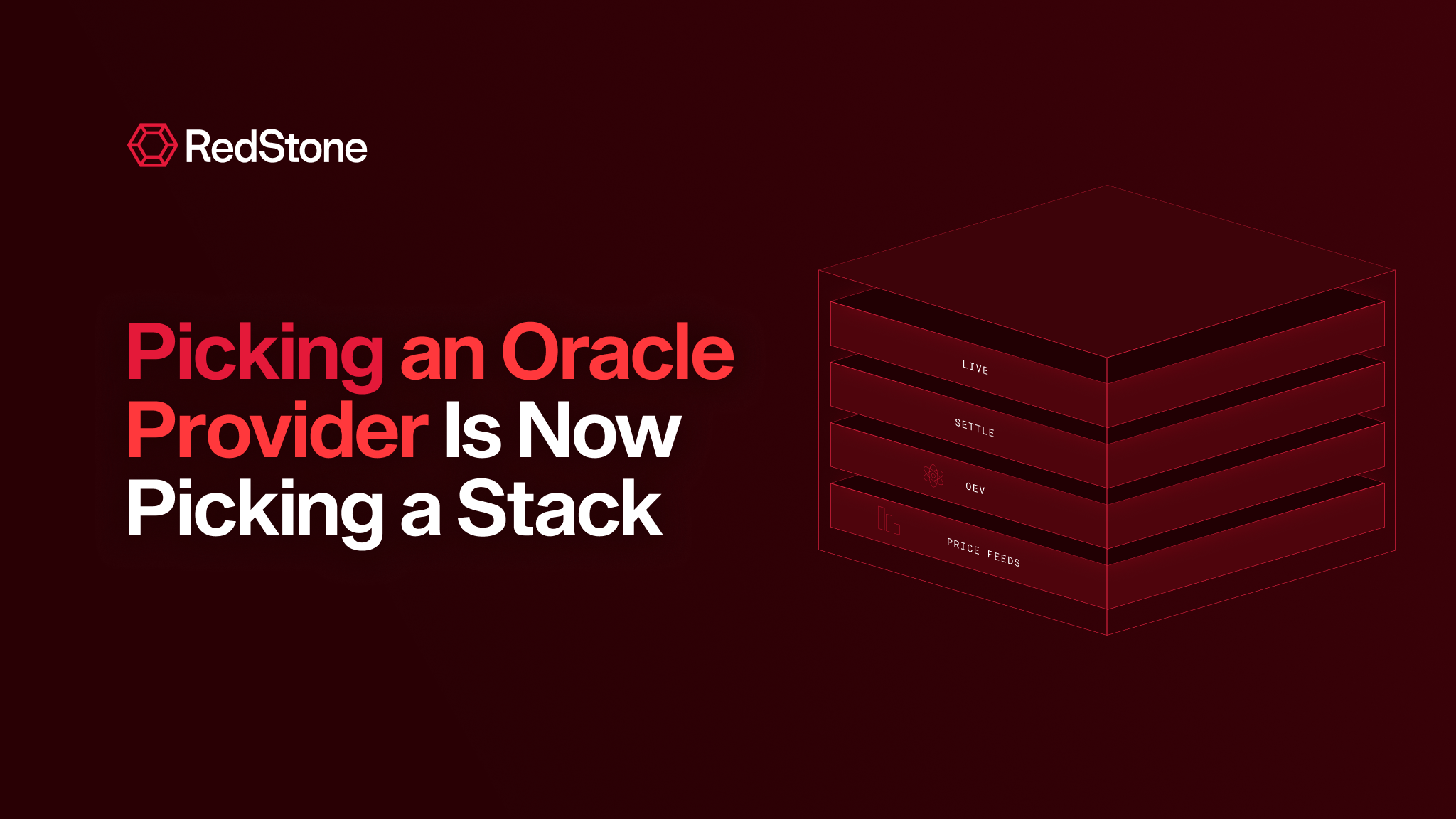
The RedStone Stack organises the problem around the lifecycle of risk rather than the vendor org chart. It runs as one modular oracle infrastructure with three coordinated layers.
The first is deterministic market data. Every credit market rests on one assumption: that the price of the collateral is correct. Liquid staking tokens, restaking assets, and yield-bearing collateral are easy to manipulate under simple spot aggregation, so RedStone feeds use dedicated methodologies for LSTs and LRTs and market-aware aggregation that reflects real liquidity. Where backing has to be proven rather than assumed, Proof of Reserve replaces the periodic, off-chain attestation most systems rely on with continuous, cryptographic verification onchain, so a protocol can prove every token is backed at the moment it matters. For markets where speed is the constraint, RedStone Bolt delivers updates as fast as every 2.4 milliseconds.
The second is liquidation intelligence. Liquidation bonuses on major lending markets run 5% to 15% of the position, and in a conventional setup that value leaks to MEV searchers. RedStone Atom turns the moment into an auction: searchers compete for the right to act on the triggering update, and the value they generate returns to the protocol. The auction also tightens execution, shrinking the window where bad debt builds.
The same layer extends to collateral that cannot settle instantly. Tokenized real-world assets often carry 60-to-180-day redemption windows, which clashes with the near-instant liquidation DeFi lending expects. RedStone Settle closes the gap with an onchain auction: liquidity providers buy the liquidated position immediately and take on the delayed redemption, so the protocol gets cash at once. RedStone estimates this could unlock more than $30 billion in tokenized RWAs as collateral.
The third is credit risk. Most onchain lending still runs the pawnshop model: lend against collateral, set a ratio by vote, hope it holds. Credora, part of the stack after RedStone’s 2025 acquisition, brings continuous, model-driven DeFi risk ratings through the same infrastructure that carries prices. They move with the market rather than governance cycles, and are live across Morpho and Spark today.
| Concern | Price feed alone | RedStone Stack |
|---|---|---|
| Pricing under stress | Spot aggregation, manipulable | Asset-specific, liquidity-aware methodology |
| Reserve backing | Periodic, off-chain attestation | Continuous, cryptographic Proof of Reserve |
| Liquidation value | Leaks to MEV searchers | Recaptured via OEV auction (Atom) |
| RWA collateral settlement | Blocked by 60–180 day redemption windows | Instant settlement via auction (Settle) |
| Risk Ratings | Lack of | Continuous, model-driven ratings (Credora) |
What this changes for a buyer
Because the layers share one architecture, they share information: the risk layer can flag rising exposure before the price breaks, the data layer captures the move, and the liquidation layer keeps the value in the protocol. The seams that fragmentation leaves open are closed by design.
For an asset issuer, a new token becomes productive collateral with pricing and risk data from day one, not after a multi-month governance process. For a protocol or institution, every data point is signed and verifiable, the property an audit trail requires and a quarterly snapshot cannot provide.
Key takeaways
- The oracle decision has become a stack decision. Price accuracy is the entry requirement; liquidation behaviour and credit risk decide whether a position survives stress.
- Fragmentation between pricing, execution, and risk is measurable cost: leaked liquidation value and avoidable bad debt.
- The RedStone Stack combines deterministic market data and Proof of Reserve, OEV recapture and RWA settlement via Atom and Settle, and Credora risk ratings in one signed, auditable layer.
- It is in production now: Atom recapturing OEV across lending markets, Credora ratings live on Morpho and Spark, and integrations like Lotus and REAL built on the full stack.
The next phase of onchain finance is not about whether financial products can run onchain. That is settled. It is about whether they hold up under stress as they scale, a question about the infrastructure underneath.
Frequently asked questions
I already have a reliable price feed. Why would I need more than that?
A price feed tells you what an asset is worth at a point in time. It does not govern what happens when the price moves: who captures the liquidation value, whether bad debt accumulates during the unwind, or how the credit exposure was priced before the loan existed. For tokenized assets and onchain credit, those three questions decide whether a position is sound. The RedStone Stack answers all three in one layer.
Is the RedStone Stack actually in production, or is this a roadmap?
It is in production. The data layer secures live markets with asset-specific methodologies and Proof of Reserve, RedStone Atom recaptures OEV across lending protocols, and Credora’s DeFi risk ratings are live on Morpho and Spark. Integrations such as Lotus and REAL already build on the combined stack.