RWAs made it on-chain. But without reliable liquidation flow, they cannot function as collateral. RedStone Settle changes that, enabling RWA lending at scale.
TL;DR:
- Real-world assets are moving on-chain. Their core value proposition lies in DeFi composability: RWAs can serve as collateral in DeFi lending, enabling borrowing and leveraged yield.
- The existing infrastructure is inadequate to manage it for RWAs. DEX pools are too shallow, compliance restrictions eliminate permissionless liquidation, and redemption windows of 60 to 180 days make forced exits impossible.
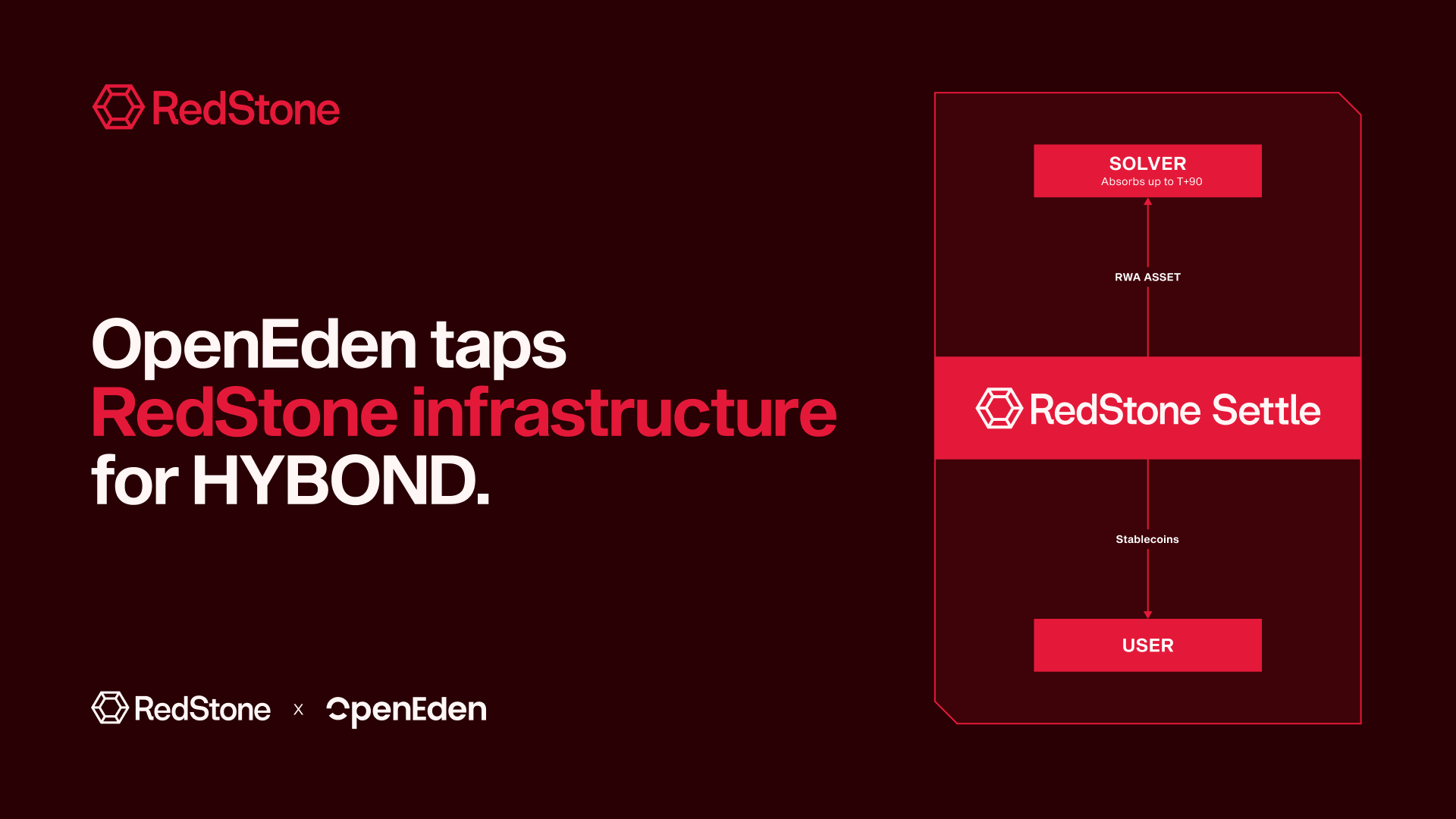
- RedStone Settle solves this by introducing an auction-based liquidation system. Instead of relying on open markets, it connects distressed positions with specialized, KYC-verified solvers. The winning solver closes the position instantly on-chain at T+0, while taking on the underlying asset off-chain.
- Built on RedStone Atom’s proven auction and oracle architecture, Settle integrates directly into lending protocols and enforces compliance by design.
- The result is a reliable way to liquidate RWA collateral, making lending against real-world assets finally viable at scale.
The Moment
Tokenized real-world assets are having their breakout moment. Trillions in traditional assets are moving onto programmable rails.
Tokenization went from a thesis to reality: treasury bills, private credit, money market funds, and tokenized equities. BlackRock. Goldman Sachs. BNY Mellon. The institutions that built the global financial system over centuries moved from experiments to live deployments. Tokenized equities grew nearly 2,900% year-over-year. Tokenized gold trading surpassed the volume of all but one U.S.-listed ETF. Industry analysts are projecting that the tokenized asset market will reach $400 billion by the end of 2026.
The assets are real. The demand is real. The capital is moving.
Getting RWAs on-chain was the first step. It added distribution, transparency, and programmability to assets that previously lived entirely in traditional rails. But distribution alone is not the full value proposition.
The real value unlocks when RWAs become collateral in DeFi lending protocols, enabling leverage on RWA yield, capital efficiency, and composability with the broader ecosystem.
And that is precisely where a structural problem has been hiding.
The Structural Problem
Historically, liquidations in DeFi have relied on DEX liquidity to absorb distressed collateral. This model breaks down for RWAs for two interconnected reasons:
- Low trading velocity: RWAs are typically store-of-value instruments rather than speculative trading pairs. On-chain trading volumes are a fraction of comparable crypto-native assets, making DEX pools shallow and unreliable during stress events.
- Expensive passive capital: Providing DEX liquidity for RWAs means locking capital in pools that generate minimal fees due to low volume. The cost of maintaining sufficient depth to handle liquidation events is prohibitively high relative to returns.
Tokenized securities carry transfer and holding restrictions enforced at the token contract level. Only KYC-verified, whitelisted addresses can hold or receive these tokens. This constraint eliminates the permissionless, open-market liquidation that works for crypto-native collateral and dramatically shrinks the pool of eligible liquidators, further concentrating risk.
Redemption windows make it worse. Even for whitelisted participants, there is no mechanism to force an early exit from the underlying asset. Some tokenized money market funds process withdrawals the next business day. Others, particularly private credit, real estate, and structured products, have redemption windows of 60 to 180 days. A lending protocol holding RWA collateral in a stress scenario cannot liquidate it on demand, and a risk module that cannot liquidate on demand cannot safely set meaningful loan-to-value ratios.
The combination of thin liquidity, compliance constraints, and redemption timelines creates a structural bottleneck: lending protocols cannot safely accept RWA collateral at meaningful loan-to-value ratios because liquidation is unreliable. This bottleneck is one of the largest barriers to RWA-collateralized lending growing beyond its current nascent scale.
Introducing RedStone Settle
RedStone Settle is an on-demand liquidation settlement infrastructure for tokenized real-world asset positions in DeFi lending protocols.
When a borrower’s RWA collateral falls below the liquidation threshold, an auction is initiated instantly on RedStone’s infrastructure. Specialized solvers, each KYC-verified and whitelisted for the specific RWA token type, compete to offer the best available settlement rate. The winning solver delivers liquid assets to close the lending position in a single atomic transaction. T+0. No redemption window. The transaction happens inside the vault.
The solver acquires the RWA position and waits out the underlying redemption period, earning the spread between the discounted settlement price and the face value at maturity. RedStone provides the infrastructure that makes the match: the auction layer, the oracle pricing, and the atomic settlement guarantee.
The lending protocol is protected. The position is resolved. The entire sequence settles in a single block.
How It Works
RedStone Settle operates across three layers that function as a single system.
The Auctioneer Module runs off-chain, continuously monitoring RedStone price feeds and detecting settlement opportunities. When a position is eligible, it broadcasts an auction payload to all registered solver engines: position data, collateral amounts, settlement thresholds, and deadline. It collects bids, selects the highest valid offer, and submits the winning transaction on-chain, all within a time window ranging from 300 milliseconds to minutes, depending on whether institutional participants are coordinating off-chain capital.
The Solver Engine is the bidder. Each solver operates an off-chain engine connected to the Auctioneer and a corresponding on-chain contract. Solver strategies vary: some draw on liquid restaking capital, others use on-demand stablecoin minting mechanisms, others are institutional OTC desks, and others operate purpose-built settlement vaults. Every solver is KYC-verified and whitelisted for each specific RWA token type before participating. Compliance is enforced at the settlement layer itself, not as a post-hoc check, but as a structural condition of participation.
The Executor Contract handles on-chain settlement. It receives the winning transaction and executes the full sequence atomically: price update, solver callback, repayment, and collateral release. Every step happens in the same transaction. If anything fails, the entire transaction reverts. No partial settlements. No orphaned positions. Atomicity is the guarantee.
The lending protocol is protected. The borrower’s position is resolved. The solver earns the spread. None of this complexity surfaces to the end user.
Built on Proven Architecture
RedStone Settle extends the RedStone Atom model to the RWA settlement context.
Atom, launched in July 2025, proved that large-scale auction-based settlement is both possible and dependable. It runs real-time auctions that settle in under 300 milliseconds, works across several EVM chains, and has never experienced mispricing or downtime.
RedStone Settle uses proven technology. The auction system, price oracle, and instant settlement are all production-ready and now applied to a new use case. For real-world assets, the main change is the compliance layer: solvers must be approved for each token type, and auction times can be adjusted to align with how institutions move capital.
RedStone already sits inside the oracle layer for a significant portion of institutional RWA infrastructure, including BlackRock’s BUIDL fund via Securitize and European treasury assets via Spiko. The settlement layer is the natural extension of that position.
Who RedStone Settle Is For
The primary customer is the curator.
Curators are risk managers and vault operators who use real-world asset collateral strategies in lending protocols. They have struggled with the exit problem since RWA collateral began in DeFi. RedStone Settle gives them a solution they can use and trust.
For asset issuers, having a reliable settlement system changes what they can do with collateral. Real-world asset positions that lending protocols once avoided due to uncertainty now become possible when exits are handled efficiently, with compliance, and instantly.
For lending protocols, this enables better loan-to-value ratios on real-world asset collateral for the first time.
RedStone Settle works within existing vault systems. There’s no need for a separate interface or manual steps. The settlement process is built into the protocol, so investors experience it as one simple action.
The Infrastructure Layer for the RWA Era
The tokenization trend that analysts predicted is now a reality. Institutions are already working in this new market. How fast it grows from here depends on whether the infrastructure can earn the trust of those who control the capital.
Pricing must be accurate. Reserves must be verifiable. Settlement must be enforceable under real conditions.
These are not independent components, but a carefully designed system.
RedStone Settle is the liquidation settlement layer. It’s the part that makes collateral strategies, lending protocols, and institutional allocations work when it matters most.
RWAs are on-chain. The capital is moving.
RedStone Settle enables RWA DeFi.