RedStone delivers onchain NAV data for Pareto’s Credit Vaults, making tokenized institutional credit usable as collateral wherever the assets go.
TL;DR:
- RedStone is now the data layer behind Pareto’s Credit Vaults, publishing onchain NAV data for its vaults.
- Pareto’s Credit Vaults tokenize institutional credit. The FalconX Credit Vault, over $170M+ of credit exposure, is the first integration.
- A tokenized credit asset is only usable where its value is published, so every chain a vault token reaches needs its NAV delivered there.
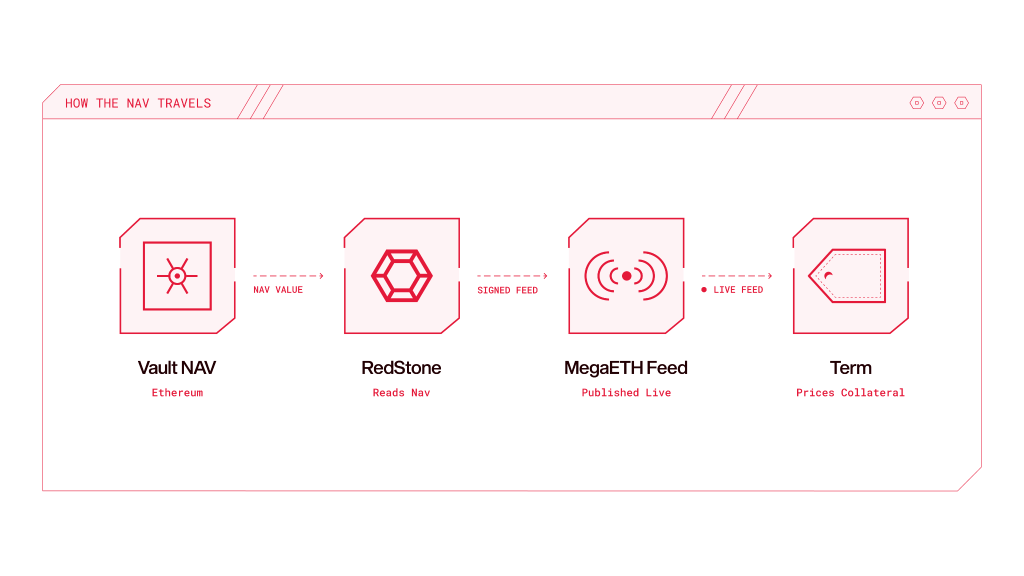
- RedStone reads the vault’s NAV from its Ethereum contract and republishes it as a standardized feed on every chain the token reaches. The feeds are live on Monad, Plume, and MegaETH through the push and pull models.
- Priced onchain, a vault token can be posted as collateral and borrowed against, so holders access liquidity without unwinding the position or losing the yield.
RedStone Prices Pareto’s Credit Vaults
RedStone is now the data layer for Pareto‘s Credit Vaults, delivering onchain NAV for their tokenized institutional credit products.
The integration starts with the FalconX Credit Vault, a tokenized private credit vehicle whose funds are used by FalconX, an institutional digital asset prime broker, to finance part of its prime brokerage business, extending overcollateralized credit to trading firms and hedge funds. The vault’s position is secured at a minimum 110% collateral ratio, held in segregated custody, and holds over $170M of credit exposure at the time of writing.
Pareto connects institutional lenders and borrowers through its onchain private credit marketplace, with roughly $225M TVL across its Credit Vaults at the time of writing. Curators such as M11 Credit underwrite the borrower and monitor the credit.
Bringing Private Credit to Onchain Lending Markets
RedStone’s NAV data feeds for the FalconX Credit Vault are now live on Monad, Plume and MegaETH. They are available through the push model, with a 24-hour heartbeat and a 0.1% deviation threshold, and on demand through the pull model.
FalconX’s Credit Vault participants who deposit USDC (non-U.S. accredited depositors, 250,000 USDC minimum) receive AA_FalconXUSDC, a redeemable token that represents their position in the vault. It’s the vault’s senior tranche and, as the AA slice, it’s first to be paid and last to take losses.
AA_FalconXUSDC is an interest-bearing token, so the yield is reflected in the token’s NAV, which grows continuously over time. Token holders are able to post it as collateral in a lending market and borrow against it, freeing up liquidity without exiting their position.
For any of this to work, the lending market needs a NAV to value the collateral and liquidate positions that go underwater.
From a Single Contract to a Standard Feed
Until now, a vault’s NAV has lived in its contract on Ethereum, rising as interest accrues, and any market on that chain can read it directly. Extending it to other chains meant handling each integration case by case, bridging the token and wiring each venue to read that value on its own.
“Consistent pricing is what makes a credit position usable across the ecosystem.
By standardizing pricing for Pareto’s Credit Vault tokens, RedStone gives any protocol, application, or market participant a reliable foundation to integrate and use them on any chain.”
– Matteo Pandolfi, Co-Founder and CEO of Pareto
Now, RedStone reads the vault’s NAV directly from its contract on Ethereum and republishes it as a standardized feed on each destination chain.
Bringing FalconX Credit Vault to New Chains
Over the past year, Pareto’s Credit Vaults have expanded across venues and networks, used as collateral on Morpho and deployed onto Monad and Plume (the FalconX vault reaching Plume as the FALX token). Each new chain needs the vault’s value published there, which is the job RedStone now takes on.
Additional NAV feeds are planned for Pareto’s vaults as it expands to more networks.
About RedStone
RedStone is the data layer for institutional DeFi, delivering secure, low-latency price feeds for digital assets, RWAs, stablecoins, LSTs, LRTs, and Bitcoin LSTs across 110+ chains. Trusted by 200+ clients, including Securitize, Morpho, Pendle, Spark, Ether.fi, Ethena, Lombard, Venus, and Compound, RedStone powers lending, stablecoins, perpetuals, and tokenized asset markets with custom pricing infrastructure built for complex onchain systems. RedStone provides data for tokenized products including BlackRock’s BUIDL, Apollo ACRED, and Hamilton Lane SCOPE. Zero mispricing events. 100% uptime. Learn more at redstone.finance.
About Pareto
Pareto is a private credit marketplace that connects institutional lenders and borrowers, providing scalable, yield-generating opportunities and enabling institutional capital to move onchain.
Tailored for asset managers, digital asset funds, fintechs, and other professional investors, Pareto offers seamless access to regulatory-compliant alternative credit products, alongside whitelabel infrastructure that enables partners to launch branded credit products onchain.
Website | App | X | LinkedIn | Discord | Telegram | Blog
Frequently Asked Questions
What are Pareto’s Credit Vaults?
Tokenized private credit products that bring institutional credit onchain. Allocators deposit USDC and receive a token representing their position; curators such as M11 Credit underwrite and monitor the credit. The FalconX Credit Vault is one example, where deposited USDC is used by FalconX, a tier-1 digital asset prime broker, to finance part of its prime brokerage business.
How does a lender earn yield from a vault?
The interest paid on the underlying credit accrues into the token’s NAV, so the token rises in value over time. Lenders realize the yield when they redeem the token for USDC, rather than receiving separate payouts.
What is M11 Credit’s role?
On the FalconX Credit Vault, M11 Credit is the curator: it underwrites FalconX as the borrower, sets and monitors the loan terms, and manages the credit risk on an ongoing basis.
What does RedStone provide?
RedStone reads a vault’s NAV from its contract on Ethereum and republishes it as a standardized feed on every chain the token reaches. That feed is what lets a lending market price the token as collateral.
Who can deposit into the FalconX Credit Vault?
Access is limited to non-U.S. accredited allocators, with a minimum subscription of 250,000 USDC.
Can a vault token be redeemed for USDC?
Yes. The FalconX Credit Vault token is redeemable for the original deposit plus accrued interest, on the vault’s monthly cycle.
What happens to a vault position used as collateral if the loan isn’t repaid?
If a borrowing position falls below the lending market’s required ratio, it can be liquidated: the market sells the collateral token to cover the loan. This is why an accurate, timely NAV feed matters, it’s what the market uses to value the collateral and trigger liquidation.