The RedStone Product Stack is a single modular oracle layer made up of seven products across three categories: market data, capital efficiency, and risk intelligence. Most providers solve one piece, usually the price feed. The Stack treats the others as part of the same problem and serves them through one architecture. You can start anywhere, and each product you add makes the others more useful.
The reason for that design is simple. Financial markets run on data, and every price, every liquidation, and every credit decision starts with knowing what something is worth. A single feed answers the first question and leaves the rest open: who captures the value when the price moves, what happens to collateral that cannot be sold in a single block, and how risky the borrower was before the loan existed. Onchain credit markets hold around $40 billion in value, and the collateral inside them has shifted from a few liquid majors to restaking tokens, tokenized Treasuries, and private credit. Each new asset class exposes a gap the price-feed model was never built to close.
Today the RedStone Stack runs across 70+ chains, with 200+ clients, more than $500 million in OEV recaptured, and 100% uptime. Here is what each category covers.
Market data: the input that everything else depends on
Onchain applications need data from the outside world, and four products handle different versions of that problem.
Price Feeds deliver customizable data across 70+ chains with Pull and Push models. The test of a feed is whether it holds the correct price under stress, and when assets like ezETH and wstETH mispriced elsewhere, RedStone feeds held. BlackRock’s BUIDL fund relies on this layer through Securitize.
RedStone Bolt is the push feed for real-time chains, delivering updates at 2.4 millisecond latency and more than 400 per second. A 30-second feed cannot operate on a chain with 10ms block times, which is why Bolt is live on MegaETH and Monad.
RedStone Live is a low-latency 24/7, off-chain data streaming service delivering equities, commodities, forex, indexes, and cryptocurrencies.
Proof of Reserve turns “this token is backed” from an attestation you trust into something a smart contract can verify every block. Lombard runs the first continuous Proof of Reserve for a Bitcoin liquid staking token on it.
Capital efficiency: value that was leaking, returned
Reliable data is the start. The next problem is the value that escapes onchain markets through liquidations, and two products address it.
RedStone Atom is a liquidation-aware oracle. Liquidations and arbitrage generate oracle-extractable value that historically went to searchers and bots. Atom auctions that value back to the protocol that produced it and settles liquidations in under 300 milliseconds, which lets lending markets raise loan-to-value ratios by 5 to 10% with no integration work. HyperLend is among the live markets.
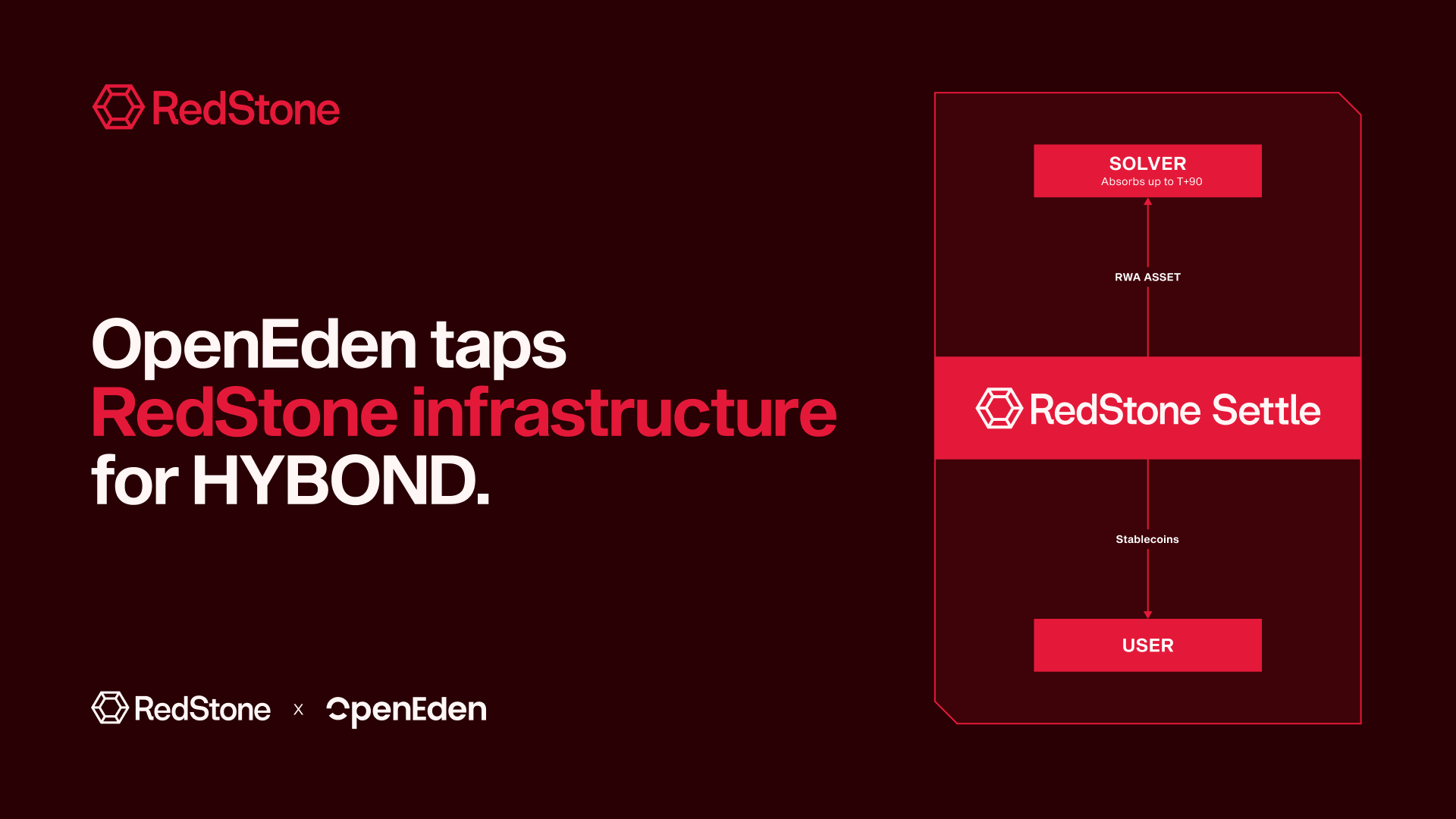
RedStone Settle closes a structural gap. Lending protocols liquidate in seconds, while real-world asset redemption windows run 30 to 180 days, and that mismatch locks more than $30 billion in tokenized assets out of DeFi collateral markets. Settle uses an onchain auction so liquidity providers absorb the delayed redemption and the protocol receives cash at T+0. It is in production with Symbiotic as the first live integration.
Risk intelligence: surfacing what a depositor stands to lose
DeFi has always surfaced yield. Every interface leads with APY, and almost none show the probability that a position loses value. Credora closes that gap with simulation-based risk ratings: a five-dimension assessment of collateral quality, smart contract risk, oracle design, liquidity, and counterparty risk, run through 100,000 Monte Carlo simulations per market. The output is one number, the Probability of Significant Loss, which is the annualized chance a depositor loses more than 1% of principal, expressed as a letter grade from A+ to D and updated continuously rather than quarterly. Credora has rated 100+ products and more than $10 billion in onchain capital, and runs live on Spark.
| Category | Question it answers | Products | Example partner |
|---|---|---|---|
| Market data | Is the collateral priced correctly and actually backed? | Price Feeds, Bolt, Live, Proof of Reserve | BlackRock BUIDL, MegaETH, Lombard |
| Capital efficiency | Who captures the value when the price moves? | Atom, Settle | HyperLend (ATOM) Symbiotic (Settle) |
| Risk intelligence | How much could a depositor lose? | Credora | Spark, Morpho |
Why one stack instead of seven vendors
The categories are connected, so the solution is too. Because the products share one architecture, they share information. The risk layer can flag rising exposure before the price breaks, the data layer captures the move, and the capital-efficiency layer keeps the value inside the protocol. Assemble the same capabilities from separate vendors and you inherit the seams between them: the feed updates, the liquidation logic lives elsewhere, and the risk parameters reflect conditions from weeks ago. When a mid-cap asset drops 40% on a quiet weekend, those seams become bad debt that nobody owns.
The Stack is modular, so a protocol picks the products it needs and expands as it grows. Most DeFi protocols enter through Price Feeds, Atom, and Bolt. Chains start with Bolt, Live, and Settle. Asset issuers begin with Proof of Reserve and Price Feeds. Institutions tend to start with Credora and Canton.
Key takeaways
- The RedStone Stack is one modular oracle layer of seven products across three categories: market data, capital efficiency, and risk intelligence.
- Sharing one architecture lets the layers exchange information, closing the gaps that appear when pricing, liquidation, and risk come from separate vendors.
Frequently asked questions
Is the RedStone Stack one product or several?
It is one layer made up of seven products across three categories. A protocol can adopt a single product, such as Price Feeds, and add liquidation intelligence or risk ratings later. The products share an architecture, so running them together means they exchange information rather than operating as disconnected systems.
How is this different from a standard price feed?
A standard feed answers one question: what an asset is worth right now. The Stack also answers what happens when that price moves (Atom), how illiquid real-world collateral settles when it has to be liquidated (Settle), whether reserves actually back a token (Proof of Reserve), and how much a depositor could lose (Credora). For tokenized assets and onchain credit, those questions decide whether a position survives stress.
Which parts of the Stack are in production?
All of them. Price Feeds and Proof of Reserve secure live markets, Bolt runs on MegaETH and Monad, RedStone Live powers Extended, Atom recaptures OEV across markets like HyperLend, Settle is live with Symbiotic, and Credora’s ratings run on Spark. The full Stack serves 200+ clients across 110+ chains, including BlackRock’s BUIDL fund via Securitize.