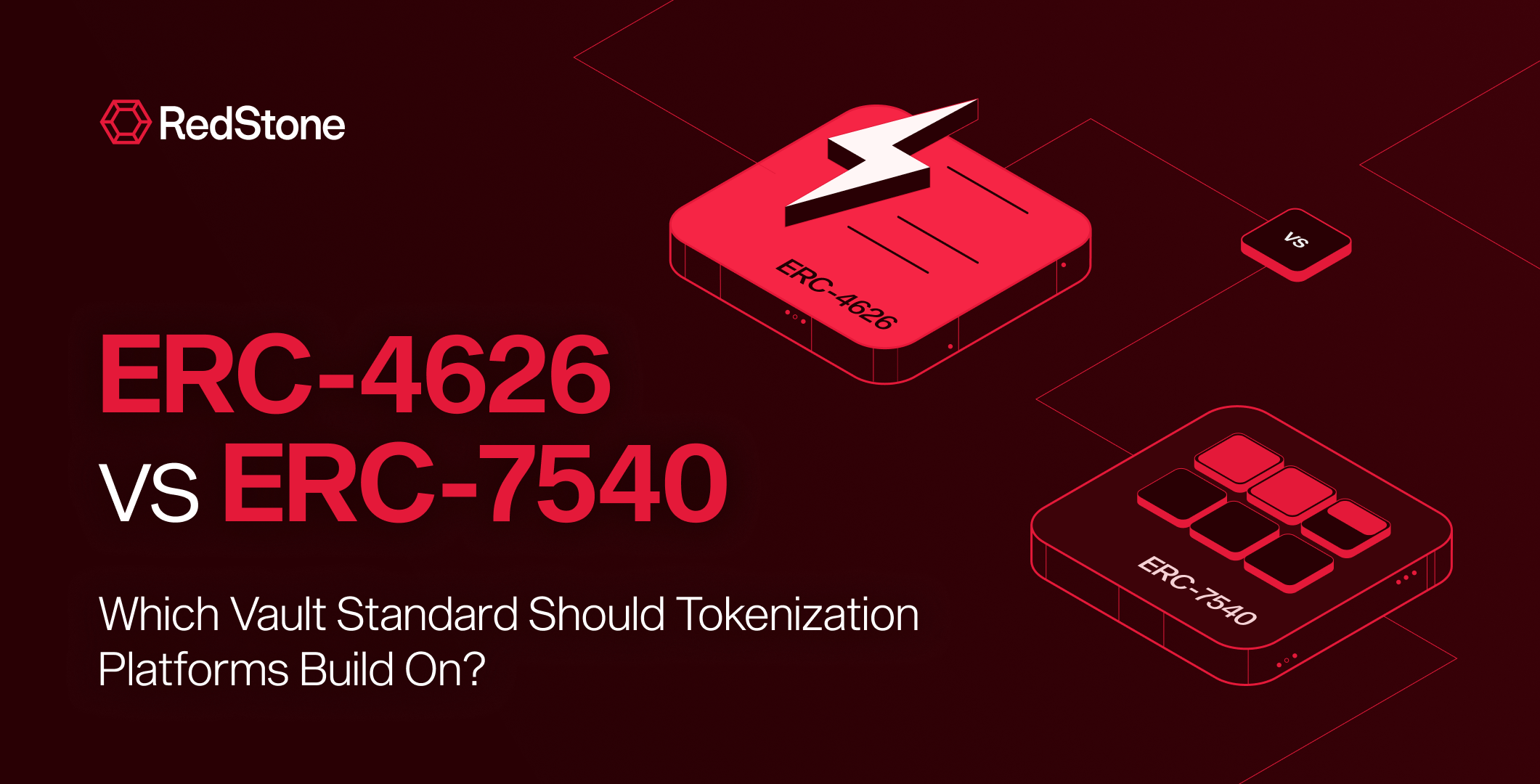
As tokenized real-world assets (RWAs) move from proof-of-concept to productive collateral, one architectural question shapes the sector: which vault standard should tokenization platforms actually build on? ERC-4626 and ERC-7540 are both live and widely referenced, but they solve different problems. Getting this wrong at the architecture level has downstream consequences for composability, liquidity, and institutional adoption.
What ERC-4626 Actually Does
ERC-4626 is the dominant vault standard in DeFi. It standardizes how yield-bearing vaults issue shares, process deposits and withdrawals, and calculate share-to-asset ratios. Yearn, Aave, Morpho, and a growing number of RWA platforms all reference it. When a tokenized asset wraps itself in an ERC-4626 vault, it becomes immediately legible to any DeFi protocol that already speaks the interface.
For liquid, instantly redeemable instruments, the standard works cleanly. Tokenized treasury funds, money market products, and equity tokens with real-time DEX liquidity, such as Ondo Global Markets’ 100+ U.S. stocks and ETFs, fit its synchronous deposit/redeem model. Theo’s thBILL token, a yield-bearing tokenized Treasury product, holds $200M+ in TVL across 15+ DeFi integrations including Morpho and Pendle.
Where ERC-4626 Breaks Down
The standard’s assumption of synchronous settlement is also its central limitation. For crypto-native assets, the assumption mostly holds. For RWAs it frequently does not.
A vault holding tokenized private credit cannot liquidate its position in a single onchain transaction. NAV updates may arrive daily or less often, creating pricing gaps that synchronous redemption logic cannot handle. Redemption windows may be monthly or quarterly, so the vault’s liquidity profile diverges from what depositors expect. Forcing illiquid RWAs into synchronous withdrawal either demands idle cash buffers that drag on yield, or creates redemption risks that undermine the product.
What ERC-7540 Adds
ERC-7540 extends ERC-4626 with an asynchronous request/fulfillment state machine, built for assets where settlement is not instantaneous. It introduces a two-stage lifecycle: a request is submitted, enters a pending state, and is fulfilled when the underlying asset’s operational reality permits. The cycle covers requestDeposit, fulfillment, and claim, with cancellation support that mirrors traditional fund order management.
Centrifuge, which co-authored the standard alongside Maple Finance and Superform, uses it for epoch-based order processing. At each epoch close, the pool manager approves deposit and redemption orders at the current NAV, issues or revokes shares, and sends fulfillment callbacks cross-chain. Idle liquidity buffers become unnecessary: redemption process at verified NAV within defined windows.
The Architecture Decision
Choosing between ERC-4626 and ERC-7540 is not binary. ERC-7540 extends ERC-4626, so the real question is whether an asset’s settlement profile requires asynchronous handling.
Use ERC-4626 when: The underlying asset can be liquidated or priced in real time, redemptions can be honored on demand without material liquidity risk, and DeFi composability is the primary objective. Tokenized T-bills, money market funds, and equity tokens with continuous DEX liquidity fit here.
Use ERC-7540 when: The asset has defined redemption windows, NAV is calculated on a lag, or settlement requires off-chain coordination with a fund administrator. Private credit, structured products, and institutional fund vehicles with monthly or quarterly liquidity fit here.
What the Collateral Data Shows
The real-world adoption data on Morpho is instructive. RWA deposits on the protocol grew from near zero in early 2025 to over $620 million by March 2026, across assets that span the full spectrum from liquid T-bills to illiquid private credit. The assets with meaningful collateral utility, Maple’s syrupUSDC at 38% of total collateral and FalconX private credit at 24%, are structured precisely to handle the asynchronous settlement reality of their underlying instruments. The levered looping strategies running on top of them depend on vault infrastructure that can manage monthly redemption cycles, NAV-based pricing, and formal liquidation agreements with asset issuers.
Conversely, the rapid collapse in T-bill deposits on Morpho, down 92% from their October 2025 peak, and the simultaneous 7x growth in tokenized gold collateral illustrates something important: institutional allocators are already rotating across RWA collateral based on macro conditions. The vault standard itself does not drive these rotations, but the infrastructure’s ability to accommodate different asset profiles cleanly is what makes them possible.
The Case for Building on Both
The tokenization platforms gaining institutional traction treat ERC-4626 and ERC-7540 as complementary. Each handles the asset class it suits, within a shared infrastructure layer for compliance, identity, pricing, and cross-chain settlement.
Defaulting to ERC-4626 for liquid instruments is reasonable and well-supported. Any roadmap that includes private credit, structured products, or fund vehicles with non-daily liquidity needs ERC-7540 in its stack. The operational complexity of illiquid RWAs does not resolve by choosing a simpler vault interface. It surfaces as cash drag or redemption risk that must be managed in another way.
The vault standard is not where tokenization architectures win or lose. It is where the constraints of real-world assets collide with the composability assumptions of DeFi. Platforms that are designed for that collision from the start find the rest of the stack easier to build.
Key Takeaways:
- ERC-4626 is the default vault standard for synchronous deposits and redemptions on liquid instruments (tokenized T-bills, money market funds, equity tokens with DEX liquidity).
- ERC-7540 extends ERC-4626 with an asynchronous request/fulfillment lifecycle built for private credit, structured products, and institutional fund vehicles with NAV lag or redemption windows.
- The decision is not binary. Mixed asset platforms need both standards to live within a shared infrastructure layer.
- Morpho’s RWA collateral composition (38% Maple syrupUSDC, 24% FalconX, 92% T-bill drawdown, 7x gold growth) shows the market already differentiates asset profiles, making vault flexibility a competitive requirement.
FAQ
What is the difference between ERC-4626 and ERC-7540?
ERC-4626 is the core tokenized vault standard, designed for synchronous deposits and withdrawals with real-time pricing and settlement. ERC-7540 extends it with an asynchronous request/fulfillment state machine for assets where settlement requires time, such as private credit or tokenized funds with redemption windows. They work together.
Can a tokenization platform use both ERC-4626 and ERC-7540?
Yes, and this is the emerging pattern. Platforms deploy ERC-4626 vaults for synchronous assets and ERC-7540 vaults for asynchronous ones, sharing infrastructure for compliance, identity, and oracle feeds. Centrifuge’s production architecture combines both standards with ERC-7575 for multi-asset entries.
Which vault standard is right for tokenized T-bills?
ERC-4626 is sufficient for most tokenized T-bill products. Short-duration Treasuries can be priced and redeemed continuously against deep markets, matching the synchronous model. ERC-7540 becomes relevant only if the product introduces settlement delays.