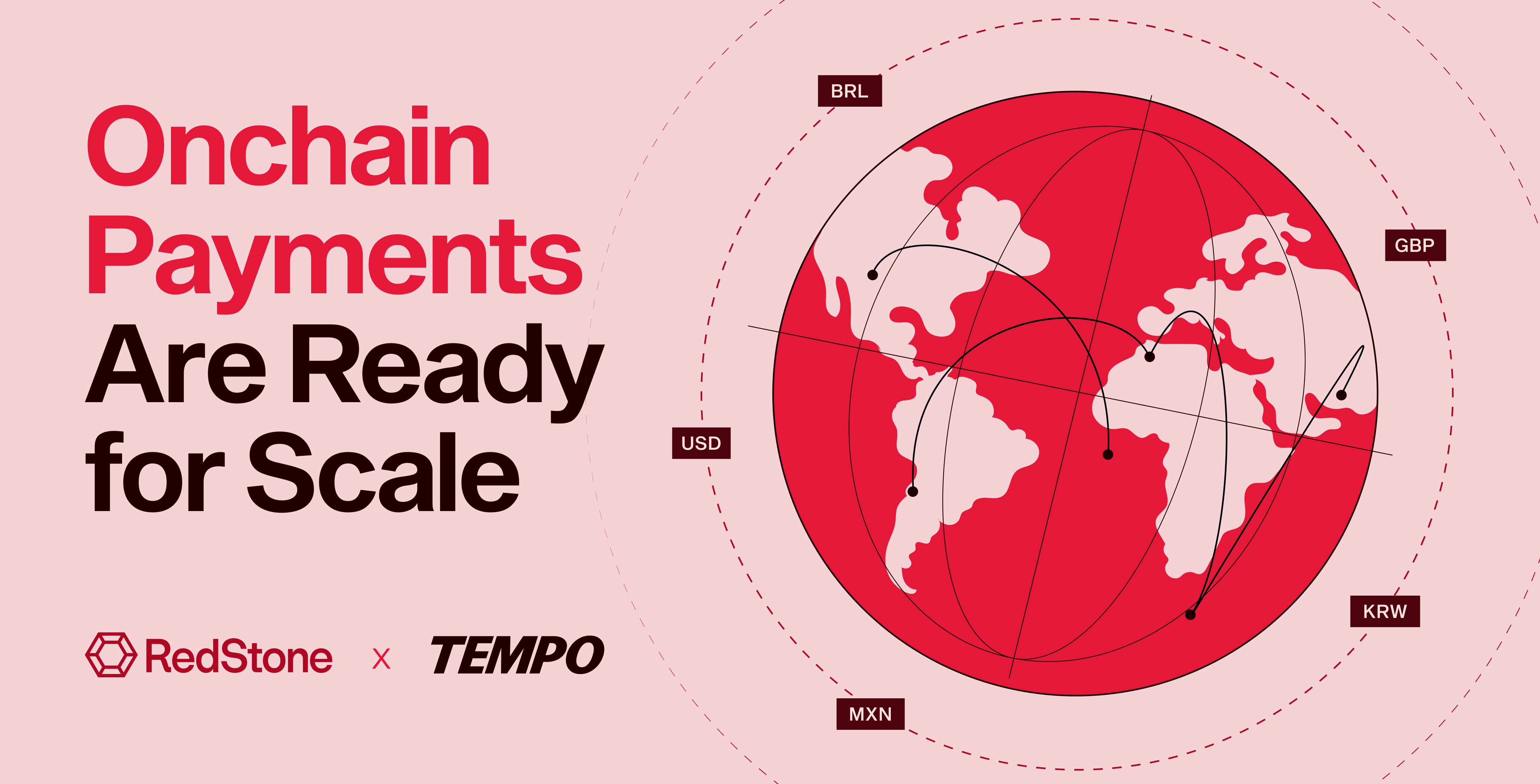
Blockchain solved settlement. What it lacked was a pricing infrastructure reliable enough for real financial flows.
TL;DR:
- Blockchain can already support institutional-grade payments. What held it back was not settlement speed, but the absence of data infrastructure built for real financial flows.
- Traditional FX operates on millisecond-level, institution-grade pricing across hundreds of currency pairs. Most onchain systems still fall short of that standard.
- RedStone brings that standard onchain with real-time, verifiable FX and stablecoin data, alongside compliance-ready risk intelligence from Credora.
- With Tempo’s Machine Payments Protocol, AI agents can make autonomous payments backed by RedStone’s live, institutional-grade prices.
Fifty Years of FX Infrastructure, Compressed into a Programmable Rail
In the spring of 1973, the Bretton Woods system finally collapsed, and the world’s major currencies began floating freely against one another. Within a decade, FX trading had grown into the largest financial market on earth, processing over a trillion dollars daily. It did not do this through clever settlement mechanics. It did it by building the most sophisticated real-time data infrastructure the financial world had ever seen: Reuters terminals, SWIFT messaging, and millisecond quote propagation across every major market simultaneously.
Fifty years later, blockchain is trying to bring all of this into a single global, programmable system. The settlement process works – transactions that used to take days now finish in seconds. But the data layer did not keep up, and without it, faster settlement does not matter.
“Payroll in Brazilian real, invoices in Korean won, and remittances in Mexican peso all depend on reliable market data that reflects live currency markets. Until now, that data layer has largely been missing from onchain payment systems.” — RedStone blog, March 2026
The Price Problem That Defi Obscured
DeFi introduced a usable oracle system to the blockchain, but it was designed for specific use cases such as liquidation triggers, collateral pricing, and yield calculations for crypto assets. In these cases, a few seconds of delay is fine, and uptime is more important than how the data is gathered. The main users are developers who understand smart contract audits.
Enterprise payment systems have much stricter requirements. For companies like Standard Chartered or Revolut, the FX rate is a firm contract, not just an estimate. Even a tiny stablecoin price difference can add up across thousands of transactions, becoming a major accounting issue that could end compliance partnerships.
Most blockchain oracles were never built to meet this bar.
As RedStone has noted, traditional finance runs on millisecond FX data supporting direct currency relationships across every time zone, not just USD pairs but MXN/KRW, EUR/BRL, and hundreds of others. The infrastructure for a payroll platform distributing wages to workers in Korea, Mexico, or Brazil cannot be priced against a rate from six hours ago. That is not an improvement on the system it is meant to replace.
Building To Bloomberg Standards
When RedStone created FX infrastructure for Mento, a highly technical decentralized currency platform, the requirements were closer to those of a Bloomberg terminal than to those of a typical DeFi price feed. They needed liquidity for many currency pairs, 24/7 uptime, and a clear, verifiable method. The main takeaway was that onchain FX is not a simpler version of traditional FX data – it is the same challenge, but with extra cryptographic rules.
“Most oracles treat FX as an afterthought, a few extra price feeds bolted onto a system designed for crypto pairs. RedStone has done the deep work.” — RedStone blog, March 2026
The issue of stablecoin accuracy makes this even more important. Stablecoins are the standard for all payments in the chain, so getting their price right on Tempo is essential. RedStone’s stablecoin feeds have been used in applications like Cap Protocol, where even small price changes can have significant financial effects. This real-world testing with billions in value is not just for show; it is the proof institutions need to trust the data layer in real operations.
Compliance is another important factor that is often overlooked in technical talks. By working with Credora, RedStone provides risk ratings that compliance teams can actually use. While most blockchain tools are explained for developers, Credora’s ratings are made for risk officers. For enterprise and institutional use, this enables large-scale onboarding.
When The Data Layer Is Already Trusted, Expansion Is Faster
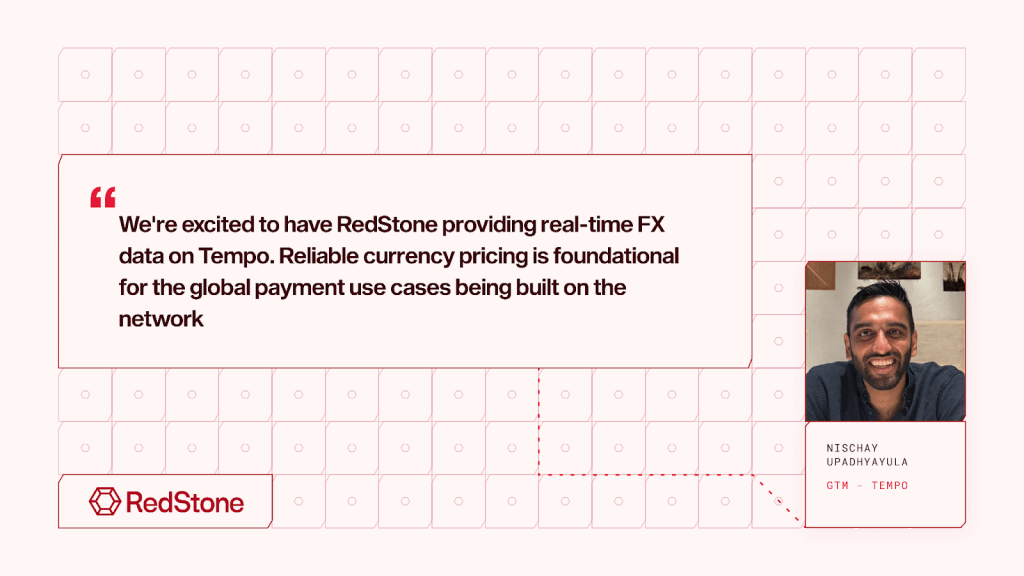
One aspect of RedStone’s position on Tempo that deserves more attention than it typically receives is the network effect of existing integrations. The institutions coming to build on Tempo, including Mastercard, Revolut, Standard Chartered, Morpho, BlackRock’s BUIDL via Securitize, Ethena, and EtherFi, do not all arrive as blank slates. Many of them already rely on RedStone’s data infrastructure in other contexts.
“As these partners expand onto Tempo, the market data layer is already in place. Integrations do not need to be rebuilt. Trust assumptions do not need to be renegotiated.” — RedStone blog, March 2026
This kind of consistent architecture becomes more valuable over time. When new institutions can use the existing data trust layer, they get to production faster. Keeping old relationships without renegotiation also lowers expansion costs. In traditional finance, this is known as a switching cost. In blockchain payments, it could be the key advantage for the first oracle to meet institutional standards before demand existed.
Autonomous Agents Need Real-Time Prices Too
There is a new side to the data challenge that people are just starting to discuss. Tempo’s Machine Payments Protocol lets AI agents make payments automatically and at scale. As companies like Anthropic, OpenAI, and DoorDash use Tempo, these autonomous systems will make purchases much faster than any human team could monitor in real time.
For these transactions to be reliable, the FX data layer must be front and center. It ensures that each automated payment matches real-world prices at the time it happens. RedStone addresses these institutional concerns by providing strong guarantees around data freshness: price feeds are updated in near real time, with latency monitored and kept within strict sub-second thresholds.
Now, the world’s currencies are connected to the internet’s payment systems. The question of whether blockchain’s data infrastructure is ready for real-world use finally has a clear answer with Tempo. The bigger question is whether the rest of the industry will notice.
About RedStone
RedStone is a leading blockchain oracle provider, delivering fast, cross-chain data feeds to power DeFi protocols and institutional applications. As the oracle of choice for real-world asset tokenization, including BlackRock’s BUIDL fund and European treasury assets via Spiko, RedStone bridges traditional finance with on-chain infrastructure. RedStone offers the industry standard for secure pricing and quality support, serving as the market leader for emerging ecosystems and institutional use cases.
About Tempo
Tempo is the blockchain for real-world payments at scale. It enables instant settlement, predictable low fees, and high throughput for any payment use case. Tempo is incubated by Paradigm and Stripe and built in partnership with leading fintechs and Fortune 500 companies. Tempo Mainnet is live, and developers can build on Tempo via public RPC endpoints.