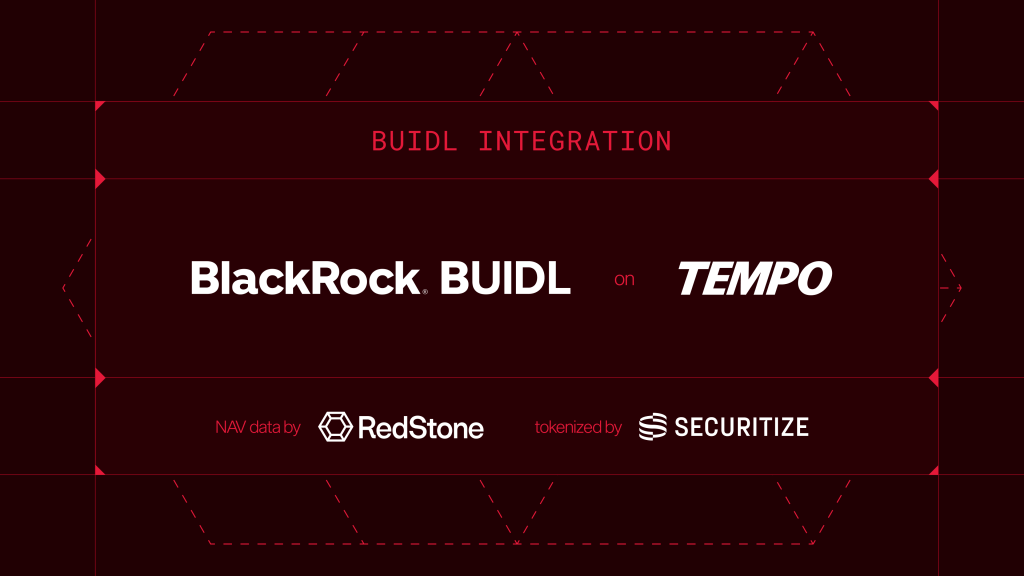
The BlackRock USD Institutional Digital Liquidity Fund (BUIDL), Securitize’s flagship tokenized money market fund worth $2.5B+ at the time of writing, has just expanded to Tempo. RedStone powers the fund’s daily onchain NAV valuation and interest accrual; its data layer will now also enable BUIDL to enter the DeFi ecosystem on Tempo.
TL;DR
- BUIDL is now available to eligible users on Tempo, a Layer 1 blockchain incubated by Stripe and Paradigm and specifically designed for high-scale, stablecoin-native payments.
- RedStone is BUIDL’s official data layer powering its daily onchain NAV attestations as well as yield payouts.
- Onchain NAV data is crucial for integrating tokenized funds into the wider DeFi space as it enables accurate valuation of collateral used in e.g. borrow and lend protocols.
Connecting the Dots
Bringing an asset onchain is not too tricky these days. BlackRock, the global finance giant behind BUIDL, knows that for a fact. BUIDL went live in 2024 on the Ethereum mainnet and has since then expanded to eight new chains, with Tempo as the latest one. It’s a good match, by all accounts. Launching in March this year, Tempo has been built for institutional needs, focusing on low fees and rapid settlement.
As Tempo is expanding its ecosystem, BUIDL is well-positioned to become one of its foundational assets. Already accepted as collateral on a wide range of platforms, including Binance and OKX, it is also a major reserve asset for protocols like Ondo Finance. On Tempo, BUIDL could play a similar role, bringing liquidity and a stable, low-risk yield into the ecosystem.
However, DeFi access requires onchain NAV data available at any time. The reason is that this data is needed for collateral valuation in DeFi markets, on a 24/7 basis; without it, a protocol cannot calculate onchain logic parameters such as Loan-To-Value or the size of the loan available.
And that’s where RedStone steps in.
RedStone: Unlocking DeFi for Tokenized Money Market Funds
RedStone has been BUIDL’s data layer of choice ever since Securitize selected it as its official NAV data layer. RedStone’s onchain NAV attestation for BUIDL has already enabled it to join the DeFi ecosystems on the chains it has expanded to, including Ethereum, Solana, Arbitrum and other key chains. The same data engine will now power BUIDL’s composability in Tempo’s growing ecosystem.
RedStone also provides NAV feeds for other key tokenized funds on Securitize, including VanEck’s VBILL, Apollo’s ACRED, and Securitize’s own STAC. In all cases, the integration has enabled the funds’ DeFi expansion. VBILL is live as collateral in Euler’s USDC Prime RWA vault, curated by KPK; ACRED powers a DeFi-native looping strategy on Morpho; and STAC became part of Ethena’s USDe collateral base following a $250M allocation in June 2026.
Every one of these NAV feeds, on Tempo and across Securitize’s broader fund family, runs on TSSO (Trusted Single Source Oracle), the standard RedStone and Securitize co-designed for assets that have no continuous market price. Each NAV update is chained, signed, and timestamped, giving Tempo’s DeFi ecosystem the same auditable guarantees institutions already rely on elsewhere in the Securitize network.
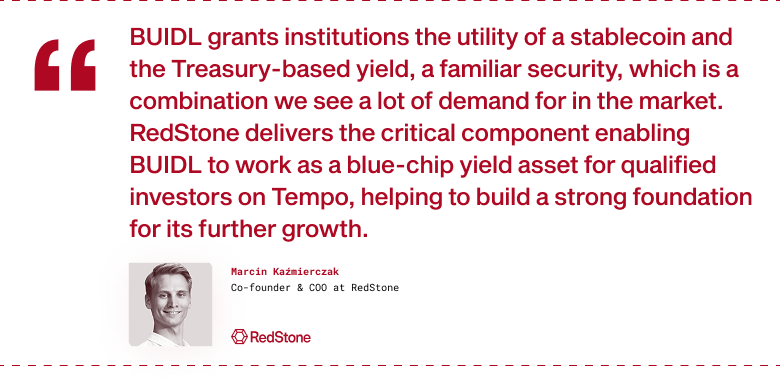
Marcin Kazmierczak, co-founder & COO at RedStone
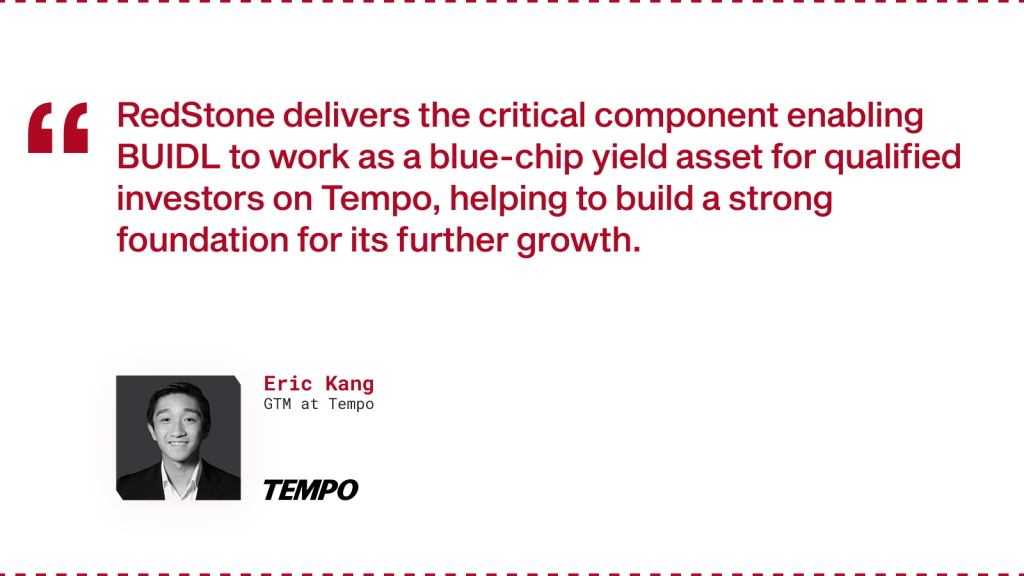
Eric Kang, GTM at Tempo
Frequently Asked Questions
What is BUIDL?
BUIDL (BlackRock USD Institutional Digital Liquidity Fund) is a blockchain-based money market fund launched by BlackRock in partnership with Securitize. It lets qualified investors earn yield from US Treasury bills and repurchase agreements while maintaining a stable $1.00 net asset value.
What is TSSO?
TSSO stands for Trusted Single Source Oracle. It is a cryptographic framework developed by RedStone together with asset tokenization platform Securitize. TSSO is designed to solve a specific problem: how DeFi can price RWAs with prices calculated offchain by a single trusted source such as a fund administrator. Such RWAs can include tokenized mutual funds, private credit, and government treasuries.
Why is BUIDL’s NAV important for DeFi on Tempo?
On Tempo and beyond, pricing an asset is crucial for any DeFi protocol: a DEX must know how the asset trades, a lending protocol must know when a position in this asset is due for liquidation, etc. Without reliable NAV available 24/7, a tokenized money market fund cannot be used in DeFi.