Key Results in Numbers

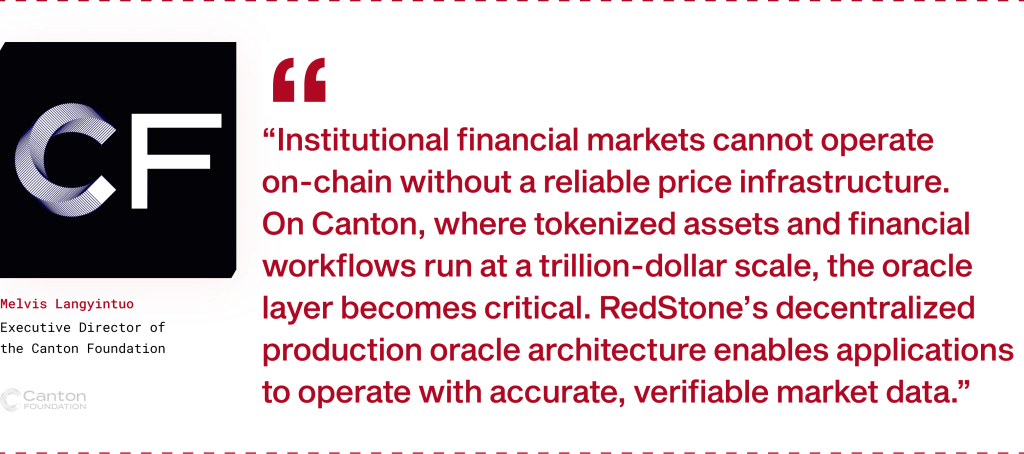
Partner Perspective
What Is Canton Network
Canton Network was designed specifically for institutional financial markets.
Instead of asking banks and asset managers to expose their activity on public blockchains, Canton enables programmable finance while preserving privacy, regulatory compliance, and counterparty confidentiality.
Developed by Digital Asset and powered by Daml smart contract technology, Canton is a purpose-built blockchain for institutional financial markets, designed from the ground up around the constraints that actually govern how the world’s largest financial institutions operate: strict privacy requirements, regulatory compliance, counterparty confidentiality, and the need for programmable automation without public exposure of sensitive data.
It is the only blockchain in production with configurable privacy at the contract level, meaning institutions can participate in shared financial infrastructure without ever revealing positions, strategies, or counterparty relationships to other network participants.
The result is a network where real financial market activity is happening at scale. Canton hosts over $8 trillion in tokenized assets, spanning tokenized real-world assets (RWAs), including U.S. Treasury repos, syndicated loans, money market funds, mortgages, natural gas, and physical commodity settlements. It processes approximately $350 billion in daily volume. The institutions operating in Canton include Goldman Sachs, Broadridge, and a growing base of crypto-native teams, building institutional-grade stablecoins, Bitcoin products, and tokenized fund structures.
Behind Canton stands the most concentrated gathering of institutional capital ever assembled around a blockchain infrastructure project. Digital Asset, the creators of Canton, is backed by DRW Venture Capital, Tradeweb Markets, Nasdaq, S&P Global, Goldman Sachs, and Citadel Securities. In 2025, Digital Asset raised a further $135 million to accelerate Canton’s global expansion.
Canton is where the future of tokenization is being built at scale, with real assets and real counterparties. That is precisely why getting the oracle layer right here matters more than anywhere else.
The Infrastructure Requirement of Tokenization
Tokenization is rapidly expanding beyond crypto-native assets. The onchain real-world asset market has already grown from roughly $5 billion to more than $30 billion, as money market funds, credit instruments, commodities, and structured products increasingly move onto blockchain infrastructure.
But tokenized RWA markets cannot function without a reliable price infrastructure. Collateral management, NAV calculations, and leveraged credit strategies all depend on continuous, verifiable market data.
On Canton Network, where institutions manage trillions in tokenized assets, solving the oracle layer becomes a prerequisite for institutional onchain finance.
The Challenge: The Need For Financial-Grade Oracles Built To Work At Trillion-Scale
Despite Canton’s institutional architecture, one critical infrastructure layer was missing: financial-grade oracle systems.
The challenge was not simply connecting a price feed but building a native oracle architecture compatible with Canton’s privacy model, contract design, and complex asset universe, ensuring stakeholders’ confidence in its fit for their needs.
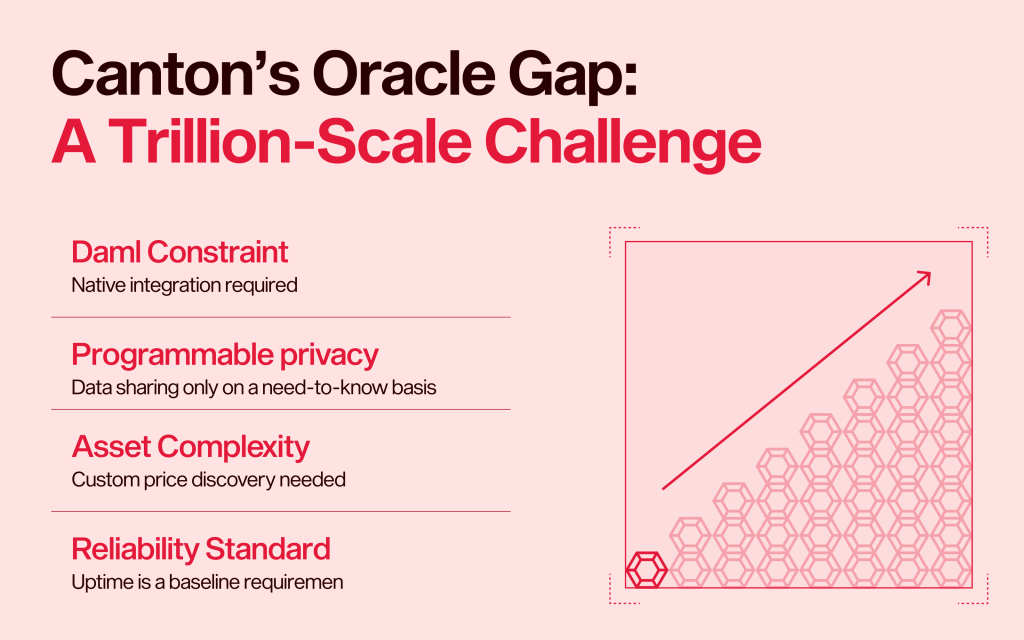
The Daml constraint. Canton runs on Daml smart contracts, a language designed for privacy-preserving institutional workflows. It uses an immutable contract model – the updates archive old contracts and create new ones – and enforces party-specific data visibility. Every oracle integration must be built natively for this model. Lifting a standard EVM oracle configuration and deploying it on Canton is not possible.
Programmable privacy – data sharing only on a need-to-know basis. Canton enables institutions to configure privacy at the smart contract level: each party sees exactly what it needs to see, and nothing more. Institutions program who can see what, preventing exposure of sensitive transaction data without making the network private or closed. Oracle feeds must be designed to support this data segmentation and access configuration. Applications need to automate transactions against live price data without revealing counterparty information, portfolio compositions, or strategy details to other network participants. This is a fundamentally different delivery requirement than a public DeFi price feed, and it cannot be met by an oracle that wasn’t built for it.
The asset complexity. Canton’s tokenized asset universe is not a list of liquid crypto tokens with active spot markets. It includes exotic and illiquid instruments – private credit, syndicated loans, tokenized real estate, Canton-native assets like CBTC and USYC – that require custom price discovery methodologies. NAV calculations for funds must account for how managers actually value assets, not proxies built for EVM chains.
The reliability standard. A missed Ethereum update may trigger a liquidation cascade. A missed update on Canton, where the client base includes institutions managing trillions in regulated assets, could have consequences at a different order of magnitude. Here, uptime is a baseline requirement for remaining on the network.
Without a reliable oracle layer, the full potential of on-chain pricing, collateral management, and leveraged credit strategies remained locked.
Traditional oracle systems were designed for public DeFi markets where assets are liquid, data sources are standardized, and privacy is not a primary concern. Institutional tokenization platforms operate under very different constraints: permissioned access, complex asset valuation, and regulatory auditability.
This is why the oracle layer on Canton required a new approach rather than a standard DeFi integration.
The Solution: RedStone Builds Custom Oracle Infrastructure for Canton
RedStone became the first decentralized oracle provider to deploy production infrastructure on Canton.
Instead of adapting an EVM-first design, RedStone built a Daml-native oracle architecture from first principles, aligned with the requirements of permissioned, institutional-grade systems.
The result is an architecture that supports configurable data delivery, asset-specific price discovery, and reliability standards expected by financial institutions. It operates within Canton’s privacy model, preserving data confidentiality while maintaining real-time performance and verifiability.
This design allows RedStone to integrate natively with Canton’s environment while remaining scalable as transaction volumes and product complexity increase.
It is infrastructure designed for how institutional onchain markets actually operate.
Canton Foundation Membership
On July 24, 2025, RedStone officially joined the Canton Foundation, the cross-industry initiative that supports the development and growth of the Global Synchronizer and facilitates its governance within the Canton Network. Foundation membership signals deep technical and governance integration, not just API connectivity. RedStone is embedded in Canton’s institutional fabric, not sitting on its periphery.
Data Architecture and Flow
External Data Sources (CEX, DEX, TradFi APIs, NAV providers)
↓
RedStone Data Aggregation Layer
(multi-source validation, outlier filtering, signed packaging)
↓
RedStone Oracle Node (Canton Participant)
(Daml-native contract creation, push intervals / pull availability)
↓
Canton Ledger (via Explicit Disclosure)
↓
Application Smart Contracts
(collateral pricing, NAV calculation, margin management, leveraged credit)
Both push and pull oracle models are built for Daml’s immutable contract architecture. Oracle data is delivered via explicit disclosure, a Daml feature that allows reference data contracts to be consumed by application parties without maintaining persistent on-chain visibility at scale. This preserves Canton’s performance characteristics while making live price data available exactly when applications need it.
RedStone serves as a Canton participant node, not an external API adapter, meaning it operates within Canton’s privacy and access control model from the ground up.
Asset Coverage
RedStone’s Canton deployment supports the full asset universe institutions expect to trade and collateralize on-chain:
- Crypto assets – BTC, ETH, and the broader digital asset market
- Equities – U.S. and international stock prices
- Commodities – Physically settled oil, gas, gold, and agricultural commodities
- Foreign exchange – Major and cross-currency FX pairs
- Custom NAV feeds – Configurable net asset value calculations for tokenized RWAl funds, both large-scale asset managers and smaller Canton-native funds
- Canton-native tokens – Custom price discovery for assets like CBTC and USYC that exist exclusively within the Canton ecosystem and have no external reference market
For exotic and illiquid instruments with no standard feed, RedStone configures bespoke price-discovery methodologies in collaboration with the asset issuer. This is the part of the oracle problem that commodity providers cannot address, and where RedStone’s custom integration model provides direct competitive advantage.
Beyond the Oracle: The RedStone Stack
The Canton integration is one expression of a broader infrastructure thesis that RedStone is executing across onchain finance. As markets mature, the requirements extend beyond pricing alone. RedStone has built the RedStone Stack: a unified data and intelligence layer that brings together pricing, liquidation optimization, and credit risk into a single, coordinated system.
At its foundation sits the same infrastructure now powering Canton: ultra-low-latency, multi-source price feeds built with asset-specific methodologies for liquid tokens, LSTs, yield-bearing collateral, NAV-based instruments, and other non-standard assets. The second layer is liquidation intelligence through RedStone Atom, designed to strengthen protocol resilience by reclaiming value that would otherwise be extracted by MEV searchers. The third layer adds real-time, model-driven credit risk ratings onchain through RedStone’s partnership with Credora.
For Canton, this Stack defines the longer-term roadmap. The oracle layer is already live in production. Liquidation intelligence and credit risk infrastructure can extend that foundation as institutional onchain finance grows more complex and more capital-intensive.
The pricing layer is live today. The full Stack is the direction of travel.
Business Impact
Security and Data Integrity
RedStone enters Canton with a proven reliability record. Across more than 200 global deployments, RedStone has recorded zero mispricing events.
Every price update is aggregated from multiple independent data sources, validated against outlier thresholds, and cryptographically signed before delivery. Applications consuming RedStone feeds on Canton can verify data provenance on-chain, which is essential for regulated entities that must demonstrate data integrity to auditors and regulators.
The permissioned design of RedStone’s Canton integration means that price data is available to authorized application parties without being publicly visible, preserving Canton’s core privacy guarantee even as applications execute against live market data.
Institutional Access and Ecosystem Impact
With reliable price infrastructure in place, Canton applications can support the core financial workflows institutions require:
Leveraged credit strategies – Funds can automate collateral calls and margin management against live commodity, equity, and FX prices. Without accurate on-chain pricing, these strategies cannot be safely automated.
Accurate collateral valuations: Institutions posting tokenized assets as collateral need their counterparties to verify the current on-chain value. RedStone’s feeds enable atomic, verifiable collateral pricing within Canton’s privacy model.
Regulated DeFi – Canton is a public, permissionless chain that powers RedStone’s pricing infrastructure. Together, they enable the category of financial products that traditional DeFi cannot serve: compliant, privacy-preserving, institutionally-credentialed on-chain finance.
NAV-based fund products – Canton-native funds can publish and consume accurate net asset values on-chain, enabling automated redemptions, subscriptions, and fund accounting without relying on off-chain calculation processes.
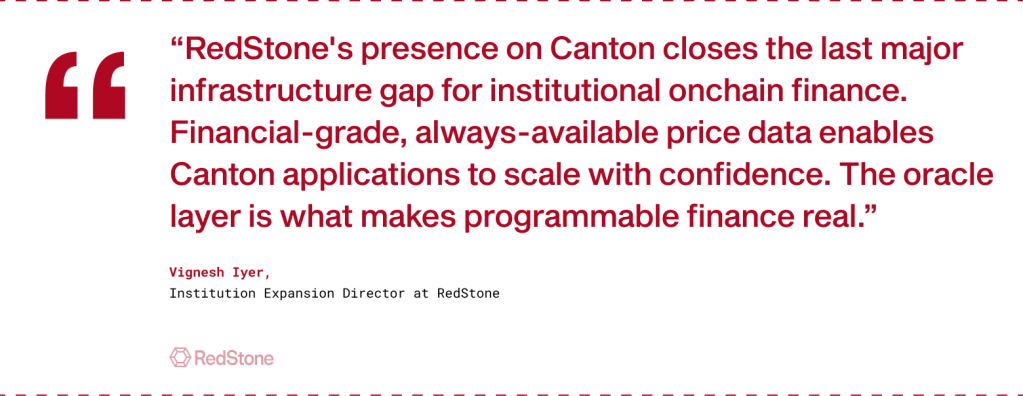
The oracle layer determines whether tokenized finance can operate safely at an institutional scale. On Canton, that layer is live.
TL;DR
- Canton Network hosts more than $8 trillion in tokenized RWA assets and processes roughly $350 billion in daily financial activity, including for institutions such as Goldman Sachs and Broadridge.
- RedStone built the first decentralized production oracle infrastructure on Canton, designed natively for Daml smart contracts and institutional privacy requirements.
- With 100% uptime and zero mispricing events, RedStone enables collateral markets, leveraged credit strategies, and regulated DeFi on Canton.