RedStone has evolved beyond price feeds oracle. The RedStone Stack transforms it into a unified intelligence layer where data, execution, and credit risk analysis operate in alignment, empowering industry professionals to lead innovation in scalable markets.
TL;DR
- RedStone has advanced from an oracle provider to a full-stack infrastructure, combining price feeds, liquidation optimization (OEV via Atom), and credit risk ratings (via Credora) into one integrated system designed for the demands of institutional-grade onchain lending.
- OEV realigns the economics of liquidations, instead of MEV bots profiting from timing gaps in price updates, that value is auctioned and flows back to the protocol.
- Credora partnership brings real-time risk ratings onchain, enabling DeFi lending to move beyond blunt overcollateralization ratios toward genuine credit assessment.
- The stack addresses fragmentation between pricing, execution, and risk intelligence, three systems that previously operated in silos, creating exploitable gaps that contributed to millions in losses.
A thermometer tells you the temperature. It does not tell you a storm is coming.
For years, that was the role of blockchain oracles: precise instruments designed to report prices. But in a $60B+ lending market representing more than half of DeFi’s total TVL, a price feed that updates “often enough” is no longer sufficient.
The RedStone Stack expands that role. Price delivery, liquidation intelligence, and credit risk now operate as parts of a single coordinated infrastructure layer.
For protocols building on it, the shift is structural. It is the difference between knowing an asset’s market price and understanding whether a position is sound within the broader credit system.
Onchain lending already operates at an institutional scale. Its infrastructure must reflect that reality.
How RedStone Stack Works
The RedStone Stack represents a structural shift: from oracle-as-feed to oracle-as-intelligence layer. Rather than treating pricing, liquidation optimization, and credit risk as separate systems maintained by distinct actors, the Stack integrates them into a unified architecture for onchain capital markets that operate continuously and at scale.

The RedStone Stack unifies ultra-low latency price feeds, real-time liquidation intelligence, and risk ratings into a single, vertically integrated infrastructure for onchain finance.
Think of the traditional oracle as a thermometer. It tells you the temperature, but nothing about the storm approaching. The RedStone Stack adds the barometer and weather model, and even an umbrella in the form of OEV, to capture liquidation-related MEV for the protocol.
Layer One: Deterministic Market Data
Every credit market begins with a single assumption: the price of collateral is correct.
This is the foundation of the entire RedStone Stack. Liquidation logic, credit risk assessment, and capital allocation all depend on reliable market data.
RedStone provides the deterministic data infrastructure required by this assumption. The Stack supports multiple delivery models and asset-specific methodologies designed for complex crypto-native markets.
Different assets require different pricing approaches. Liquid staking tokens, restaking assets, and yield-bearing collateral are vulnerable to manipulations when priced using simple spot aggregation. RedStone feeds incorporate dedicated methodologies for LSTs and LRTs, Proof-of-Reserve data where applicable, and market-aware aggregation designed to reflect real liquidity conditions.
For markets where speed is critical, RedStone Bolt enables ultra-low-latency price updates, delivering data as fast as every 2.4ms – over 400 times per second. At the same time, the architecture is flexible enough to support assets that require deeper modeling, reserve verification, or specialized methodologies. The result is a system capable of reliably pricing virtually any asset used as collateral in modern DeFi.
RedStone showed that accurate data does not just protect safety. It unlocks growth, improves user economics, and turns the oracle into a competitive advantage. See the CAP protocol case study for a concrete example of millions saved through a 80% cost reduction with a bespoke implementation.
At this layer, the objective is simple: establish the data foundation on which the rest of the Stack operates.
Layer Two: Liquidation Intelligence
This is where the Stack moves beyond conventional oracle design.
In traditional systems, price feeds and liquidation mechanisms operate as separate components. When a price update creates a profitable liquidation opportunity, MEV bots race to capture the spread. The protocol itself receives none of that value, even though the liquidation event was triggered by its infrastructure.
Liquidation bonuses across major lending protocols typically range from 5% to 15% of the liquidated position. In most systems, that value leaks out of the protocol entirely.
The RedStone Stack introduces a new model, RedStone Atom, that captures Oracle Extractable Value (OEV) and returns it to the protocol. Instead of allowing liquidation opportunities to be passively exploited, Atom structures them as auctions. Searchers compete for the right to act on price updates that trigger liquidations, and the value generated by those events flows back to the protocol treasury or can be used to strengthen the system itself.
But the impact goes beyond value recapture.
Because searchers compete to react to price updates, the system becomes more responsive to real market conditions. Price updates propagate faster, liquidation opportunities are executed closer to true market prices, and risk is reduced before bad debt can accumulate. In this model, liquidation events are no longer a leak in the system’s economics. They become a mechanism that strengthens the protocol’s resilience.
For a deeper technical breakdown of this mechanism, see the RedStone Atom blog.
Layer Three: Risk Ratings via Credora
The top layer is where the stack becomes genuinely novel for onchain markets.
To bring this final layer to life, RedStone partnered with Credora, a risk intelligence provider. This collaboration combines real-time risk ratings with robust infrastructure, making the system more trustworthy and appealing to industry professionals seeking advanced solutions.
Credora brings real-time, model-driven risk ratings into the same system that handles pricing and liquidation. Rather than a protocol relying purely on overcollateralization ratios set by governance committees working from first principles, it can now incorporate dynamic, data-driven risk scores that update as market conditions change.
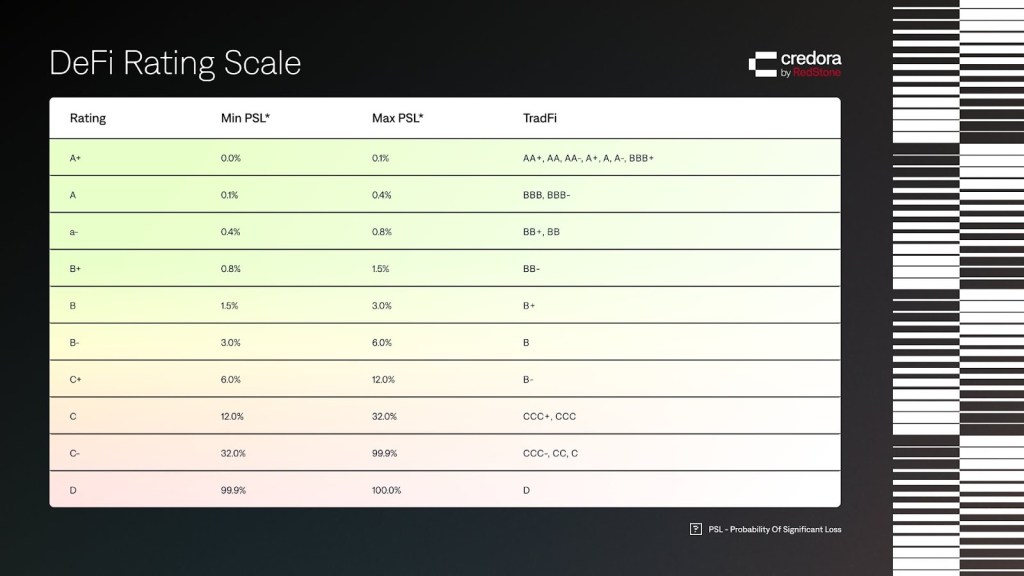
Credora’s DeFi rating scale. A single, quantitative standard for comparing risk across DeFi protocols, assets, markets, and vaults.
In credit markets, information asymmetry between borrowers and lenders is one of the oldest problems in finance. Credora’s ratings layer begins to dissolve that asymmetry on-chain.
In practical terms, the RedStone Stack enables real-time, data-driven credit assessments, reducing information asymmetry and improving risk management in onchain markets.
Credora’s risk models are already being applied across DeFi lending markets, including integrations with protocols such as Spark and Morpho.
What It Looks Like in Practice
Abstract architecture diagrams have a way of concealing what actually matters. Consider three concrete scenarios.
Scenario A: A Volatile Collateral Event
A protocol accepts a mid-cap token as collateral. Late on a Sunday evening, the token drops 40% in 10 minutes. In a traditional system, the price feed updates, liquidation bots notice the opportunity, and a race begins. Some positions get liquidated at poor prices, MEV leaks to searchers, and the protocol’s insurance fund absorbs losses it didn’t need to take.
With the RedStone Stack, the sequence unfolds differently.
Before the event even occurs, the Credora risk layer may have already identified elevated exposure to that collateral class, allowing the protocol to adjust parameters or limits before the drop happens. When the price begins to move, RedStone’s data layer captures the change with minimal latency, ensuring that collateral valuations reflect real market conditions. Finally, when liquidations occur, RedStone Atom structures the process through OEV auctions. Instead of value leaking to opportunistic bots, the liquidation opportunity is coordinated, and the resulting value flows back into the protocol.
Each layer operates at a different moment in the lifecycle of risk: anticipating it, reacting to it, and managing its economic consequences.
Scenario B: Institutional Credit Assessment
Every credit system eventually chooses between two models: the pawnshop or the bank.
Pawnshops lend purely against collateral. Banks lend against an assessment of credit risk. Most DeFi lending today still resembles the pawnshop model.
Now imagine a borrower with a strong credit history in traditional finance wants access to onchain credit that is undercollateralized or lightly collateralized. Without risk infrastructure, a protocol either refuses the product entirely or relies on blunt governance parameters with no underlying signal. With Credora’s ratings integrated directly into the stack, the protocol can offer differentiated rates and terms based on a continuously updated, quantified risk score.
This is underwriting, not just overcollateralization. The difference between a pawnshop and a bank.
Scenario C: A New Protocol Launch
A team building a new lending market faces a classic bootstrapping problem: they need risk infrastructure on day one, before they have historical data or battle-tested parameters. Building the equivalent from scratch, price feeds, liquidation logic, and risk frameworks, is six to twelve months of work and carries substantial security overhead. The RedStone Stack collapses that timeline, delivering production-ready infrastructure from the genesis block.
Why This Changes the Market
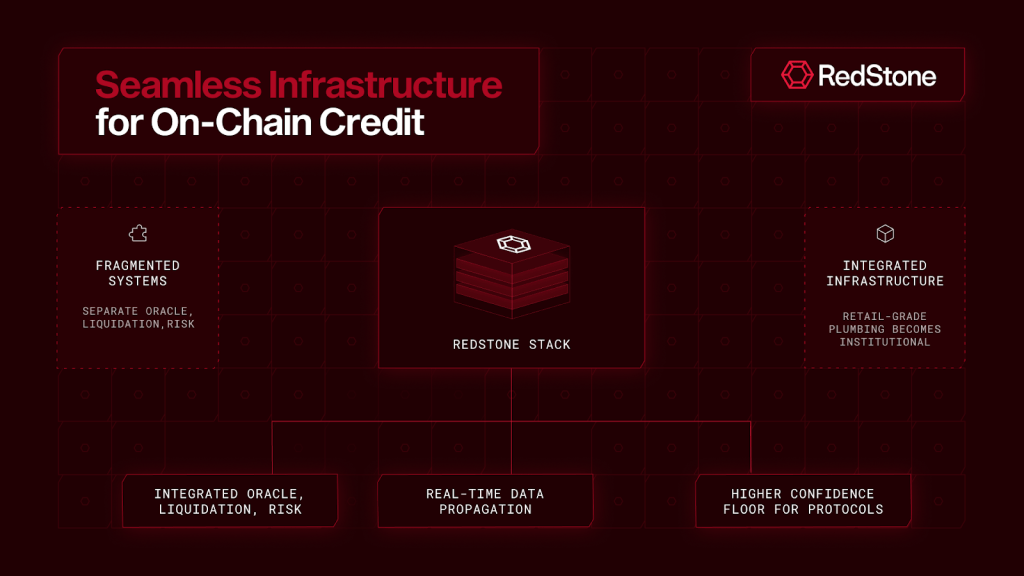
From fragmented systems to an integrated stack, RedStone unifies data, liquidation, and risk into institutional-grade onchain credit infrastructure.
The RedStone Stack tackles the fragmentation caused by separate oracle, liquidation, and risk systems, creating a seamless, communicative infrastructure that reduces operational costs and risk.
But the cost of that fragmentation is measurable.
When pricing, execution, and risk live in separate systems, there are gaps: moments when information hasn’t propagated, when the liquidation engine doesn’t know what the risk model knows, and when arbitrageurs exploit the seams between layers. The RedStone Stack closes those gaps by design rather than by hope.
For protocol teams, this means the ability to build more sophisticated credit products with a higher confidence floor. For users, it means protocols that are harder to exploit and more likely to handle stress events without cascading failures. For the market overall, it means the infrastructure layer is finally catching up to the complexity of what’s being built on top of it. On-chain credit has been trying to do institutional-grade work with retail-grade plumbing. That changes.
The New Infrastructure Layer
A thermometer tells you the temperature. But when a storm is approaching, knowing the temperature alone is not enough.
For much of DeFi’s history, that was the role of the oracle: a precise instrument reporting price. It worked when markets were small and credit systems were simple.
Today, onchain lending operates at an institutional scale.
The next phase of DeFi will not be defined by whether financial primitives can run onchain. That question has already been answered. The question now is whether these markets can withstand stress, coordinate incentives, and manage risk as they grow.
The RedStone Stack is designed for that next phase. By combining deterministic market data, liquidation intelligence, and quantified credit risk into a single architecture, it transforms the oracle from a passive data courier into infrastructure that helps markets anticipate and respond to the storms ahead.
Because a multi-billion-dollar credit system needs the full weather model.