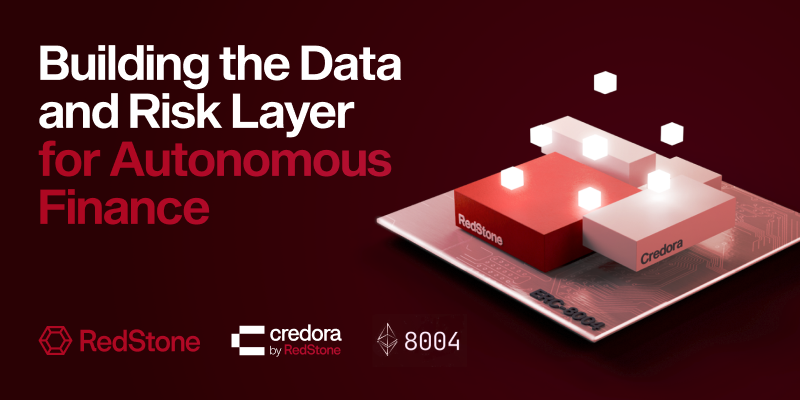
Inside the infrastructure layer powering data and risk intelligence for 10,000+ AI agents on Ethereum
Consider this scenario: An AI agent is managing a $10 million DeFi portfolio, making real-time trading decisions, rebalancing positions across a dozen protocols, and executing complex arbitrage strategies.
The question is: How does anyone verify its competence?
Not in an abstract, philosophical sense, but in the immediate, practical sense. How does another agent trust it? How does a lending protocol know this agent won’t drain liquidity? How does a DEX aggregator verify that this agent’s routing algorithm actually optimizes for users rather than extracting value?
There’s no way to verify whether this agent has ever successfully done this before. No way to know if it’s been managing portfolios for six months or six minutes. No way to check if its last trade made $100,000 or lost everything.
Every interaction is an unproven hypothesis with serious capital at stake. No identity. No track record. Just code, executing strategies, hoping for the best. This has been the fundamental challenge holding back the agent economy: every agent interaction has been like a blind date with serious capital at stake.
ERC-8004 solves this.
The Solution: Identity and Reputation for Machines
On January 29, 2026, ERC-8004 went live on Ethereum mainnet, introducing something the agent economy has desperately needed: a permanent, verifiable identity system for AI agents.
Think of it as a social contract, but for machines.
Authored by Marco De Rossi from MetaMask, Davide Crapis from the Ethereum Foundation, Jordan Ellis from Google, and Erik Reppel from Coinbase, and refined through feedback from over 80 teams, ERC-8004 introduces three interconnected registries that transform anonymous code into accountable economic actors.
First: Identity
Every agent registers by minting an NFT. That’s it. Simple, elegant, tamper-proof. The token ID becomes the agent’s unique identifier across the entire ecosystem, and points to an “agent card,” a standardized file containing everything you need to know: what the agent does, how to reach it, which validation methods it supports, and where it receives payments.
But here’s what makes this powerful: the identity is portable. For the first time, an agent can build a track record in one ecosystem and carry that credibility to another.
Second: Reputation
After every interaction, clients can submit structured feedback on-chain. Performance metrics. Success rates. Response quality. All tagged, timestamped, and permanently recorded.
This goes beyond a simple review system for robots. It creates an immutable audit trail that can’t be gamed, can’t be deleted, and can only be responded to.
Third: Validation
For high-stakes operations where reputation isn’t enough, the Validation Registry enables third-party verification of agent work. The registry simply records what was validated, by whom, and the result.
Think of it this way: there’s a difference between “this agent says it can execute complex arbitrage strategies” and “this trusted validator confirmed the agent actually executed this specific strategy successfully.” That difference is everything.
The Ecosystem Has Already Materialized
The numbers tell a compelling story.
During three months on testnet, the ecosystem registered 10,000+ agents and exchanged 20,000+ feedback entries. Before the mainnet launch, community-built scanners, SDKs, and tooling had already emerged organically.
The ecosystem today spans agent frameworks, validation infrastructure, identity providers, DeFi protocols, and Layer 2 networks.
Together with x402 (the standard for programmable agent-to-agent payments), ERC-8004 creates something we’ve never seen before: an economy where AI agents discover one another, verify their track records, and purchase services from each other, all completely autonomously.
Sumeet Chougule, Founder of ChaosChain, captured it perfectly: “Without ERC-8004, AI agents are just code. With it, they’re accountable economic actors. This is the unlock.”
The Data Layer: Making Identity Actionable
Identity and reputation solve the trust problem. But autonomous agents need more to actually operate effectively.
An AI trading agent with a verified identity and solid reputation still needs to know: What’s the current price of this asset? Is this protocol safe to interact with? What’s the risk profile of this yield farming strategy?
The agent economy requires real-time information and sophisticated risk assessment to function.
This is where RedStone and Credora’s collaboration with ERC-8004 comes in. We’re providing the foundational data and risk infrastructure that enables agents to make informed decisions within this new trust framework.
RedStone: Real-Time Data That Agents Can Trust
Think of RedStone as the data-physics engine for autonomous finance.
When an AI trading agent needs to know the current price of an obscure DeFi token, or the exchange rate between two emerging assets, or the volatility metrics for a complex derivative, RedStone provides that information instantly. But it’s how we deliver this data that matters for an agent-driven economy.
Legacy oracles use a push-based architecture that constantly broadcasts data, creating significant on-chain noise. It’s a firehose of information when what an agent needs is a laser.
RedStone’s flexible architecture is designed to meet the diverse needs of the on-chain economy. For protocols that require traditional, continuous on-chain data, our push model provides a constant stream of verifiable information.
However, for the hyper-efficient agent economy, our pull model is the perfect fit. Instead of a firehose of data, agents get a precision laser that requests exactly the data they need, the moment they need it.
Credora: The Risk Intelligence Layer
If RedStone provides the data, Credora provides the understanding.
When an autonomous agent is deciding whether to deploy capital into a yield farming strategy, it needs more than current prices. It needs to assess whether the protocol is actually safe, evaluate the credit quality of borrowers, and understand the systemic risk if liquidity suddenly dries up.
Credora provides institutional-grade risk ratings for DeFi protocols and assets. These are credit scores for smart contracts. The ratings incorporate on-chain metrics, off-chain data, protocol audits, team reputation, historical performance, liquidity depth, and dozens of other factors. The result is a comprehensive risk profile that enables informed decision-making, not just fast ones.
Why This Combination Matters
Here’s what makes the RedStone + Credora stack unique: risk-aware autonomous decision-making. Most data providers give you information. We give you understanding.
The difference is this: we don’t just tell an agent what the market is doing. We explain what it means, the risks, and the trade-offs.
This matters because the Ethereum Foundation has identified trading agents as the primary use case for ERC-8004. There are already 40-50 teams building in this category. And every single one of them is trying to solve the same problem:
How do you build an agent that trades effectively without exposing users to risk?
The answer requires more than better algorithms. It demands better information architecture. Real-time price data combined with sophisticated risk assessment, delivered through a standardized interface, available from day one on mainnet.
That’s what we’re providing.
The Paradigm Shift in DeFi Users
The next generation of DeFi users won’t be human.
They’ll be autonomous agents, operating 24/7 across global markets, executing strategies too complex for manual management and coordinating activities across dozens of protocols simultaneously. Managing portfolios, providing liquidity, hedging risks, rebalancing positions, optimizing yields, all without waiting for human approval.
This is happening right now.
The mental model of blockchain infrastructure centered around individual humans is becoming outdated. The paradigm is shifting from “how do we make DeFi easier for humans?” to “how do we build DeFi that works for autonomous agents?”
ERC-8004 answers the identity question. X402 answers the payments question. RedStone and Credora answer the information question.
What We’re Building
From a broader perspective, what’s emerging here is a living, self-organizing system where agents communicate, coordinate, and transact based on shared standards and verifiable information.
ERC-8004 provides the identity layer. X402 provides the payment rails. RedStone provides the real-time data infrastructure. Credora provides the risk intelligence.
Together, these components form the foundational infrastructure for a financial system that can operate autonomously, transparently, and accountably.
This goes beyond replacing human activity. It’s about augmenting human economic capability with autonomous systems that can operate at scales, speeds, and complexities that would otherwise be impossible.
The goal is credibly neutral infrastructure, open to all, controlled by none. Infrastructure that enables the next generation of financial innovation by providing essential tools, without attempting to predict or control what that innovation will look like.
The Agent Economy Begins
The agent economy is no longer theoretical. It’s no longer confined to whitepapers or testnet experiments. It’s live, it’s growing, and it’s accelerating.
The question isn’t whether autonomous agents will become major economic actors. They already are. The relevant question is whether the infrastructure exists to support them responsibly, transparently, and effectively.
Through the collaboration between ERC-8004, RedStone, and Credora, that infrastructure is being built, block by block, agent by agent. The agent economy isn’t coming. It’s already here. The only question is whether you’re building for it.
Learn More:
- ERC-8004 Standard: 8004.org
- RedStone Documentation: docs.redstone.finance
- Credora Network: @CredoraNetwork
About RedStone: RedStone is a leading blockchain oracle provider, delivering fast, cross-chain data feeds to power DeFi protocols and institutional applications. As the oracle of choice for real-world asset tokenization, including BlackRock’s BUIDL fund and European treasury assets via Spiko, RedStone bridges traditional finance with on-chain infrastructure. RedStone offers the industry standard for secure pricing and quality support, serving as the market leader for emerging ecosystems and institutional use cases.
About Credora: Credora provides independent, data-driven risk ratings for on-chain finance. By standardizing risk measurement across assets, lending markets, and vault strategies, Credora enables transparent, resilient capital allocation. Through quantitative modeling, stress testing, liquidity analysis, and governance assessment, Credora converts complex protocol mechanics into comparable risk signals, supporting the sustainable growth and institutional adoption of on-chain markets.