Inside the blockchain oracle layer, pushing MegaETH into top-tier throughput from day one of mainnet.
MegaETH’s public mainnet went live this week. RedStone shipped with it.
Two systems came online at the same time: one enabling real-time execution on the chain, the other providing real-time data to the applications built on top of it. From the very first block, MegaETH was producing live markets, powered by RedStone push-based pricing for the industry’s largest assets.
As blocks started flowing, RedStone Bolt-driven oracle transactions followed, pushing MegaETH to top-tier throughput across the Ethereum ecosystem. Real-time data for real-time DeFi, from the first block.
Today, RedStone is already deeply embedded across MegaETH, having been chosen as the primary oracle layer by a growing set of MegaETH-native DeFi protocols and consumer-facing apps shaping the ecosystem’s first wave.
This post breaks down how that alignment happened, what it tells us about where DeFi is going, the kind of infrastructure it will need to get there, and why RedStone was built for exactly that world. The real-time world.
RedStone’s Footprint in the MegaETH Ecosystem
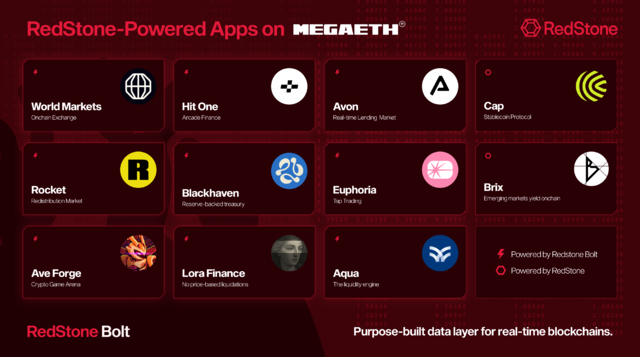
RedStone is currently integrated with a broad cross-section of MegaETH-native projects, including:
Hit.one · WorldMarkets · Avon · CapMoney · Brix Money · AveForge · Euphoria · Rocket · Blackhaven · Aqua · Lora Finance
This provides horizontal coverage across the lending, trading, yield, and consumer UX layers.
When protocols with different risk profiles converge on the same oracle layer, it usually signals two things: the oracle is trusted for the most critical paths of protocol execution, and the developer experience is strong enough to become the default choice.
Why RedStone Bolt Became the Standard on MegaETH
Traditional push price feeds are constrained by two factors:
- slower block times on early blockchains
- the gas costs of pushing data onchain
On Ethereum mainnet today, push oracles typically deliver ETH/USD price updates roughly 40–60 times per 24 hours. This works for low-frequency DeFi, but becomes a bottleneck for high-throughput execution environments.
MegaETH is architected for speed. Its execution layer can process block orders of magnitude faster than Ethereum L1. To unlock that performance for DeFi, the oracle layer has to operate at the same tempo.
RedStone Bolt does.
In practice, Bolt streams price updates into every MegaETH block, making it approximately 576,000x faster than corresponding push feeds on Ethereum mainnet. Instead of batching updates every few minutes or waiting on deviation thresholds, Bolt keeps prices continuously in sync with the market.
This is why Bolt ended up powering the most risk-sensitive protocols first, and then spreading horizontally across the ecosystem.
How Bolt Achieves Real-Time Oracle Performance
RedStone Bolt achieves its performance through a fundamental re-imagining of oracle architecture.
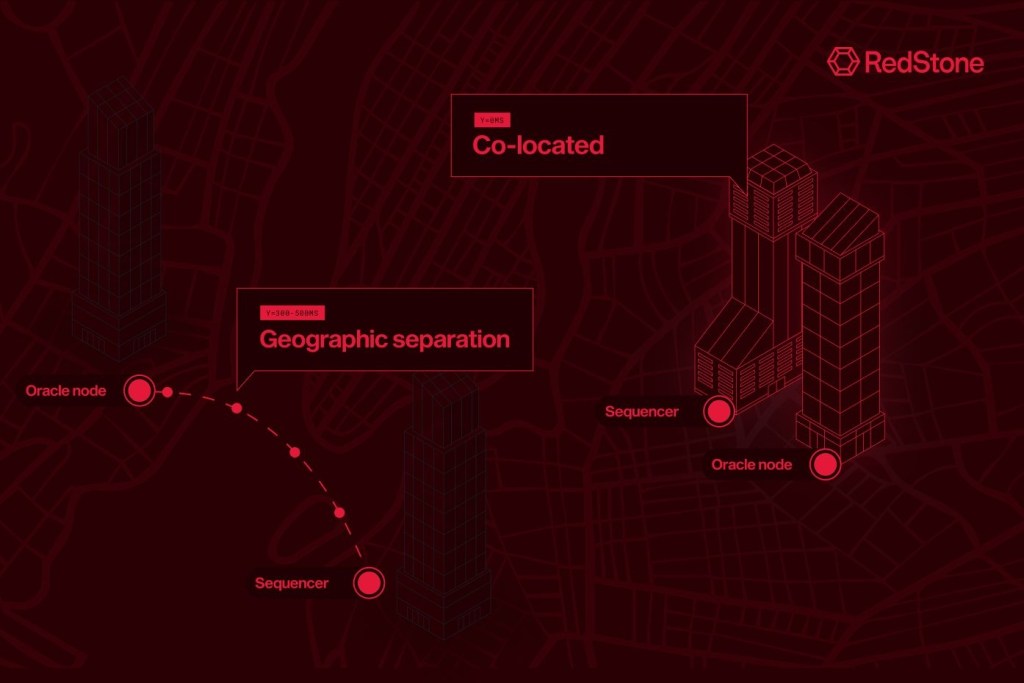
Physical co-location with the execution layer eliminates oracle latency as a factor. The data arrives where execution happens, at the moment execution happens. Source: X Article by @MarcinRedStone.
Bolt nodes are geographically co-located with MegaETH sequencer nodes to minimize infrastructure-level latency. Rather than waiting for offchain reporting windows or heartbeat intervals, Bolt nodes monitor live trading activity directly on major venues such as Binance, Coinbase, OKX, Bitget, or Kraken.
This market data is streamed via high-speed gateways directly into MegaETH nodes. The result is that every incoming MegaETH block receives the latest price state, keeping the chain continuously synchronized with real-world market movements.
The Oracle Network Effect and Its Benefits for the MegaETH Ecosystem
Once multiple major protocols in one ecosystem standardize on the same oracle layer, second-order effects emerge:
- Shared reliability assumptions: Builders can reason about oracle behavior across apps, reducing integration friction.
- Composable risk models: Money markets, perps, and yield protocols reference the same data source, enabling safer cross-protocol strategies.
- Ecosystem-level safety: When pricing and liquidation logic share an oracle backbone, systemic risk becomes easier to model and stress-test.
In the MegaETH ecosystem, RedStone provides the go-to data infrastructure that other infrastructure is built on. RedStone Bolt acts as the common pricing engine for the ecosystem.
This topology usually emerges after an ecosystem matures. MegaETH is getting there unusually early.
What This Signals for MegaETH
The convergence of MegaETH-native protocols on RedStone suggests:
- Teams are optimizing for execution performance, not just compatibility
- Builders are shipping pricing-sensitive products early
- The ecosystem is architected for high-throughput finance from the start
As MegaETH scales liquidity and user volume, RedStone’s role compounds:
- more volume → more oracle demand
- more protocols → stronger standardization
- deeper integration → stronger oracle entrenchment
Signals of Trust From Builders Shipping at Speed
Infrastructure choices in early ecosystems aren’t made lightly.
When teams build liquidation engines, money markets, and trading venues from day one, the oracle layer becomes a core dependency.
Across MegaETH, teams consistently cite the same reasons for choosing RedStone:
- confidence in the RedStone engineering team
- fast iteration cycles and direct technical support
- production-proven oracle design
- reliability under real throughput conditions
- alignment with MegaETH’s real-time execution model
Teams building fundamentally different products converged on the same oracle layer because they trusted both the technology and the people operating it.
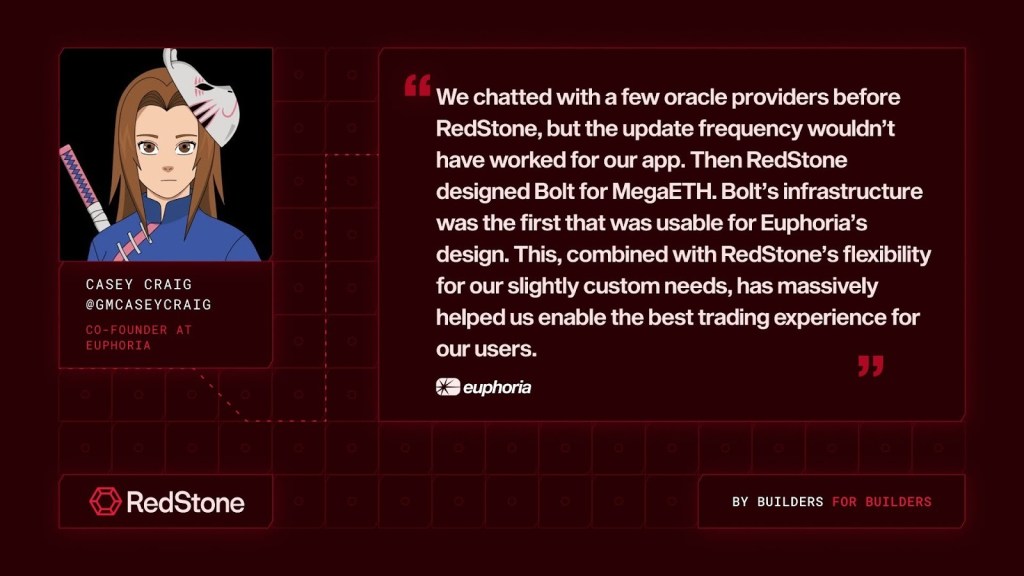
Euphoria prioritized enabling innovative DeFi with real-time prices. Thanks to Bolt’s architecture and custom solution, they achieved this goal.

Kevin Kap from World Markets on their experience with RedStone Bolt, the fastest blockchain oracle on MegaETH.
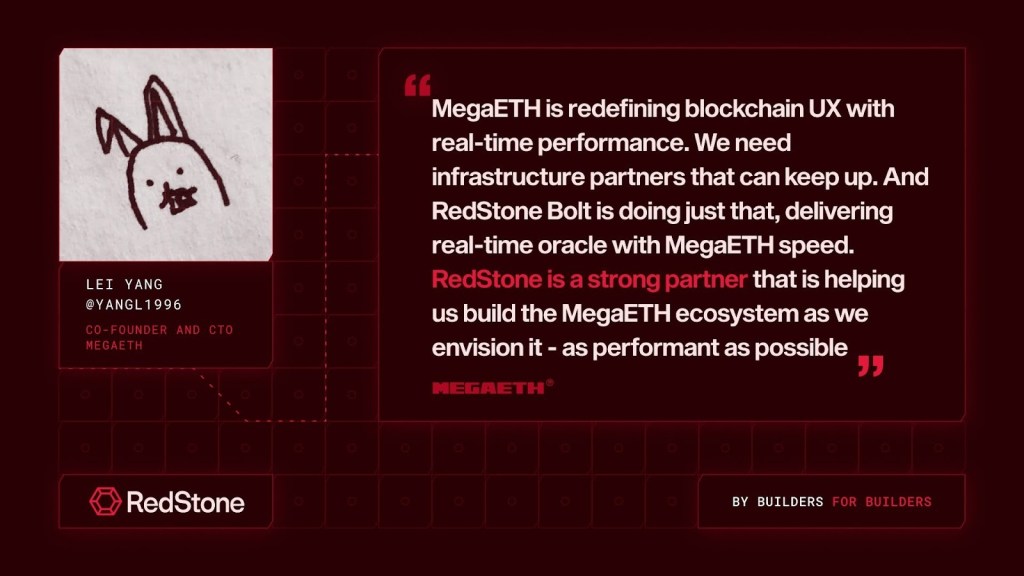
A quote on RedStone Bolt from Lei Yang, @yangl1996, CTO and co-founder of MegaETH.
This layer of trust is what turns early integrations into long-term infrastructure commitments. In fast-moving ecosystems, teams usually commit to what they believe will still be reliable as usage scales and failure modes become more complex.
MegaETH launched with real-time execution; RedStone launched with real-time data
As MegaETH scales, the oracle layer becomes the system’s bottleneck or its catalyst. It’s where throughput either compounds into usable performance or collapses back into theoretical capacity.
What’s emerging today is standardization around an oracle model that matches the chain’s tempo.
Today, that standard is increasingly RedStone Bolt.
And the MegaETH ecosystem is starting to build as if real-time DeFi is the default, not the exception.