TL;DR
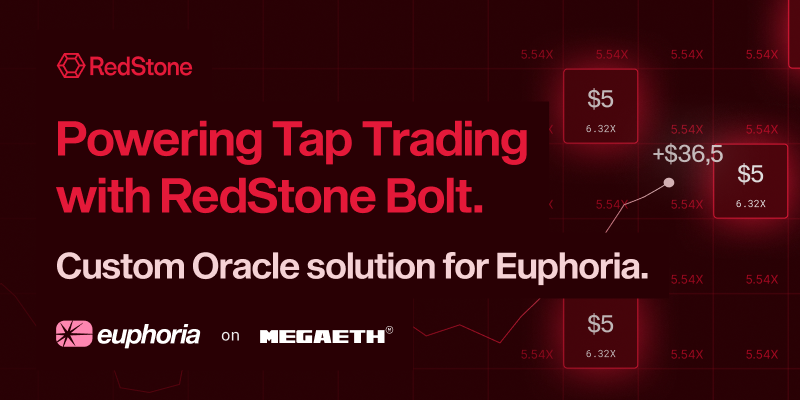
- Euphoria enables tap-based trading where milliseconds impact the user experience.
- Legacy oracles are not designed for real-time execution environments.
- RedStone has developed a custom oracle solution specifically for Euphoria.
- RedStone built Euphoria’s OHLC candles directly at the data layer using RedStone Bolt.
- This integration reduces execution risk and enables deterministic trading on MegaETH.
Introduction: Why Real-Time Trading Breaks Traditional Data Models
In most DeFi systems, users interact with markets that move faster than the underlying infrastructure. Blocks finalize, prices update, and charts refresh, but rarely at the same pace.
This mismatch is usually tolerable. For long-horizon trades, lending, or liquidity provision, a few seconds of delay rarely changes outcomes.
Tap-based trading is different.
Euphoria Finance is designed around instant user actions. When a user taps to trade, execution, price visibility, and risk exposure collapse into a single moment. Any delay between market movement and price data becomes a direct source of slippage or mispricing.
On real-time execution environments like MegaETH, this problem becomes more pronounced. Execution can occur faster than traditional oracle systems are able to update.
A delayed high or low can distort risk calculations. A stale price can turn a tap into unintended slippage. Downstream candle construction introduces ambiguity about what the market actually looked like at execution time.
These are data integrity issues.
This creates a structural question:
How do you represent market reality accurately when both users and chains operate in real time?
Building OHLC at the Oracle Layer
To address this, RedStone developed a custom oracle solution for Euphoria using RedStone Bolt.
Rather than delivering occasional snapshots, Bolt computes prices multiple times per second directly from exchange sources. These prices are aggregated into short, fixed windows that capture actual market movements as they occur.
Critically, OHLC candles are constructed at the data layer, not inferred later by the application.
For each supported asset, RedStone produces dedicated feeds for:
- the latest price
- the window high
- the window low
Each value is cryptographically signed and independently verifiable.
This shifts OHLC data from an approximation to a first-class primitive.
Real-Time Streaming and Deterministic Execution
Once produced, signed data is streamed to Euphoria in real time. This architecture removes several common sources of latency:
- no waiting for downstream aggregation
- no reconstruction from partial snapshots
- no ambiguity about candle boundaries
For users, this means the price they see is aligned with the price the protocol uses for execution.
For the system, it enables deterministic behavior under rapid market movement, a requirement for safe tap-based trading.
Technical Implementation
The integration extends RedStone Bolt nodes to compute spot prices at sub-second intervals while simultaneously aggregating deterministic, non-overlapping short windows to produce signed high and low values.
For each asset, three distinct feeds are generated: the latest price, window high, and window low (e.g., ETH, ETH_HIGH, ETH_LOW), with window timestamps fixed at the exact end of each aggregation period. All values are cryptographically signed, encoded as standardized transaction payloads, and streamed in real-time via a secure MQTT layer, where current prices are broadcast at sub-second resolution and window high and low values are published at the close of each aggregation window.
In parallel, all signed outputs (values, timestamps, feed IDs, signatures) are persisted in DynamoDB, enabling direct historical access through native AWS tooling without downstream reconstruction or reinterpretation.
Implications for Euphoria Finance
With real-time OHLC data available at the oracle layer, Euphoria can support:
- ultra-low latency tap trading
- reduced execution and oracle-induced risk
- consistent, verifiable market representation
- trading behavior that remains synchronized with real-time chain execution
What This Integration Signals for DeFi Infrastructure
As execution environments evolve, data layers must evolve with them.
Real-time blockchains expose the limits of oracle architectures built for slower systems. When execution accelerates, delayed or reconstructed data becomes a source of systemic risk.
Euphoria pushes MegaETH’s execution layer toward real-time interaction. RedStone Bolt ensures the data layer keeps pace.
The result is not a new feature, but a tighter alignment between execution and market truth.
Conclusion
The RedStone – Euphoria integration demonstrates how oracle design must change as DeFi moves toward real-time execution.
By constructing OHLC data directly at the oracle layer and streaming it continuously, RedStone removes latency, ambiguity, and hidden risk from tap-based trading.
This approach does not speculate on future behavior. It addresses a present constraint in real-time financial systems.
RedStone’s role is to make market data precise, verifiable, and aligned with execution. Even when milliseconds matter.