Key Takeaways
- Solana has become a dominant force in onchain finance. The network delivers 400ms transaction finality at $0.001 median cost, maintained 100% uptime for +1.5 years, and processed $38B in peak daily DEX volume. The next frontier is lending markets. Robust money markets on Solana represent the clearest path to a trillion-dollar DeFi economy, and the infrastructure is ready now.
- Solana’s lending markets hold $3.6B in TVL as of December 2025, up 33% from $2.7B a year prior. Competition is intense. Protocols can capture category leadership within six months of launch, a pace unmatched in other ecosystems. New entrants continuously deploy and iterate, deepening market liquidity and pushing innovation forward.
- DeFi strategies on Solana have reached institutional-grade sophistication. Gauntlet, a premier risk curator, manages $140M across model-tested leverage strategies and advanced delta-neutral positions spanning multiple protocols on the network. User experience has evolved in parallel. The CASH vault exemplifies this shift: a Gauntlet-curated strategy on Kamino, delivering sophisticated yield with consumer-grade simplicity.
- The next wave of growth centers on tokenized real-world assets and institutional capital deployment. The sector is aligned on this trajectory. Bringing traditional finance onchain at scale can unlock trillions in Internet Capital Markets. Solana’s infrastructure is positioned to capture a significant share of this expansion.
Credora DeFi Ratings Are Expanding On Solana
Request Ratings Today: https://www.credora.network/
Featured Projects and Organizations
| Solana Money Markets Ecosystem | |||||
| Money Markets | Curators1 | Asset Issuer Stablecoins | Asset Issuer Liquid (Re)Staking Tokens | Asset Issuer Crypto Blue-Chips | Asset Issuer Tokenized RWA |
| Kamino | Gauntlet | Circle (USDC & EURC) | Jito (jitoSOL) | Coinbase (cbBTC) | Securitize (BUIDL & ACRED & VBILL) |
| Jupiter Lend | SteakhouseFi | Tether (USDT) | DoubleZero (DZSOL) | Wormhole (wETH) | Ondo (USDY & OUSG) |
| Drift | Allez Labs | Maple’s (SYRUPUSDC) | Sanctum (INF) | Zenrock (zenZEC) | OnRE (ONyc) |
| Loopscale | MEV Capital | Phantom (CASH) | Jupiter (JUPSOL) | Sunrise (MON) | BackedFi (TSLAx & CRCLx & NVDAx etc.) |
| Save | Sentora | Global Dollar (USDG) | Marinate (MSOL) | Hastra (PRIME) | |
| marginfi | Sky (USDS) | Drift (DSOL) | Huma (PST) | ||
| PayPal (PYUSD) | |||||
| Solstice (USX) | |||||
1: Note, read this table vertically (column-by-column), not horizontally (row-by-row). The curator names, lending markets etc. are separate unordered lists – there is no concrete relationship between items in the same row across different columns.

Two-Day Online Conference, Feb 2026
Solana Network: Racing Against Physics
For crypto natives, Solana needs no introduction. If you’re newer to the space, check out our recent Real-World Assets (RWA) on Solana Report for a solid intro. It breaks down what makes Solana special and why its builders say their only real competition is the laws of physics.
When Solana launched in 2020, the main narrative circled by the crypto community was simple: Ethereum killer. By late 2025, Solana has moved far beyond any such comparison. The Solana ecosystem has become one of the most innovative onchain environments out there, home to builders completely revamping how we think about what’s possible on blockchain across a variety of use cases. It’s carving out its own onchain story across multiple verticals, from e-commerce and payments to entirely new categories only possible in an onchain environment. The network is building toward a “Decentralized Nasdaq” trading narrative while leading core DeFi primitives like onchain-first yield creation.
What makes Solana truly unique is its pragmatic, open approach to building the best onchain environment possible. If collaborating with competitors leads to better infrastructure, Solana doesn’t hesitate. Status quo barriers don’t matter here. This philosophy shows up clearly in a statement from Lucas Bruder, co-founder and CEO of Jito Labs, one of Solana’s most prominent ecosystem projects. His take: you should be able to trade every asset on Solana, even competitor tokens. And that’s exactly what’s happening.
Major stablecoin issuers like Circle and Tether have been aggressively minting USDC, EURC and USDT on Solana, alongside the development of Solana-native products such as Solstice’s USX, bringing over $15 billion in stablecoin supply now on the network according to DeFiLlama, cementing its position as a go-to hub for fiat-denominated DeFi activity. Solana’s activity profile has shifted dramatically. What was once predominantly high-velocity speculative trading has evolved into serious onchain finance, with a new frontier of DeFi emerging through fierce competition among innovators. This competition spans decentralized exchanges, lending markets (money markets), and perpetual exchanges. It’s not just the core primitives driving this transformation, but also the financial incentives drawing more ecosystem players to build dedicated solutions on Solana, bringing real market depth to Internet Capital Markets.
Blue-chip crypto assets such as wSOL, cbBTC, wETH are increasingly finding Solana as a major trading venue, which opens up more opportunities with increased market depth for leverage strategies on money markets, such as looping. The size of Solana’s DeFi pie is growing vertically in this dimension. Keel emerged as an onchain capital allocator through Sky’s Star program and is now establishing itself as Solana’s capital engine. Real-world asset tokenization is another major growth area. Securitize brought its RWA platform to Solana in early 2025, with BlackRock’s BUIDL fund, VanEck’s VBILL and Apollo’s ACRED private credit token both launching on the network. Ondo has been having a lot of success with its treasury-backed products OUSG and USDY. Tokenized stocks provided by Backed Finance are seeing growing asset coverage, trading volume, and money market strategies available through platforms like Kamino. Solana is also becoming a preferred venue for trading L1 tokens from other chains and deploying DeFi strategies on them. When Monad launched its mainnet in November 2025, Solana immediately became one of its major trading venues. Other than that, privacy coins like Zcash are finding new life on Solana as well, with wrapped ZEC hitting over $15 million consistent daily trading volume within the first weeks of launch.
This all leads to the prolific and expanding lending markets, or in other words money markets ecosystem, which is the foundational DeFi primitive that powers further growth and enables users to generate yield on their assets. That is the main subject of this report.
Lending Markets: Liquidity is King
Let’s start with a quick detour into Solana’s market structure, because it says a lot about how different this ecosystem is.
On EVM chains, we’ve watched the same players dominate for 3-4 years straight. Uniswap leads DEXs, followed by Curve, Aerodrome, and Balancer. Lido owns liquid staking, with Ether.fi, Rocketpool, and Puffer.fi competing for the remainder. Aave holds the largest share of money markets, with Morpho, SparkLend, Euler, Fluid, and Compound operating as established alternatives. The pattern is consistent across categories: established leaders rarely get displaced.
Solana DeFi doesn’t work like that. Competition here is brutal, and market leaders change quarter by quarter. The recent wave of prop AMMs (HumidFi, SolFi, GoonFi, Tessera, ZeroFi) went from niche experiments to major players almost overnight. Liquid staking? No single protocol locks down the market. Instead, you get a distributed playing field where multiple providers such as Jito, DoubleZero, Sanctum, Jupiter, Binance, Marinade and Drift actually compete for dominance.
Lending markets tell a similar story, though with a twist. Kamino led the category for a while, but that dominance is now being challenged. Capital is ruthlessly efficient on Solana. The introduction of Jupiter Lend and other players trying to grab a bigger piece of the pie has heated up competition considerably. This is an ecosystem where you can literally become a category leader in sometimes as short as six months.
The total TVL locked within Solana’s lending markets reached $3.6B as of December 2025 according to DeFiLlama data, representing 33% YoY growth from $2.7B in December 2024.
Note: Individual protocol TVLs listed below sum higher than $3.6B because DeFiLlama eliminates double-counting when borrowed capital flows between protocols.
Understanding Solana’s money markets means understanding a place where nothing is settled and liquidity genuinely rules. Let’s look at the key players.
Kamino Lend
Kamino dominates Solana’s lending landscape with $3.5 billion in TVL as of December 2025, operating a modular architecture that conceptually resembles Morpho’s DeFi-as-infrastructure approach, though built fully independently with Solana’s unique ecosystem at its core.
The protocol’s May 2025 v2 upgrade introduced a two-layer structure: a permissionless Market Layer enabling instant creation of isolated markets with custom risk parameters, and a Vault Layer featuring Curated Earn Vaults managed by expert risk managers such as Gauntlet, Steakhouse Financial, Allez Labs, MEV Capital and Sentora. This curator model allows specialized risk managers to optimize returns with vaults built on different risk parameters, ranging from very safe strategies to highly leveraged approaches, reflecting how Kamino’s base layer infrastructure enables diverse DeFi primitives to be built on top.
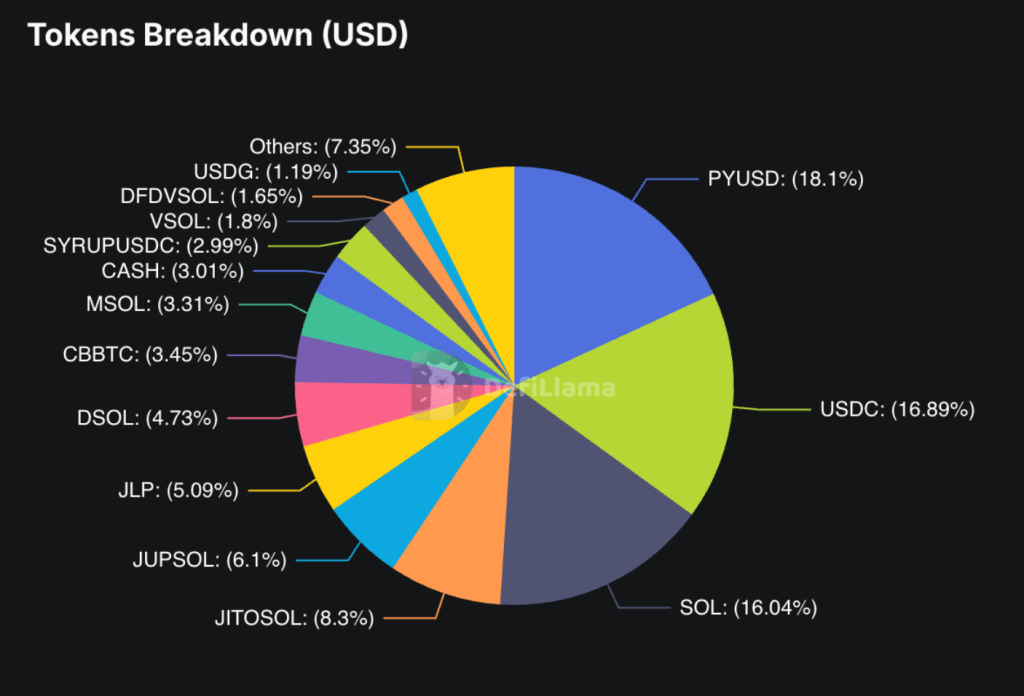
Source: DeFillama
Kamino’s comprehensive vertical integration spans Kamino Lend, Kamino Swap, and Kamino Liquidity, creating a full-stack DeFi suite where users can access multiple products under one trusted brand. This integration creates powerful user stickiness by allowing users to perform all essential DeFi operations without leaving the platform, from lending and borrowing to swapping and liquidity provision, strengthening Kamino’s competitive moat in an increasingly crowded market. The protocol has doubled down on real-world assets, launching high-profile collaborations including PRIME with Hastra and Figure, sACRED (a tokenized Apollo private credit fund tokenized via Securitize), and Huma’s PST. Kamino’s v2 launch attracted significant deposits in long-tail asset markets, with the majority of Maple’s syrupUSDC supply on Solana flowing to the platform. The protocol maintains zero bad debt since inception across 18 audits and formal verification, positioning it as Solana’s battle-tested institutional choice despite Jupiter Lend’s aggressive growth challenging its dominance.
Jupiter Lend
Jupiter Lend stormed onto the scene in late August 2025, amassing $1.65 billion in TVL within months and becoming the fastest-growing money market in Solana history. Built in partnership with Fluid (a dominant Ethereum DeFi heavyweight now expanding to Solana), Jupiter Lend introduces a fundamentally different architecture: the Fluid model uses isolated vaults with rehypothecation to achieve capital efficiency while compartmentalizing risk. Each vault maintains independent configs, liquidation thresholds, and caps, though assets are rehypothecated across vaults to generate yield on collateral. Jupiter Lend’s aggressive LTV ratios (up to 95%) and ultra-low liquidation penalties (as low as 0.1%) are enabled by a bespoke liquidation engine that processes all positions in a single transaction, dramatically reducing bad debt risk. The protocol supports 40+ vaults spanning stablecoins, wrapped BTC, LSTs, and JUP itself as collateral, with automated routing optimizing returns for lenders. Jupiter Lend’s explosive growth stems from its integration with Jupiter’s broader DeFi superapp ecosystem, which includes the DEX aggregator commanding 95% of Solana’s routing volume, perpetuals trading, portfolio management, and now lending. This vertical integration creates powerful network effects where users can borrow and instantly swap or trade perps within one interface. The platform benefits from substantial incentive campaigns totaling $2M+ from Jupiter, Fluid, and partners, attracting nearly $1.7 billion in the six months since inception.
Competition Drives Innovation
Building on the principle that liquidity is king in money markets, competition on Solana has reached fever pitch as protocols wrestle to capture and retain capital.
In early December 2025, Kamino implemented a program-level block preventing users from refinancing their positions to Jupiter Lend via the latter’s new Refinance tool, sparking intense debate about open finance principles versus competitive moats. The block emerged after Jupiter COO Kash Dhanda initially claimed “zero contagion risk” between Jupiter Lend vaults, which Kamino co-founder Marius and Fluid co-founder Samyak Jain later challenged by revealing that rehypothecation creates cross-vault exposure where lenders face recursive borrower risks. Dhanda subsequently acknowledged the “zero contagion” claim was not “100% correct,” admitting limited contagion risk exists due to rehypothecation, though vaults remain isolated at the asset level with independent risk parameters. Kamino justified the block by citing concerns over Jupiter’s risk model transparency and potential user confusion about cross-contamination risks, while Jupiter supporters framed it as anti-competitive behavior aimed at protecting market share. Despite the controversy and technical revelations about rehypothecation mechanics, Jupiter saw $13 million in daily net flows on December 6, 2025, suggesting a subset of users remained confident in the protocol’s risk management.
The situation underscores how fierce the battle for lending dominance has become, with every protocol leveraging its advantages to maximize opportunity in Solana’s rapidly expanding DeFi ecosystem.

Source: Token Terminal
Drift
Drift launched v3 on December 4, 2025, delivering 10x faster trade execution and cementing its position as one of the leading Solana perpetual DEXes. While primarily known for derivatives trading (perps and spot with margin), Drift also operates integrated money market functionality with cross-margin lending and borrowing across its unified account system. Users can deposit assets like USDC, SOL, and ETH to earn yield while simultaneously using these deposits as collateral for trading positions, creating capital-efficient cross-margined exposure. Drift’s lending feature automatically compounds interest and allows borrowers to access liquidity in an overcollateralized fashion, with all positions managed through the protocol’s sophisticated risk engine. The v3 upgrade brought execution speeds under 400 milliseconds for 85% of market orders and began testing the Drift Liquidity Provider Pool (DLP), enabling permissionless liquidity provision for both perp and spot markets while earning yield from trading activity. Drift’s unique value proposition lies in combining high-performance derivatives trading with integrated money market operations, allowing users to maximize capital efficiency by using a single collateral pool across multiple financial primitives.
Loopscale
Loopscale represents a paradigm shift in Solana lending with its order book-based architecture, departing radically from traditional pool models. With $124.9 million in TVL and $40 million in active loans, the protocol enables lenders to create customized loan offers specifying exact terms, rates, collateral requirements, and durations. Borrowers then match against these offers in a peer-to-peer fashion, facilitating true fixed-rate lending without the rate volatility inherent in utilization-based pool systems. Loopscale’s modular marketplace excels at supporting exotic assets that struggle in conventional lending markets, including RWA tokens (like OnRe’s ONyc), AMM LP positions, JLP/MLP tokens, and variety of LSTs (representing over $7 billion in market opportunity on Solana). The protocol standardizes loan terms through its structured, proprietary framework while enabling efficient order matching mechanisms, and offers automated leveraged yield strategies powered by flash-loan technology.
Loopscale has facilitated over $480 million in lending volume during its evolution, positioning itself as critical infrastructure for institutional users and specialized assets requiring granular risk control.
The order book model represents an intriguing alternative to pool-based lending, with Morpho on the EVM side of things announcing similar architecture in their v2, signaling growing confidence in the approach. However, the model remains relatively unproven at scale, and whether the industry will adapt to its peer-to-peer mechanics over the familiar pool-based systems remains an open question. Loopscale’s innovation is noteworthy, but its long-term success will depend on overcoming adoption barriers as the market adjusts to this fundamentally different lending paradigm.
Save & marginfi
Save (formerly Solend) retains $300 million in TVL as one of Solana’s OG lending protocols, operating a straightforward algorithmic pool model akin to Aave. The protocol offers permissionless pool creation and has pivoted toward simplicity and reliability as its core value proposition. However, despite being among the earliest movers in Solana lending, SAVE has struggled to capture a meaningful share of recent growth, watching newer entrants like Kamino and Jupiter Lend rapidly eclipse its position.
marginfi carved out a niche with its multi-market structure featuring interconnected core asset markets, isolated pools for higher-risk tokens, and dedicated liquid staking collateral options. The protocol emphasizes sophisticated risk management systems and has integrated deeply with Solana’s DeFi stack. Yet despite these innovations, marginfi has similarly been unable to retain competitive positioning against the aggressive growth of better-capitalized rivals. Its role as the core lending venue within Project 0’s prime brokerage platform could provide a catalyst for renewed growth, though execution remains critical.
Both protocols underscore a fundamental truth of Solana’s money market landscape: no position is permanent, and past innovation offers no protection against well-executed competition. In an ecosystem where liquidity begets liquidity and network effects compound rapidly, even established protocols can find themselves struggling to maintain relevance as the market consolidates around dominant players.
Keel (Sky Protocol’s Onchain Capital Allocator)
Keel launched in late September 2025 as Sky’s (formerly MakerDAO) third autonomous “Star” unit, bringing a massive up to $2.5 billion allocation roadmap to Solana’s money markets.
Crucially, Keel is not itself a money market protocol but an onchain capital allocator that sits between Solana DeFi protocols and the broader financial ecosystem spanning DeFi, CeFi, and institutions tokenizing real-world assets, making it one of the most prominent players within the money market sector through its capital deployment activities. Funded directly by Sky’s USDS stablecoin reserves, Keel dynamically allocates capital across lending markets, stablecoin swap liquidity, and tokenized RWAs to generate sustainable yield while catalyzing ecosystem growth.
The protocol functions as Solana’s “liquidity engine,” providing the institutional-scale capital that DeFi platforms need to bootstrap and scale their operations. Keel represents a shift in DeFi infrastructure: rather than competing with money markets, it acts as a strategic liquidity partner, directing billions in liquidity to promising protocols while bridging TradFi and DeFi through its focus on high-quality tokenized assets and RWA integration. This positions Solana as a leading marketplace for internet-scale capital markets while simultaneously boosting market depth, generating uncorrelated yield for Sky’s DAO, and diversifying Sky’s operations beyond its primary EVM-based activities.
Vault Curation on Solana: Gauntlet Case Study
Gauntlet provides yield opportunities on Solana for over $140 million in TVL across Kamino and Drift.
Drift Vault Strategies
Gauntlet helps engineer and calibrate sophisticated perpetual vault strategies on Drift. Vaults deploy funds into a liquidity provider position (Jupiter’s JLP pool) that earns trading fees/funding yields. The vaults then take short perpetual futures positions on Drift (BTC, ETH, SOL contracts) to hedge out market exposure, rendering the overall position delta-neutral.
In essence, Gauntlet built a capital-efficient and market-neutral trading strategy overlay on multiple assets, relying on Gauntlet’s quantitative risk models to dynamically rebalance the portfolio as market conditions change.
Kamino Curation
Beyond bespoke vaults on Drift, Gauntlet is also instrumental in curating broader lending and yield infrastructure on Solana through partnerships like Kamino Finance. Kamino operates Solana’s largest unified lending platform, and Gauntlet was recently onboarded as an official vault curator to bring its risk-management expertise to Kamino’s user-facing vaults. Two Gauntlet-managed lending vaults – USDC Prime (stablecoin yield) and SOL Balanced (SOL lending) – have gone live on Kamino, offering transparent, optimized yield to depositors while Gauntlet’s backend systems handle strategy allocation and risk controls.
CASH Earn Vault
Phantom, the leading Solana wallet, recently launched CASH in collaboration with Bridge and Stripe. CASH is a fiat-backed, USD-pegged stablecoin issued by Bridge through Stripe’s Open Issuance platform. As an open, neutral, fully-backed asset designed for real-world utility, CASH gives developers and users a simple, reliable way to move dollars at Solana speed.
Within the Phantom ecosystem, CASH underpins Phantom Cash, Phantom’s new suite of consumer-focused money features that make crypto work like everyday money. Today, Gauntlet curates the CASH vault on Kamino.
By entrusting Gauntlet-curated vaults to manage the underlying deposits, Solana users can earn yield on their CASH with institutional-level risk management behind the scenes.
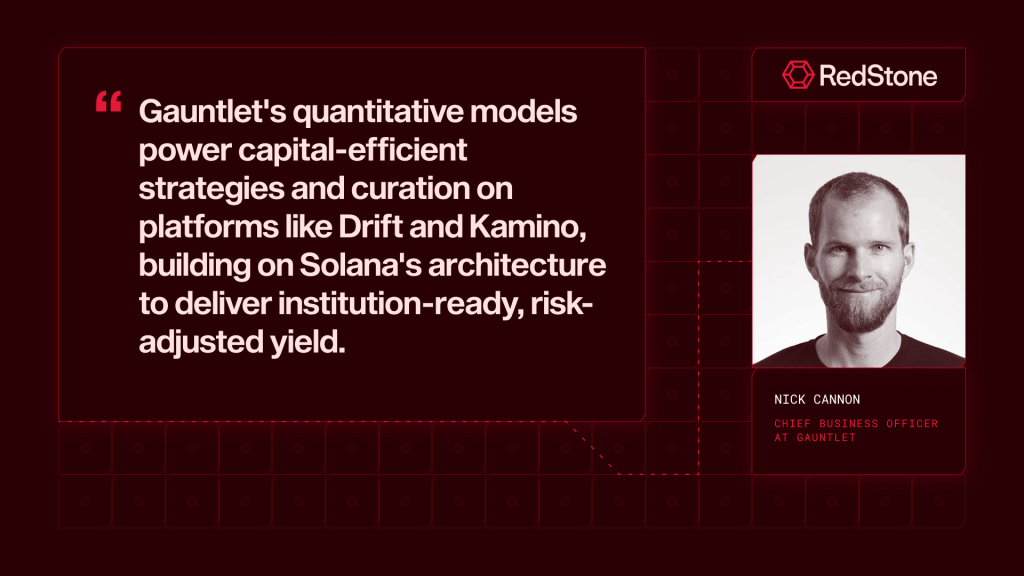
This involvement not only benefits individual protocols and users but also adds confidence for larger capital allocators: professional risk calibration and active management are making Solana DeFi’s yield opportunities more institution-ready. In total, Gauntlet now helps manage over $1.5 billion across DeFi vaults, applying its quantitative models for volatility targeting and cost minimization to Solana’s fast markets.

Source: Kamino
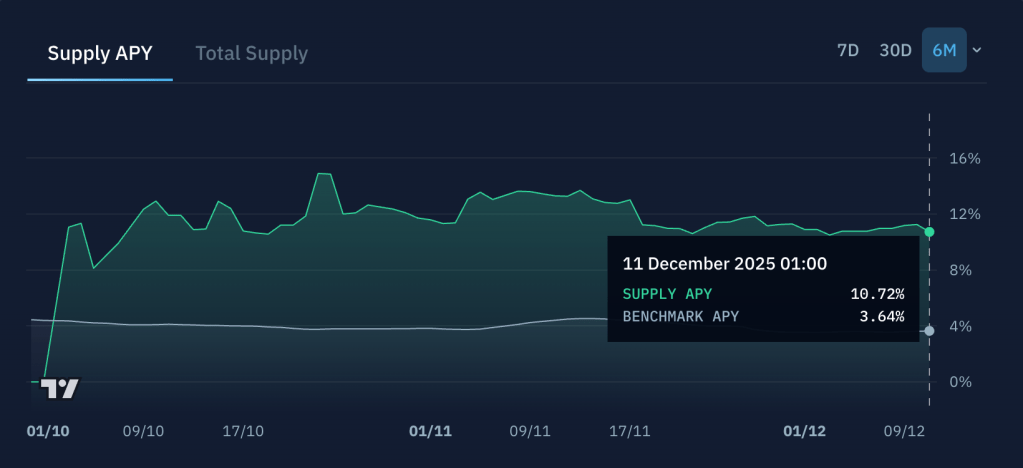
Source: Kamino
What’s Next for Solana DeFi
Solana DeFi has survived the trenches. From the 2020 launch through network outages, FTX collapse, and the “$8 and left for dead” moment, the ecosystem proved it could weather storms that would have sunk lesser chains. But survival isn’t the goal anymore. Solana is now competing for a spot in the premier league of institutional blockchain infrastructure, where the real game isn’t about memecoin velocity but about which rails will move trillions in tokenized assets.

On one hand, Solana’s ecosystem is filling out the same core primitives (lending pools, DEXs, perpetual futures, collateralized stablecoins) that exist in the EVM world, suggesting some convergence in terms of available primitives. Initiatives like Kamino’s lending markets or Drift’s margin trading features are analogous in functionality to protocols operating on Ethereum mainnet and across layer 2 chains.
On the other hand, Solana’s technical features suggest a path of architectural divergence. Its specialization is rooted in its monolithic architecture, which enforces a single, unified state and enables synchronous composability. This capability guarantees that complex, multi-step financial interactions, such as lending, derivatives trading, and instantaneous liquidations, settle atomically within a single block, maximizing capital efficiency across the entire ecosystem. This focus on real-time execution and speed is paramount, with the network aiming to reduce settlement finality to approximately 150 milliseconds, thereby addressing the stringent latency requirements of institutional algorithms.
A key structural advantage appealing to institutional capital is Solana’s unique approach to risk and cost management. Unlike global fee market structures, Solana utilizes local fee markets combined with a low base fee. This predictability is non-negotiable for institutions, as it ensures that extreme market volatility or high-volume activity in an unrelated sector (such as memecoin trading) does not create effective outages by spiking transaction costs for critical financial applications.
This predictable environment is also essential for the reliable operation of algorithmic systems, such as the complex Hedged JLP (HJLP) basis trade strategy that Gauntlet runs on Drift, which requires continuous, low-cost rebalancing. Furthermore, Solana’s use of the Gulf Stream protocol structurally mitigates Maximal Extractable Value (MEV) opportunities, offering higher market integrity for large-volume, high-value transactions.
Given these foundational strengths, Solana could establish itself as a definitive leader in institutional DeFi, particularly if catalyzed by a concentrated influx of TradFi capital. Its architecture is explicitly prepared to absorb and deploy massive liquidity with maximum efficiency and minimal execution risk. This readiness is validated by tangible institutional commitments: global financial players including Visa, PayPal, Stripe, and Western Union have already selected Solana for their payment rails.
Sustained institutional flows into Solana ETFs further confirm that regulated finance views the network as the specialized, production-grade backbone for future high-speed capital markets.
Market Depth Reaching Institutional Scale
The final piece is coming together: onchain market depth capable of handling institutional-scale capital flows. Multiple protocols are building this infrastructure simultaneously. The thesis is straightforward. Institutional capital needs scale capacity, rate stability, and credible counterparties.
Keel’s instantly scalable balance sheet is designed to provide deep liquidity at speed, addressing the capacity constraints that have historically limited institutional participation. It’s worth noting some structural challenges remain. Solana’s lending markets have seen impressive growth, but the ecosystem is still maturing and facing obstacles.

Kamino is actively expanding RWA, working with qualified curators to bring TradFi-correlated assets onchain where they can be used in leveraged strategies that would be practically impossible in traditional finance due to regulatory complexity and legacy operational constraints. Maple’s loan origination protocol is seeing significant growth on Solana, demonstrating demand for institutional-grade credit products. Securitize’s presence is bringing additional legitimacy to tokenized asset issuance.
When institutions can access deep, elastic liquidity that absorbs demand spikes, the risk of getting stuck in illiquid positions drops dramatically. This creates a snowball effect. More liquidity attracts more institutional capital, which deepens markets further, which stabilizes rates and reduces volatility. Each new participant strengthens the infrastructure for everyone else, building a competitive moat that’s difficult for other chains to replicate.
The ETF-Enabled Basis Trade Machine
Solana ETF approvals this year opened a door that most market participants are still figuring out how to walk through. The basis trade, a staple of crypto institutional strategies, just got significantly more accessible and more profitable on Solana. Here’s why it matters: institutions that can only touch regulated products can now run delta-neutral strategies by pairing Solana ETF exposure with SOL futures on regulated venues like CME.
JitoSOL makes this particularly interesting. Instead of holding plain SOL as the spot leg, institutions can hold JitoSOL (either spot onchain or wrapped in ETF vehicles) and capture a staking yield of around 7% APY on top of whatever basis they’re earning from the futures curve. You’re essentially stacking two yield sources in a single hedged position. For asset managers used to grinding out 50-100 basis points of alpha, a double-digit yield on a market-neutral position looks transformative. This is notably more lucrative than the equivalent Ethereum trade, where staking yields sit around 3-4%. The higher base yield on Solana actually justifies the additional risk of using an LST instead of the vanilla asset.
The DeFi layer adds another dimension. These basis trade structures can be automated and wrapped into DeFi strategies, making them accessible beyond institutional desks. More sophisticated users can bootstrap additional yield by layering in DeFi-specific risk exposures.
The key advantage: DeFi risk is transparent. Every smart contract, every collateral position, every liquidation parameter is onchain and auditable. Users know exactly what they’re dealing with before committing capital.
Compliant Rails for DeFi
Tokenization became one of 2025’s defining narratives. The market moved past debating whether it matters to executing actual deployments. But getting assets tokenized is just step one. The real opportunity unlocks when these tokenized assets can leverage DeFi rails for capital efficiency. Traditional finance operates with massive friction: settlement delays, custody chains, collateral immobilization. DeFi removes those constraints and enables something more powerful.
Once a Treasury bill or corporate bond is tokenized on Solana in a regulated fashion, it can be used as collateral in lending markets and looped through leverage strategies that DeFi has battle-tested for years. This matters especially for assets without established liquid markets in TradFi – private credit, structured products, niche debt instruments. These assets traditionally can’t be levered efficiently because the market infrastructure doesn’t exist. Onchain, they leverage the same liquidity rails as everything else. Taking a 4% yield asset and looping it to 9% through controlled leverage might seem standard to DeFi natives, but for institutions managing exposure to less liquid instruments, this represents a massive capital efficiency unlock. The yields compound, the strategies are transparent and auditable onchain, and the risks are clearly defined.
While tokenization has surged dramatically in 2025, the reality is that crypto-native assets still drive the vast majority of DeFi activity. That won’t change overnight. Despite the industry’s long-term vision of tokenizing traditional finance, crypto-native assets will continue to provide the deepest liquidity and most active markets in the near term. The tokenization thesis is real and accelerating, but the foundation of Solana’s DeFi economy remains firmly rooted in native digital assets.

Multiple platforms are racing to establish the standard for compliant tokenization. R3’s Solana Toolkit targets the next trillion dollars of RWAs with infrastructure designed for regulated institutions. Securitize brings its own frameworks and compliance approach. This competition is healthy. Different institutions have different requirements, and having multiple credible paths to tokenization increases the likelihood that major capital allocators find a structure that works for their mandates.

The collective goal is the same: bring tokenized traditional assets onto Solana where they can interact with DeFi protocols while maintaining regulatory compliance. When institutions can use tokenized government bonds as collateral to borrow stablecoins, or deploy Treasury bill tokens into automated yield strategies, capital efficiency jumps dramatically. This is where tokenization meets its actual use case. Not just digital representations of assets, but those assets actively participating in a composable, permissionless financial system.
Internet Capital Markets Everywhere
Internet Capital Markets isn’t just a tagline for Solana’s builders – it’s the actual goal.
All finance, running on Solana rails. Money market TVL surged this year, but numbers alone miss the point. What matters is the fierce competition and constant building across every corner of onchain finance, with new protocols attacking problems that didn’t even have clear product-market fit yet. Traditional institutions are moving in because they recognize what’s been built: deep liquidity, technical advantages, and a pace of innovation that simply doesn’t exist elsewhere.
References
- The official documentation for all the described projects
- DeFiLlama. Analytics Platform. Accessed 2025. https://defillama.com
- Token Terminal. Analytics Platform. Accessed 2025.
- Solana. Internet Capital Markets. Accessed 2025. https://solana.com/pl/solutions/tokenization
- Internet Capital Markets on Solana: The RWA Report Q4 2025. https://blog.redstone.finance/2025/09/29/solana-rwa/
- Orb Explorer. Markets Analytics Platform. Accessed 2025. https://orb.helius.dev/markets?category=majors
- Jito Network. JitoSOL and ETFs. Blog. Accessed 2025. https://www.jito.network/blog/jitosol-and-etfs/
- Helius. Solana Ecosystem Report H1 2025. Blog. Accessed 2025. https://www.helius.dev/blog/solana-ecosystem-report-h1-2025