Key Takeaways
- Solana has emerged as one of the leading platforms for onchain finance through massive engineering efforts by core contributors. The network processes transactions with average 400ms finality at median costs below $0.001, maintained 100% uptime over the past 12 months, and achieved $35.9B in peak daily DEX volume. These technical achievements make Solana a natural fit for expanding the Real-World Assets (RWA) category.
- RWA represents one of the fastest growing sectors in onchain finance. RWA tokenization exploded from $5B in 2022 to over $31B by September 2025, representing 600% growth excluding stablecoins. Solana hosts nearly $700M in RWAs and over $13.5B including stablecoins, achieving nearly 500% year-over-year growth. This positions Solana as one of the biggest networks when it comes to tokenized assets.
- Solana uniquely hosts both popular crypto-native applications like Phantom, Raydium, Jupiter and Pump.fun alongside major financial institutions including BlackRock, Apollo Global, Janus Henderson and VanEck issuing tokenized funds on the network. This demonstrates Solana’s versatility and early validation of its potential as a unified execution environment for global financial activities. Internet Capital Markets.
- Solana’s DeFi ecosystem stands as one of the most innovative across all networks. The combination of speed, performance, and battle-tested programs securing billions since 2021 enables its dApps to lead industry innovation. RedStone, a leading oracle provider on Solana, secures the first RWA DeFi markets on both Drift Institutional and Kamino.
Join Solana Ecosystem at APEX – Singapore 30th Sept 2025 🇸🇬
RedStone Acquired Credora, Creating The Biggest DeFi Ratings Platform
X:https://x.com/redstone_defi/status/1963594835933499711 LinkedIn:https://www.linkedin.com/feed/update/urn:li:activity:7369361228638457859/
Request Ratings Today:https://www.credora.network/
Sign up for RedStone Summit♦️
Two-Day Online Conference, Jan 2026
Featured Projects and Organizations
RedStone, as the author of the report, would like to express true gratitude to all the contributors, projects, and key opinion leaders who helped us create such a comprehensive piece on the Solana RWA landscape.
| Solana RWA Ecosystem | ||||
| Stablecoins | U.S. Treasuries | Private Credit & Onchain Equities | RWA Infrastructure | dApps |
| Circle (USDC) | BlackRock (BUIDL) | Apollo (ACRED) | R3 | Phantom |
| Tether (USDT) | Ondo (USDY) | Hamilton Lane (SCOPE) | Securitize | Raydium |
| Global Dollar (USDG) | Ondo (OUSG) | Maple (syrupUSDC) | Ondo | Jupiter & JupLend |
| First Digital(FDUSD) | VanEck (VBILL) | Backed Finance (xStocks) | Centrifuge | HumidFi |
| Paypal (PYUSD) | OpenEden (TBILL) | SuperState | Superstate | Drift |
| Circle (EURC) | Etherfuse (USTRY) | Republic | Paxos | Kamino |
| Sky (USDS) | Superstate (USTB) | KAIO | Loopscale | |
| Agora (AUSD) | Franklin Templeton (BENJI) | RedStone | Keel | |
| KAIO (UMA) | Gauntlet | Jito | ||
| Steakhouse Financial | Sanctum | |||
| Marinate | ||||
Solana Network: Racing Against Physics
“Our competition is physics,” declares Solana’s Foundation. This bold statement captures what made the Solana blockchain fundamentally different from the start. Rather than accepting conventional wisdom around blockchain limitations, Solana engineers asked a different question: what if we could push the theoretical limits of distributed computing itself?
Born from this engineering-first mindset, Solana emerged as the first high-performance non-EVM network to prove a point. An entirely different category of blockchain could not only exist but thrive as a compelling alternative operating system. While the EVM approach had established the dominant paradigm for smart contract platforms, Solana demonstrated something new. Purpose-built architectures could unlock entirely different possibilities for onchain applications.
The Solana Labs founders led by Anatoly Yakovenko, coming from telecommunications and distributed systems backgrounds, built a system around maximizing the blockchain throughput and minimizing the latency (Increase Bandwidth, Reduce Latency or IBRL Movement), while allowing for permissionless validator participation and open network access. Instead of retrofitting existing distributed designs, they created Solana design completely from the ground up to be able to serve an initially targeted use case of “decentralized Nasdaq“.
Solana hasn’t been an overnight success. It required an astronomical amount of development resources before and after its official launch. The network faced significant uptime difficulties due to network congestion in its early days. Mert Mumtaz, founder of Helius and one of the most prolific Solana ecosystem figures, has openly acknowledged that Solana outages may still occur, stating in a February 2024 Decrypt interview that future outages are “likely going to happen again” and that “once Firedancer goes live, there will likely be some unforeseen issues in mainnet,” viewing this as an inevitable part of pushing the boundaries of blockchain infrastructure development. The network also faced ecosystem challenges during the broader crypto market turmoil of late 2022. However, many believe these technical and ecosystem obstacles ultimately strengthened the network and bonds between ecosystem builders. They attracted developers genuinely committed to pushing the boundaries of distributed systems engineering. This fostered a startup-like culture that produced Solana’s first successful wave of decentralized applications.
The future trajectory is even more compelling. With continuous development pushing toward 1 million transactions per second via improvements such as the new Alpenglow consensus architecture, Multiple Concurrent Leaders (MCL), and optimized block propagation methods by research organizations includingAnza, Jump Crypto, and Solana Labs, Solana is positioning itself as the internet-scale financial infrastructure layer. This vision extends far beyond the cryptocurrency industry into the foundational rails for Internet Capital Markets.
Today, Solana processes transactions at avg. 400ms finality with median costs below $0.001, maintained 100% uptime over the past 12 months, and achieved $35.9B in peak daily DEX volume, source: Solana. These metrics speak volumes about Solana’s ability of handling billions of transactions across DeFi, payments, and increasingly, Real-World Assets (RWAs).
The RWA sector represents the ultimate proof point for this thesis. As highlighted in the Real-World Assets in Onchain Finance Report, “RWA tokenization is estimated to grow to trillions of USD capitalization by 2030 according to BCG and Standard Chartered projections.”
Today’s numbers start to tell the very same story. RWA tokenization exploded from $5B in 2022 to over $29B by September 2025 (nearly 600% growth, excluding stablecoins, data: RWA.xyz). This makes it one of crypto’s fastest-growing sectors. The tokenization spans everything from fiat currencies in the form of stablecoins to public equity and commodities to private credit funds and treasury debt. This acceleration is happening rapidly across jurisdictions worldwide. Including the stablecoins vertical that already represents a gigantic +300$ billion market capitalization at its peak in 2025.
Solana sees this opportunity clearly and is capturing meaningful market share. The network already hosts over $13B in tokenized real-world assets as of September 2025, representing a massive 350% year-over-year growth. This success stems from Solana’s unique combination of technical capabilities and institutional-grade infrastructure. Solana enables sophisticated tokenized instruments to operate extremely efficiently on its network and be leveraged in the fast-growing DeFi ecosystem.
The institutional validation is already evident. Stripe, Visa, PayPal, Apollo Global Management, BlackRock and Hamilton Lane to name a few are already working with the network. These implementations are already past the proof-of-concept stage, many are wide scale initiatives from the world’s most sophisticated financial institutions.
As capital markets continue their transformation onchain, Solana’s philosophy becomes increasingly relevant. The network isn’t racing against other blockchains for crypto-native applications but against the fundamental constraints of legacy financial infrastructure. In this race against physics itself, Solana is building the high-performance, compliant, and scalable foundation that institutional finance demands for the next era of capital formation.
This report explores why Internet Capital Markets on Solana is where RWA will continue to thrive.
Why RWAs Choose Solana
“For RWAs there are really only 2 places: It’s either Ethereum or Solana,” states Robert Leshner, the longtime promoter of tokenization, crypto OG, and CEO of Superstate, one of the leading tokenization platforms helping bring traditional finance assets onchain. How did Solana build its moat to be considered by some as the only viable alternative to Ethereum, the most battle-tested and capital-heavy of all smart contract platforms?
Traditionally, in crypto-native minds, Solana has been associated with high-velocity activity like immense memecoin trading or high-frequency onchain speculation. But all this pressure helped improve the network’s stability to an extreme level. Solana can now handle up to 100k TPS during peak demand times. This testing also refined its tooling and built a user base that now serves as the most tangible proof point for institutional investors that the network can handle immense traffic, giving them confidence to build on Solana.

Data as of June 2025.
Source: Real-World Assets in Onchain Finance Report
This retail-driven stress testing became Solana’s unexpected credential with institutions, who value proven performance.
There are many reasons for Solana’s institutional appeal. The tangible market factors include several key characteristics that have solidified the network’s position in the RWA space.
The Solana Ecosystem Package
Solana hosts a mature ecosystem of battle-tested infrastructure. The network supports robust DEXes like Meteora, Orca, and Raydium, aggregators like Jupiter processing billions in daily volume, Phantom wallet serving millions of users, and Circle’s USDC handling massive settlement flows. This creates one of the most comprehensive base-layer financial primitive environments for onchain finance, complemented by an increasingly advanced and innovative DeFi ecosystem we’ll explore later.
This operational capacity across diverse market conditions gives institutional players like BlackRock, Apollo, and Hamilton Lane documented proof that the platform can handle both retail and institutional-grade demand.
For a complete overview of Solana’s ecosystem and development resources, visit https://solana.com/.
Technical Innovation tailored for RWA
Solana’s technical architecture goes beyond raw performance to address specific financial market requirements. The Token-2022 standard introduces the possibility of programmable compliance directly into token contracts, enabling automated KYC verification, transfer restrictions, and corporate action execution without external dependencies. This compliance-first design allows traditional finance to operate within familiar regulatory frameworks while capturing blockchain benefits.
Features like permanent delegate authority enable sophisticated asset controls, while transfer hooks allow real-time compliance checking and automated reporting. These capabilities function as native blockchain primitives that support complex financial instruments at the base layer. When institutions implement sophisticated compliance regimes or automate complex corporate actions, Solana provides the necessary tools natively.
To learn in-depth about these functionalities check out the “Issuing Tokenized Equities on Solana” Report
A popular market hypothesis states that strong Layer 1 economics reflect underlying network usage, fee generation, and ecosystem growth. Institutional investors recognize this connection. When evaluating blockchain platforms, they often look at token performance as a proxy for platform health and long-term viability. SOL has gained over 1000% in the last two years.
Big Names, Bold Moves on Solana
BlackRock, PayPal, Apollo Global, and VanEck have all tokenized products using the Solana network. As more established players validate the network as a valuable tokenization platform, it attracts additional institutions and products from existing partners. This growing institutional presence makes Solana exposure increasingly appealing to investors, creating a powerful RWA flywheel effect.
A significant part of Solana’s institutional success stems from Securitize, the leading tokenization platform that enabled BlackRock, Apollo Global, VanEck, and other institutions to launch blockchain products. Securitize leverages Solana’s Token Extensions to enforce complex compliance logic while maintaining DeFi interoperability through their proprietary sToken vault technology.

Securitize named RedStone as the official and primary blockchain oracle provider for its present and future tokenized products such as the BlackRock USD Institutional Digital Liquidity Fund (BUIDL), Apollo Diversified Credit Securitize Fund (ACRED), VanEck (VBILL) and the Hamilton Lane Senior Credit Opportunities Feeder Fund (SCOPE).
Strategic Ecosystem Development and Global Promotion
Perhaps the most subtle yet effective expansion methods comes from Solana’s strategic approach to ecosystem development through targeted education and relationship building. Solana Foundation organizes a series of global events specifically designed to promote institutional adoption and demonstrate real-world applications of tokenization technology.
Comprehensive ecosystem reports like “Issuing Tokenized Equities on Solana” actively lobby institutional players by clearly articulating the benefits of onchain environments and demonstrating how tokenization can lower costs and reduce operational overhead in daily financial operations. This messaging doesn’t just explain technical capabilities but provide clear implementation frameworks and business cases.
This educational approach extends to major industry events like APEX Singapore, where Solana showcases real use cases, facilitates connections between traditional finance and blockchain developers, and demonstrates practical applications of tokenized securities. By positioning itself as an educational leader rather than just a technology provider, Solana builds deep relationships with decision-makers who ultimately choose blockchain platforms for institutional deployments.

Join Solana Ecosystem at APEX – Singapore
Solana’s RWA Ecosystem
The Solana ecosystem has demonstrated remarkable vitality, with real-world asset tokenization emerging as one of its most pronounced growth areas over the past year. As Internet Capital Markets increasingly embrace tokenization, Solana’s unified execution layer combines exceptional speed with robust security guarantees and a roadmap targeting millions of transactions per second, positioning the network as a leading infrastructure choice for RWAs.
Stablecoins: Where It All Began
We often forget that it was stablecoins that first brought real-world assets onchain. Even if they are sometimes left out of reports in favor of the sheer amount of development in newer categories, they remain the most important RWA class to this day. No matter which metric you look at, whether capitalization, transaction volume, regulatory attention, or public awareness, stablecoins continue to dominate.
No different on Solana, where this dominance is especially clear, with 96% of all tokenized assets represented by stablecoins. What may come as a surprise is that on Solana, USDC holds a commanding lead with more than $8B in supply, four times larger than USDT’s $2B. This stands in contrast to Ethereum, where Tether continues to dominate.
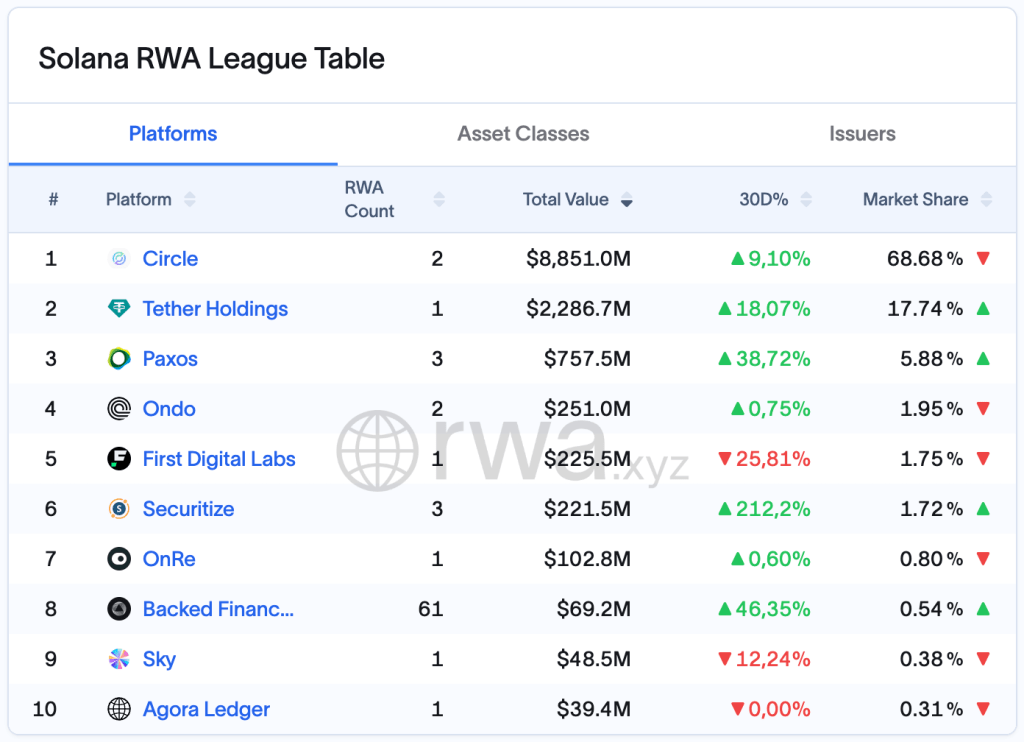
Source: RWA.xyz.
Other stablecoins are also beginning to leave their mark on Solana. The list now includes Global Dollar (USDG), PayPal’s PYUSD, First Digital USD (FDUSD), Agora’s AUSD, as well as Circle’s EURC and Sky’s USDS. Together, they point to a stablecoin landscape that is gradually becoming more competitive and diverse.
U.S. Treasury Debt
The appeal of tokenized U.S. Treasuries is clear: risk-free yields from traditional finance brought onchain with significantly lower barriers to entry than in most jurisdictions. This makes them particularly attractive for emerging markets, where direct access to U.S. debt instruments is limited. On Solana, Treasuries dominate the RWA landscape, accounting for more than 90% of all non-stablecoin tokenized assets on the network.
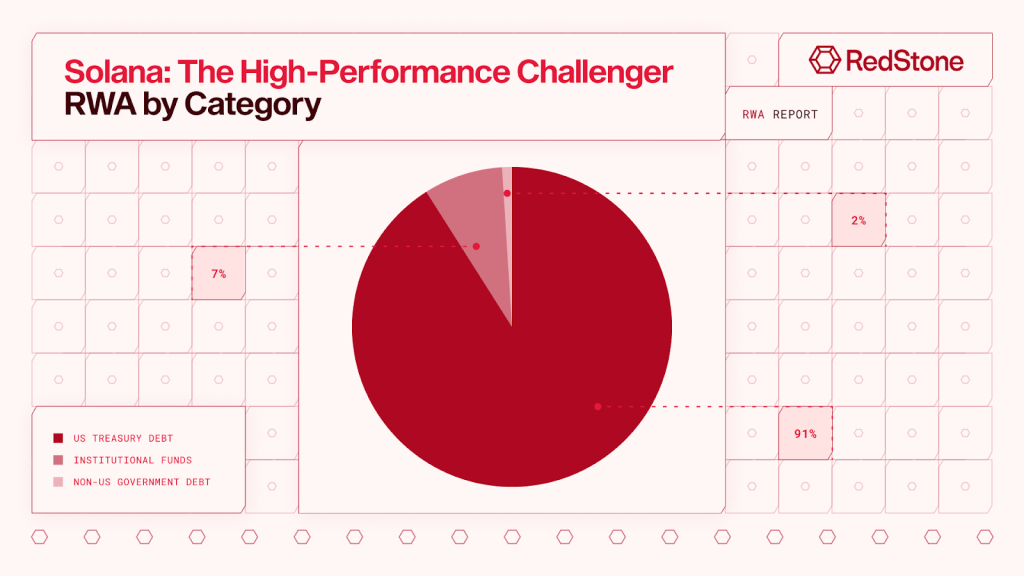
Data as of June 2025.
Source: Real-World Assets in Onchain Finance.
Two products from Ondo Finance lead the category, with USDY and OUSG together representing over $230 million in tokenized assets. BlackRock’s BUIDL, issued through Securitize, competes directly with Ondo’s USDY for the largest non-stablecoin tokenized asset position on the network, reinforcing Solana’s emergence as an institutional venue. Beyond these leaders, projects such as OpenEden’s TBILL Vault, EtherFuse’s USTRY, and VanEck’s VBILL are expanding market access, while Superstate’s USTB and Franklin Templeton’s BENJI are beginning to gain traction.

Source: rwa.xyz.
These numbers make clear that U.S. Treasury debt is not just another category on Solana but the backbone of its RWA sector, setting the stage for further growth in institutional adoption.
Private Credit
Private credit is one of the fastest-growing segments of tokenized RWAs. On Solana, the trend is taking shape as leading protocols expand their credit products onto the network. Maple Finance, DeFi’s premier institutional lending marketplace, officially expanded to Solana in June 2025 with the launch of its flagship yield-bearing asset, syrupUSDC. Maple’s team described the move as a natural step, calling Solana “the next major liquidity venue.” SOL and its derivatives have been accepted as an important collateral category for loans originated through Maple Finance, demonstrating the network’s growing institutional acceptance.
Institutional adoption follows. Apollo Global Management launched ACRED tokenized by Securitize, its first onchain private credit fund (read more in our analysis here), while Hamilton Lane is bringing its SCOPE senior private credit vehicle tokenized by Securitize to Solana through the KAIO (prev. Libre). Centrifuge has also expanded to Solana with a $400 million tokenized U.S. Treasury fund, anchoring more real-world debt instruments on the network.
At the same time, Credora has become a key tool for RWA markets by creating asset and DeFi strategy and vaults ratings, also related to tokenized private credit exposure with real-time risk evaluation. Recently acquired by RedStone, Credora now represents one of the most innovative approaches to credit ratings, lowering the barriers for institutions to participate by combining transparency with privacy in onchain credit assessment.
Even structured credit instruments are starting to cross over, with the Janus Henderson AAA CLO Fund (JAAA) pointing to how TradFi-native products may also find their place within Solana’s expanding RWA ecosystem.
Onchain Equities
Tokenized stocks are rapidly emerging as one of the most anticipated RWA categories, with much of the activity concentrated on Solana. Transfer volumes are reaching all-time highs, underscoring the strength of early demand.

Source: rwa.xyz
Driving much of this momentum is xStocks, developed by Backed Finance and launched through partnerships with major exchanges including Kraken, which makes tokenized shares of leading U.S. companies tradable directly through Solana wallets and standard DEX interfaces. This creates a powerful moat for adoption: investors can now buy tokenized stocks as easily as they swap stablecoins in Phantom, bringing an equity-like experience into the core of DeFi activity on Solana.
Still, regulatory clarity remains uncertain, and long-term frameworks for securities onchain are only beginning to take shape. While xStocks leads the market today, projects such as Superstate, Ondo and Republic are exploring similar directions, suggesting that tokenized equities may evolve into one of Solana’s defining use cases.
Forward Industries has also announced plans to tokenize its NASDAQ-listed shares through Superstate’s platform, though notably as a company that operates primarily as a Solana treasury vehicle.
Infrastructure
Infrastructure plays a core part in the tokenized industry’s success on Solana, serving as the underlying foundation that enables the network’s capabilities. One of the network’s most significant recent developments is R3’s strategic partnership with Solana Foundation.
R3’s Corda platform represents the backbone of institutional RWA tokenization, with over $17 billion in regulated assets already on-chain across its permissioned networks. Through its strategic partnership with Solana, R3 enables direct transaction confirmation on Solana mainnet while maintaining the privacy and compliance standards that traditional financial institutions require. The newly launched R3 Labs eliminates institutional barriers to public blockchain deployment, bridging Corda’s proven regulatory-grade infrastructure with Solana’s high-performance capabilities. This integration allows regulated institutions to access Solana’s liquidity and settlement efficiency without compromising on security or operational control. R3’s infrastructure essentially functions as the critical bridge bringing the traditional finance market to Solana’s public blockchain ecosystem.
When talking about the infrastructure that allows for tokenization to exist, we can’t forget about the principal enablers: tokenization platforms such as well-known Circle, Tether, but also Securitize, Ondo, Centrifuge, Paxos, BackedFi, Superstate and KAIO (prev. Libre) that use their proprietary technology and compliance techstacks. These platforms navigate complex regulatory frameworks across various jurisdictions to enable the secure, safe and compliant issuance of tokenized equivalents of well-known financial instruments.
This role represents one of the most challenging aspects of the RWA space. Tokenization platforms must navigate fragmented regulatory frameworks that vary significantly across jurisdictions, with each country having diverse laws regarding digital assets that can affect everything from token issuance to secondary liquidity. Platforms must integrate Know Your Customer (KYC) and Anti-Money Laundering (AML) tools to verify investor identities and ensure adherence to jurisdiction-specific laws, while simultaneously establishing clear legal frameworks for ownership and transfer of tokens.
The competitive landscape developing on Solana is exceptionally positive for the network’s long-term prospects. Unlike EVM-compatible chains that can often share tooling and infrastructure, Solana’s SVM architecture requires everything to be built from scratch due to its fundamentally different parallel processing approach compared to EVM’s sequential model. This constraint has paradoxically created fierce competition that drives innovation and spurs the concurrent development of multiple competing standards. Many of these solutions ultimately become open-source public goods, creating a virtuous cycle that accelerates adoption across the entire ecosystem.
Tokenization itself represents just the opening act of bringing real-world assets onchain. While the act of tokenizing assets helps financial institutions cut operational costs and streamline compliance, industry leaders have set their sights on a much bigger opportunity: leveraging DeFi’s battle-tested infrastructure to amplify asset productivity and unlock new yield streams.
The vision is compelling. Investors get access to enhanced returns by leveraging DeFi protocols, while the decentralized finance ecosystem graduates beyond crypto-native markets to work with TradFi products. It’s a win-win scenario, but there’s a critical missing piece: how do you price a tokenized corporate bond or private credit fund in real-time when these assets don’t trade on liquid secondary markets?
Enter oracles, the essential bridge between DeFi’s need for accurate pricing and RWA’s complex valuation requirements. Historically, DeFi has relied mainly on two straightforward pricing mechanisms: spot prices from liquid centralized or decentralized exchanges, or fundamental price feeds derived from smart contract exchange ratios like wstETH/stETH. But tokenized assets demand far greater sophistication. The pricing mechanisms must account for Net Asset Value (NAV) calculations, regulatory compliance requirements, and illiquidity adjustments – a level of complexity that traditional oracle designs simply weren’t built to handle. RedStone has emerged as a pioneer in this space, developing the nuanced infrastructure needed to bring trillion-dollar asset classes into DeFi protocols safely and accurately.
RWA oracle infrastructure done right means DeFi becomes the productivity engine that transforms how traditional assets generate returns.
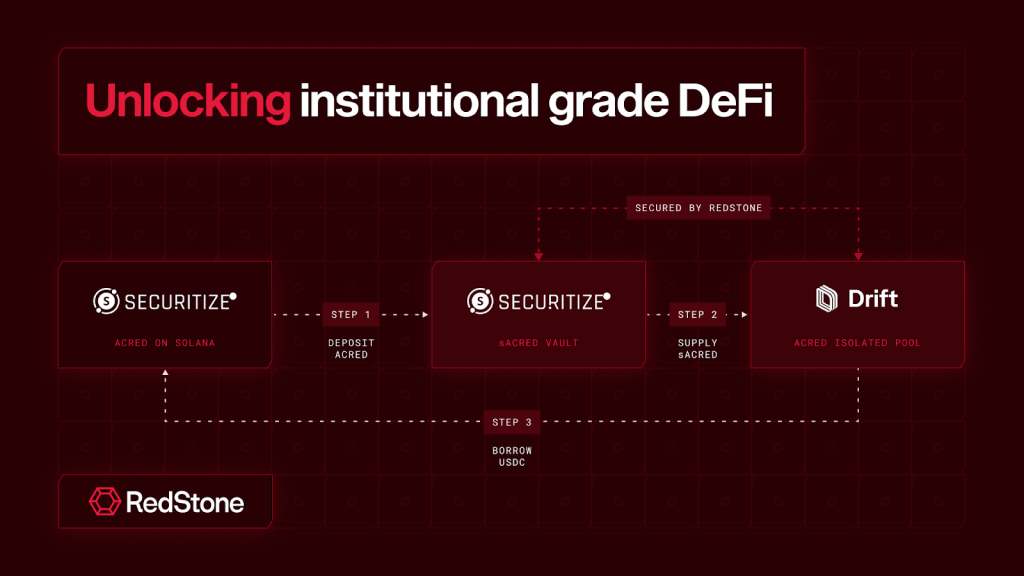
Source: RedStone adoption of Drift graphic
Internet Capital Markets Means DeFi Everywhere
DeFi on Solana has reached a scale that’s impossible to ignore, driven by intense innovation and competition across the ecosystem. Over the past calendar year, the network added $7.7 billion to its DeFi capitalization, reaching $13.5 billion as of September 2025. This 132.8% year-over-year growth reflects not just capital inflows, but the rapid competitive dynamics that characterize Solana’s DeFi landscape.
The DEX landscape exemplifies this competitive intensity. Market positioning remains highly volatile, with newer protocols regularly displacing established players within weeks. September provided a stark example when a single, relatively new protocol, HumidFi, captured one-third of Solana’s total trade volume during the second week of the month.
This competitive environment helps explain Solana’s consistent top-three positioning in Real Economic Value (REV), a metric developed by Blockworks Research to measure authentic blockchain activity. Unlike transaction counts, active addresses, or Total Value Locked (TVL), REV captures the broader economic substance behind network usage.
The core DeFi categories on Solana mirror those found elsewhere: lending protocols, liquid staking, and decentralized exchanges dominate TVL allocation. However, the competitive dynamics within these sectors drive constant innovation. In the DEX sub-sector, protocols compete for volume through increasingly sophisticated routing and fee structures. The liquid staking segment shows similar patterns, with Jito maintaining leadership while newer entrants like Sanctum, Marinate, JPool, and exchange-backed solutions (Binance Staked SOL, Bybit Staked SOL) narrow the gap through differentiated offerings.
Lending protocols represent perhaps the most active development area. Platforms like Loopscale introduce CLOB-style lending experiences, while Kamino v2’s modular architecture enables new implementation approaches across the entire stack. Concurrent development across Drift, Jupiter Lend, and the pending Keel launch suggests this sector will continue expanding.

This directly supports the report’s main thesis: conventional assets, traditionally often characterized by low secondary liquidity, become dynamic yield-generating instruments when tokenized and plugged into DeFi infrastructure. Yield generation occurs through strategies like leverage looping, which boost returns while maintaining established risk parameters. Risk managers like Gauntlet and Steakhouse Financial play a key role in modeling and managing these risks, ensuring responsible use of leverage and long-term system stability.

To illustrate this clear-cut use case, let’s examine Gauntlet’s vault leveraging Drift’s institutional sACRED market. The tokenized asset, tokenized with Securitize on Solana, generates returns of up to 16% compared to standard 8-9% yields from ACRED. This is achieved through leverage looping:
- An investor deposits $1M into ACRED, which is converted into sACRED and deposited into a looping strategy on Solana, leveraging Drift, operated by Gauntlet and secured by RedStone price feeds.
- Using $1M worth of sACRED as collateral, the vault’s automated strategy borrows USDC at a 60% Loan-to-Value ratio, securing a $500K USDC loan.
- That $500K is used to purchase more ACRED, converted again into sACRED, and deposited as additional collateral.
- This allows another round of borrowing of approximately $250K, repeating the process to safely amplify exposure.
The number of loops and borrow amounts are dynamically optimized by Gauntlet’s risk engine, which adjusts to current market conditions and risk parameters. This mechanism allows investors to safely capture the yield spread between ACRED’s higher returns (8–9%) and the lower cost of borrowing stablecoins like USDC (3–4%), effectively amplifying yields without excessive risk.
Solana has built the right foundation at the right time. The network’s combination of speed, reliability, and growing institutional presence creates an environment where tokenized assets can flourish beyond the act of tokenization. By integrating with DeFi protocols, these assets transform from static buy-and-hold positions into active yield-generating instruments, bypassing the traditionally complex underwriting processes that limit liquidity in markets like private and structured credit, treasury debt, alternative investment funds, commodities, and corporate bonds.
This transformation opens access to multi-trillion dollar asset classes that were previously constrained by traditional financial infrastructure.
As these markets continue migrating onchain, DeFi will expand alongside Internet Capital Markets on Solana.
If you’d like to learn more about RWAs, be sure to check out our Ultimate RWA 2025 Report for everything there is to know about the space. Follow us on X at @redstone_defi to stay up to date with all things RedStone and the upcoming reports we have in the pipeline!
Join Solana Ecosystem at APEX – Singapore 30th Sept 2025 🇸🇬
RedStone Acquired Credora, Creating The Biggest DeFi Ratings Platform
X: https://x.com/redstone_defi/status/1963594835933499711
LinkedIn: https://www.linkedin.com/feed/update/urn:li:activity:7369361228638457859/
Request Ratings Today: https://www.credora.network/
Sign up for RedStone Summit♦️
Two-Day Online Conference, Jan 2026
References
- The official documentation for Solana and all the described projects
- “Issuing Tokenized Equities on Solana” Report. Accessed September 2025
- DeFiLlama. Analytics Platform. Accessed 2025. https://defillama.com
- RWA.xyz. Industry-Standard Data Platform for Tokenized Real-World Assets. Accessed 2025. https://rwa.xyz
- Real World Assets on Solana by Helius. Accessed September 2025
- Asset Tokenization in Financial Markets” Report. World Economic Forum, 2025.
- Real-World Assets in Onchain Finance Report by RedStone
- sACRED Goes DeFi: The First Private Credit Fund Earning Onchain Yield