Key Findings
- Hyperliquid has achieved unprecedented market dominance in its category through exceptional execution. From zero to consistently capturing over 80% of the decentralized perpetual exchange market in one year, Hyperliquid now processes up to $30 billion daily volume. Built by a lean, self-funded team that refused to accept VC investors’ money, they’ve proven that technical excellence and community-first economics can outcompete well-funded competitors.
- The HyperCore + HyperEVM dual architecture creates unprecedented opportunities. Hyperliquid’s dual-layer design creates a new paradigm connecting permissioned HyperCore infrastructure with permissionless DeFi innovation through CoreWriter. This allows builders to restructure the design space utilizing both the deepest onchain orderbook and DeFi primitives, enabling financial engineering like tokenizing perpetual positions, creating native delta-neutral strategies, and flash-loaning liquidity—though these represent just the tip of the iceberg in early exploratory phases.
- HIP-3 and liquid staking transform HYPE into ecosystem-wide capital infrastructure. HIP-3’s permissionless market creation, combined with liquid staking protocols like Kinetiq and stakedhype, positions HYPE as active economic infrastructure. LST providers can function as ecosystem hedge funds, leveraging their stake delegation to build new HIP-3 markets while providing diversified yield strategies to delegators—essentially creating native restaking functionality at the protocol’s core.
- Builder empowerment drives organic ecosystem growth through generous economics. Unlike grant-dependent ecosystems, Hyperliquid fosters crypto’s most organic builder movement through unprecedented revenue sharing: spot deployers keep up to 50% of trading fees, UI builders capture more fees than the protocol itself. This “builders first” philosophy creates critical mass demand where developers naturally solve infrastructure gaps.
- Multi-tier oracle architecture enables a comprehensive financial infrastructure with RedStone as the backbone. Hyperliquid’s vision of bringing all finance onchain creates unique oracle challenges across three distinct layers: native HyperCore markets with validator-embedded feeds, HIP-3 builder-deployed perpetual markets requiring deployer-specified oracles, and HyperEVM DeFi protocols needing comprehensive service. Each layer demands specialized technical capabilities and infrastructure. RedStone has emerged as the primary oracle provider across this multi-tier architecture, delivering the technical expertise and coverage needed to support Hyperliquid’s ambitious financial infrastructure goals, with a strong focus on the HIP-3 markets creation.
Onchain Finance Everywhere
Hyperliquid.
The scale of success in market share, volume, and community mindshare that Hyperliquid has managed to gain throughout the last two years is staggering. If you consider yourself crypto-native and don’t know the platform, then you’re probably living under a rock.
For those less deep in the crypto trenches, “Hyperliquid,” the single word this article starts with, has been not only a brand name, but also a community-pushed slogan that has organically dominated crypto-native feeds ever since the mainnet platform launched in June, 2023. We’ve watched the continuous iteration of the core trading product, introduction of new features, a successful HYPE launch – the native coin of the platform, and now their explicit aim to become the dominant venue where the future of all finance takes place.
But let’s take a few steps back and clearly examine Hyperliquid’s vision, the core people behind it, and what they’re actually trying to achieve in their end-state. The thing that truly distinguishes Hyperliquid and the core contributors behind it, something that sometimes feels as close to magic as craft, is that they’re absolutely genius at execution, turning extremely ambitious plans into reality. That’s precisely why it’s so important to understand the specific steps they’ve planned and the elemental platform modules aimed at fulfilling their grand plan of becoming the dominant hub of finance, where the majority of activity moves onchain.
This article will give you a firm understanding of what Hyperliquid is, a complete breakdown of the new features that evolve the platform, and the fundamental, often underscored, role of blockchain oracle services: the core primitive that powers the Hyperliquid ecosystem and how RedStone works to provide best-in-class oracle versatility for ecosystem builders.
Fasten your seatbelts. We’re going down the Hyperliquid rabbit hole.
What is Hyperliquid?
Hyperliquid started simple: a perpetual futures DEX launched in late 2022 by Jeff Yan, a Harvard grad who’d spent time at Hudson River Trading doing high-frequency trading. The FTX collapse gave him and his co-founder iliensinc the perfect moment to build what the market desperately needed – a platform that delivered both transparency and performance, two qualities that had been considered mutually exclusive.
In a span of less than 2 years, they went from zero to consistently capturing over 75% of the entire decentralized perpetual exchange market. To put that in perspective, dYdX held 73% at the start of 2024 and dropped to just 7% by year’s end. Hyperliquid now processes up to $30 billion daily, getting close to matching Binance’s volume on some pairs.
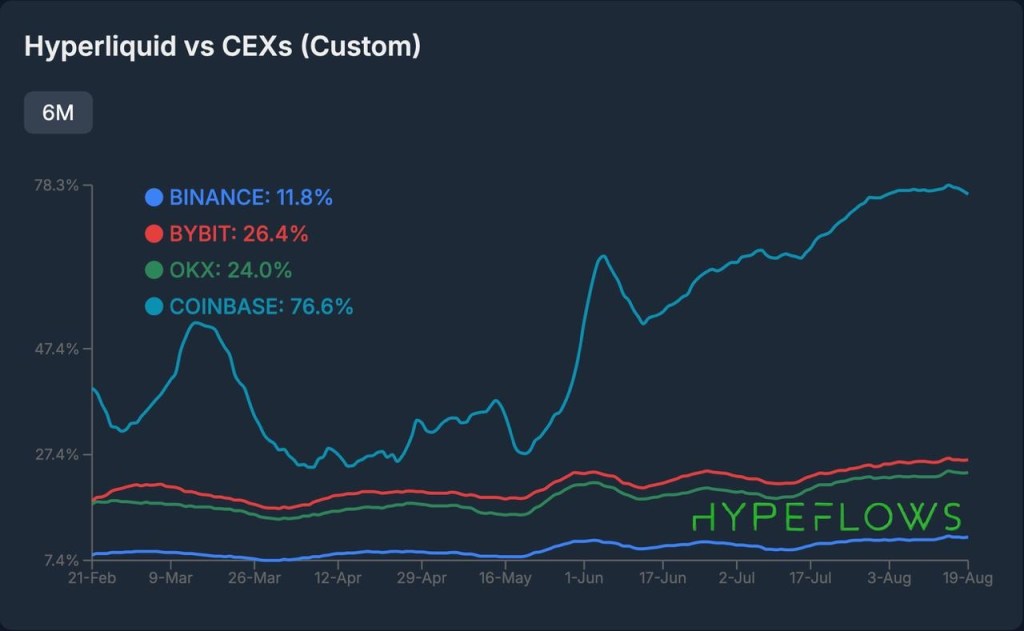
Source: https://hypeflows.com/
The execution behind this is what’s truly remarkable. Hyperliquid team consists of Harvard, MIT, and Caltech grads with backgrounds from Citadel and other elite trading firms, but they kept it lean — just 10 people, zero VC funding, no marketing budget. They’re entirely self-funded and built everything from scratch, including their own Layer-1 blockchain with a custom consensus mechanism called HyperBFT.
The key difference was execution and user experience. While most perp DEXes struggled with complex onboarding, high gas fees, and performance issues during volatility, Hyperliquid launched with one-click trading, zero gas fees, and maintained sub-second execution even at billions in daily volume. Unlike many crypto teams that lead with development of extensive general-purpose technology, Hyperliquid focused solely on the perp product to make it by far the best trading experience available across the industry, and only then moved to pushing more general-purpose infrastructure. Hyperliquid was the first DEX to revisit the much more complex fully on-chain order book (CLOB) and make it reach escape velocity. Additionally, they funneled 100% of fees back to protocol growth from day one, creating a community-first flywheel that brought unprecedented attention that no team had been able to match. This community focus culminated in what became the largest airdrop in crypto history, with 31% of the token supply distributed to users at launch and additional portions still reserved for future community distributions.
Now that we understand the overall story, let’s dive into a more detailed overview of what the Hyperliquid ecosystem is all about. Describing it as a perpetual DEX is no longer enough — Hyperliquid has started the journey toward becoming the powerhouse of financial products, and here are the key modules that will drive this transformation.
Building Global Finance: Hyperliquid’s Technical Vision
To better understand a sheer scope of product expansion and the underlying tech responsible for it, we’ve prepped the graphic that try to encapsulate all of the different development fronts that Hyperliquid is simultaneously going through right now.

HyperCore: The Foundation
HyperCore is Hyperliquid’s original perp DEX — the initial product that started their entire journey and what most people still associate with the platform today. This core trading platform has been breaking volume records repeatedly, directly competing with centralized exchanges for market dominance while processing up to $30 billion in daily trading volume. Built on the HyperBFT consensus mechanism (an optimized version of Byzantine Fault Tolerant algorithm), HyperCore can process hundreds of thousands of orders per second with block finalization in under one second, performance levels that few blockchain applications can match.
Crucially, Hyperliquid operates as its own blockchain, giving the team complete control over their block space — a fundamentally different approach than building on existing L1s or L2s. This control opens up unique opportunities to iterate on products and features that wouldn’t be possible elsewhere: users who stake HYPE tokens get reduced trading fees, built-in MEV protections are implemented directly at the consensus layer, providing critical infrastructure that integrates directly at the bare metal level of the protocol.
While HyperCore remains the core product everyone knows, it’s now serving as the foundational liquidity layer that the entire expanding ecosystem builds upon through builder-empowerment specifications like Builder Codes and HIP-3, which are presented below.
Beyond the Interface: Builder Codes
Hyperliquid isn’t limited to the UI and URL you traditionally access the exchange through. The team chose a fascinating go-to-market path — instead of going forward with wide-spread promotion campaign themselves directly, they’re allowing other protocols to benefit from their underlying technology, creating a win-win situation. Builders benefit from accessing the deep liquidity and order book of Hyperliquid as well as a share of trading fees, while Hyperliquid as a protocol benefits from increased volume and can focus solely on making the product as good as possible, outsourcing distribution outside of the core team’s focus.
Builder Codes were introduced in October 2024, and while few people initially recognized their real power, they represent one of the protocol’s deepest innovations and a strategic pillar that allows Hyperliquid to directly challenge CEXs in pursuit of their “AWS of liquidity” vision, as deliberately described by OAK Research. The idea is simple but radical: instead of acquiring users through traditional means like advertising or KOL partnerships, Hyperliquid “outsources” its product distribution by allowing any interface to connect natively to its trading infrastructure and earn revenue from it.
Concretely, Builder Codes are unique identifiers that enable any developer to connect their frontend to Hyperliquid’s backend. Every trade executed through this identifier is routed through Hyperliquid’s order book and automatically pays out a percentage of trading fees to the developer. This means any trading bot, mobile application, or wallet can use Hyperliquid as its backend infrastructure to offer crypto trading to users while earning a share of the generated fees.
What makes Builder Codes particularly compelling is their full customization, especially around fees. Since Hyperliquid’s base fees are very low, builders have the opportunity to apply a reasonable margin while remaining attractive and profitable for their users.
HIP-3: Permissionless Perps Market Creation
The next major expansion comes through HIP-3, also known as “Builder-Deployed Perpetuals,” which enables completely permissionless market creation on the platform. Currently on testnet with specifications still being actively iterated upon, the proposal will transform how new markets are created. Until HIP-3, new markets were managed by validators with community feedback having a lot of weight in it. Once live, anyone will be able to deploy new perpetual markets on HyperCore through a straightforward Dutch auction system that runs every 31 hours.
The mechanism requires participants to stake 1 million HYPE tokens and bid for the right to launch a market. The winner gains full control over key parameters, including oracle selection, margin requirements, funding mechanisms, and can earn up to 50% of trading fees from their market. The 1 million HYPE stake works as security collateral, serving as a quality guarantee that aligns market creators’ interests with the protocol’s safety and ensures only serious participants deploy markets.
HIP-3 represents another showcase of Hyperliquid’s vision to leverage global crypto community talent to accelerate protocol growth, now that the platform has hit significant velocity. However, this innovation introduces important structural considerations. Allowing anyone to create perpetual markets could potentially deviate from the economic risk standards of original HyperCore markets. There are UI challenges to consider — if several very similar markets launch, this could create interface management issues and fragment liquidity across competing venues. Additionally, since the 1 million HYPE requirement is substantial, significant ecosystem coordination is needed to manage deployment efficiently and not lose the significant edge of being first to deploy markets compared to competing derivative platforms.
Despite these challenges, the potential gains are enormous. HIP-3 reinforces Hyperliquid’s positioning as infrastructure for onchain finance, supporting their “AWS of liquidity” thesis by creating network effects where each new market attracts traders, deepens liquidity, drives HYPE demand, and increases protocol activity. Unlike centralized exchanges with opaque listing criteria, HIP-3 opens the door for permissionless access to any type of market: equities, commodities, FX, prediction markets, and beyond. For broader context, explore an in-depth research analysis of HIP-3 by OAK Research.

The implications of such interplay between all these core modules are extremely interesting, with tons of opportunities across the entire ecosystem. We’ll dive deeper later into what HIP-3 specifically means for each class of ecosystem actors.
HYPE Staking
Hyperliquid operates as a proof-of-stake blockchain where users can natively delegate HYPE, the native tokens of the platform, directly to validators through the platform interface, requiring tokens to be moved from their spot account to a dedicated staking account. As the official documentation explains:
“Each validator has a self-delegation requirement of 10,000 HYPE to become active. Once active, validators produce blocks and receive rewards proportional to their total delegated stake. At 400M total HYPE staked, the yearly reward rate is approximately 2.37% per year. Staking rewards come from the future emissions reserve. Rewards are accrued every minute and distributed to stakers every day. Rewards are redelegated automatically to the staked validator, i.e. compounded.”
The process involves a 1-day lockup period after delegation before users can undelegate, and a 7-day unbonding period when transferring staked tokens back to the spot account, though undelegating from one validator to another is instant after the initial lockup.
Over the last three months, HYPE staking has yielded approximately 2.2% APY from consensus layer rewards. A total of 430 million HYPE is currently staked (43% of the total supply of 1 billion tokens), though it’s difficult to know with certainty the exact amounts given that the foundation delegates large amounts to a handful of external validators. This includes approximately 301 million HYPE locked by the foundation. Of the circulating supply, around 130 million unlocked HYPE tokens are staked, representing about 38% of the 335 million tokens in circulation. What makes HYPE staking particularly novel is that consensus security appears to be just the base layer use case for the network.
With features like trading fee discounts based on staking amounts, market creation through HIP-3, and native interoperability with the permissionless HyperEVM ecosystem, it almost feels like Hyperliquid has built native restaking functionality into the core of its platform — continuously growing the product line while creating new synergies and alignment between ecosystem participants, builders, and the community.
HYPE Liquid Staking: The ecosystem allocators
At first glance, Hyperliquid’s liquid staking ecosystem might appear comparable to Ethereum’s or Solana’s established LST landscape, but beneath the surface lies a fundamentally unique architecture that transforms staking from simple consensus delegation for yield into active economic infrastructure functioning like ecosystem-wide hedge funds and capital allocators.
Unlike traditional liquid staking platforms whose core functionality centers on tokenizing staking receipts, Hyperliquid’s LSTs will leverage their stake delegation to provide heterogeneous opportunities to delegators that vary dramatically between providers—all executed non-custodially through Hyperliquid’s dual-block architecture.
Through CoreWriter contracts (more on it in the next section), these protocols bridge multi-faceted staking primitives between HyperCore’s native execution layer and HyperEVM’s smart contract environment, creating something akin to a Hyperliquid-native restaking protocol where underlying staked HYPE can be leveraged to build new perpetuals markets via HIP-3, positioning liquid staking protocols as the economic connective tissue of the entire ecosystem rather than isolated yield products.

Hyperliquid’s Liquid Staking Game
The Hyperliquid liquid staking sector has consolidated around several major providers, with one clearly dominating the market, while the others command significant market share. All currently offer relatively homogeneous core staking services differentiated primarily by execution approaches.

Data snapshot: 20th of August, 2025
This service similarity represents a temporary state in the ecosystem’s evolution—once modules like HIP-3 Builder-Deployed Perpetuals achieve full implementation, each LST provider could develop distinctly varied return profiles, risk exposures, and margin structures based on their underlying capital allocation strategies. This transformation will fundamentally reposition liquid staking tokens from staking derivatives into ecosystem-native capital allocators, functioning essentially as specialized hedge funds whose performance becomes directly aligned with and dependent upon Hyperliquid’s broader platform growth and market expansion.
Kinetiq: Hyperliquid’s DeFi Powerhouse
Kinetiq (kHYPE & iHYPE & vkHYPE) has rapidly emerged as the most comprehensive option, achieving the largest one-week inflows in LST history (second only to Binance’s staked ETH) with over $460 million TVL within 24 hours of launch. The protocol operates through a fully permissionless StakeHub algorithm that functions as a credit scoring system, continuously evaluating validator performance across multiple metrics before dynamically allocating stake equally among the top seven performers (including foundation validators).
Kinetiq’s product architecture demonstrates exceptional breadth while maintaining risk isolation across offerings:
- kHYPE: The primary liquid staking token integrated across Hyperliquid’s DeFi ecosystem, often regarded as “HYPE’s Lido”
- iHYPE: Compliance-focused institutional staking for KYB/KYC-verified participants with isolated validator sets
- vkHYPE: Automated yield optimization vault (partnered with Veda) deploying idle kHYPE across vetted HyperEVM protocols for enhanced risk-adjusted returns
- Kinetiq Launch: Crowdfunding infrastructure enabling HIP-3 exchange deployments through custom xLSTs without exposing core pools
Note: Each product maintains complete risk isolation—the primary kHYPE pool remains insulated from exotic HIP-3 market risks bootstrapped through Kinetiq Launch.
The protocol represents Hyperliquid’s most significant architectural advancement, pioneering trustless cross-layer operations through CoreWriter precompiles. Previously, liquid staking resembled a “digital safety deposit box” arrangement—users deposited HYPE into HyperEVM smart contracts, but actual staking required trusted human operators (EOAs) to manually bridge funds to HyperCore, similar to how WBTC relies on BitGo custody on Ethereum.
Kinetiq eliminates this “middleman problem” by directly interfacing with CoreWriter’s system contract (0x3333333333333333333333333333333333333333), enabling smart contracts to autonomously execute validator delegations, stake management, and reward distributions without human intervention—essentially upgrading from “valet parking” to “self-driving cars” for institutional staking operations.

This technical sophistication attracts institutional capital seeking automated, non-custodial infrastructure. The user base demonstrates clear institutional concentration prioritizing trustless operations over manual oversight processes. Kinetiq commands approximately 78% market share with $1.28 billion TVL.
StakedHYPE (stHYPE) serves as the established retail-accessible option with over $180 million TVL distributed across a broader user base, offering instant unstaking capabilities when liquidity permits and seamless rebase mechanics that maintain 1:1 HYPE backing while automatically compounding rewards. The protocol’s integration across Hyperliquid’s DeFi ecosystem—including HyperSwap DEX and Felix Protocol’s feUSD stablecoin as collateral—provides utility beyond basic staking rewards through native composability features.
The recent acquisition by Valantis Labs positions this LST as another building block in what could become a vertically integrated Hyperliquid protocol flywheel. StakedHYPE holds approximately 11% market share with $181 million TVL.
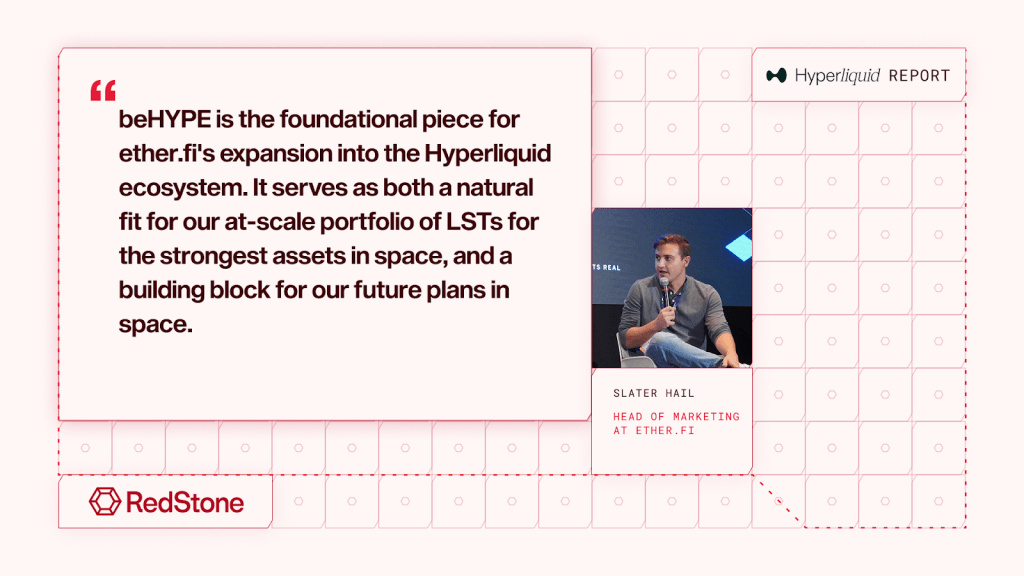
Hyperbeat (beHYPE), it’s definitely worth highlighting yet another player entering the Hyperliquid LST ring: beHYPE, a CoreWriter and HIP-3 powered LST custom-built through a collaboration between Hyperbeat and Ether.fi, has already amassed over $115M USD in its pre-deposit campaign. This represents yet another candidate for creating a comprehensive Hyperliquid product suite flywheel, leveraging Hyperbeat’s already well-capitalized complementary offerings with Ether.fi’s industry-leading security, distribution, and relationships as one of crypto’s largest staking providers. beHYPE maintains approximately 7% market share with $114 million TVL.
Looped HYPE (LHYPE) targets sophisticated yield farmers through automated leveraged looping strategies, delivering approximately 10% APY by recursively staking positions up to 15 times using borrowed capital from lending protocols. The protocol charges 10% performance fees on generated yields while reinvesting 1% of TVL into ecosystem development initiatives. This approach amplifies base staking rewards of ~2.5% through leverage exposure, creating higher returns at the cost of liquidation risk and complexity. The protocol has established a strategic partnership with StakingRewards.com, a leading crypto yield analytics platform, which increases visibility and awareness among the broader DeFi community seeking yield optimization strategies. Looped HYPE maintains approximately 3.3% market share with $54 million TVL.
Hyperpie (mHYPE) by Magpie DAO operates as an integrated ecosystem combining liquid staking with additional services including MEME token launchpad functionality, introducing ve(3,3) governance tokenomics and dynamic exchange rates that appreciate over time rather than rebasing. The protocol targets users seeking governance participation and broader ecosystem engagement beyond yield optimization, though adoption remains limited compared to pure staking-focused alternatives. Hyperpie holds approximately 0.5% market share with $9 million TVL.
HyperEVM: Permissionless innovation
HyperEVM represents Hyperliquid’s permissionless innovation layer, operating as a fully EVM-compatible environment that enables any developer to deploy smart contracts while maintaining direct access to HyperCore’s deep CLOB (Central Limit Order Book). Unlike HyperCore’s curated, capital-intensive market creation process, HyperEVM embraces an open development model that mirrors Android’s unrestricted app ecosystem—allowing experimental financial applications to flourish without barriers.
The architecture’s key innovation lies in its unified state design, eliminating the need for bridges or cross-chain complexity. Applications built on HyperEVM can read and write directly to HyperCore’s deep orderbooks in real-time, creating unprecedented composability between DeFi experimentation and traditional market infrastructure. By implementing a complete Ethereum Virtual Machine, Hyperliquid inherits web3’s most mature developer ecosystem, including existing tooling, libraries, and expertise, while providing native access to the platform’s high-performance trading engine.
This dual approach—combining HyperCore’s Apple-like curation with HyperEVM’s Android-style openness—positions Hyperliquid as both a reliable institutional trading venue and an innovative playground for the next generation of financial applications. HyperEVM serves as the platform’s experimentation layer, where developers can prototype novel use cases and build complementary services that enhance the broader ecosystem while leveraging Hyperliquid’s proven liquidity and performance infrastructure.
The Backbone of Hyperliquid EVM: RPC Infrastructure
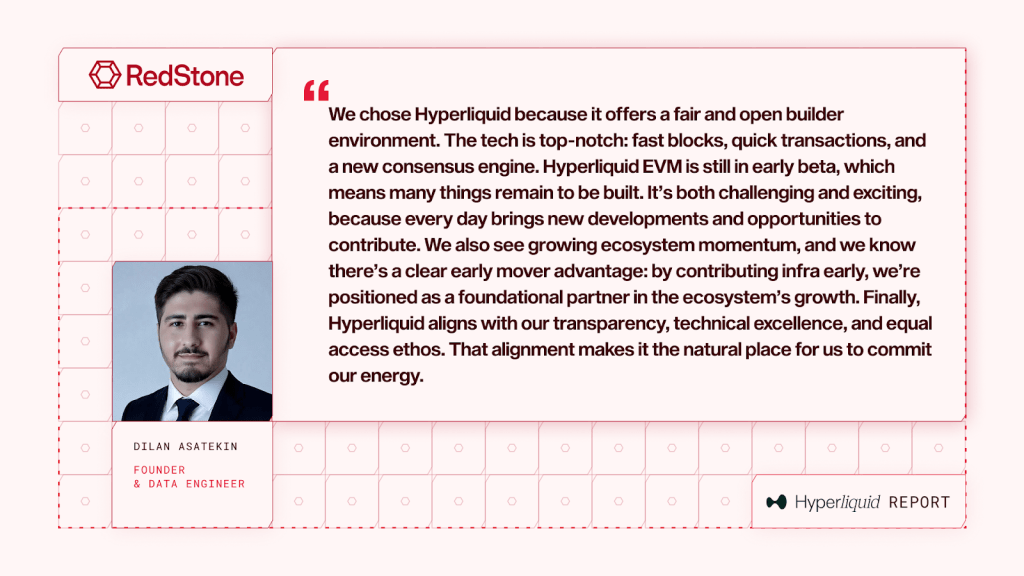
RPC (Remote Procedure Call) infrastructure is the invisible backbone that makes Hyperliquid EVM accessible. While HyperCore provides the technical foundation, RPC endpoints connect builders, traders, and users directly to the network. Reliable RPC infrastructure depends on every transaction submitted, every market interaction executed, and every DeFi contract call processed.
HypeRPC, the first dedicated RPC provider for Hyperliquid, operates institutional-grade nodes that deliver ultra-low latency and 99.99% uptime. This ensures developers can build and deploy products without throughput bottlenecks, while traders benefit from faster execution and uninterrupted connectivity. More than a technical layer, RPC bridges Hyperliquid’s architecture and expanding ecosystem of builders. By maintaining this critical infrastructure, HypeRPC guarantees that Hyperliquid remains performant, accessible, and ready to support the next wave of financial innovation.
Types of nodes HypeRPC provides:
- RPC EVM Full Node: A full EVM node that stores the most recent blockchain state and a limited amount of historical data.
- RPC EVM Archive Node: Contains the entire blockchain history from genesis to the latest block
- L1 Data Node: A node that serves low-latency, chain-level data for Hyperliquid Layer 1
- API Node: Handles a subset of API requests directly from local node state, which helps avoid public API rate limits and reduces reliance on external operators, supports requests that are entirely based on local state (not dependent on external sources).
Note: This section has been authored by HypeRPC – the first dedicated RPC provider for Hyperliquid, delivering ultra-low latency and 99.99% uptime.
HyperUnit
HyperUnit operates as a tokenization protocol that enables secure asset transfers from other blockchains into both HyperCore and HyperEVM, solving the critical problem of bringing real Bitcoin and Ethereum onto Hyperliquid without trusted custodians. The protocol uses a distributed network of three Guardians operating through Multi-Party Computation, where private keys are split and never exist in full anywhere, ensuring no single entity can control user funds. Since February 2025, Unit has processed over $761 million in native asset inflows ($392 million in BTC, $245 million in ETH, $42 million in SOL, $81 million in Fartcoin) and facilitated $16 billion in trading volume (approximately $8 billion on BTC and $5 billion on ETH), making Hyperliquid the leading DEX for native Bitcoin trading.
HyperUnit is essential to Hyperliquid’s ecosystem because it eliminates the need for users to rely on wrapped tokens or external bridges—instead of holding synthetic assets that depend on third-party custodians, users can trade real Bitcoin and Ethereum that maintain their native properties while accessing Hyperliquid’s deep liquidity and performance. This creates a unified financial environment where users can deposit Bitcoin, trade perpetuals, stake rewards, and build applications across both HyperCore and HyperEVM without ever leaving the ecosystem, bringing Hyperliquid closer to becoming a complete financial infrastructure that rivals centralized exchanges.
A glue that sticks it all: CoreWriter
CoreWriter functions as the essential connector that allows HyperEVM applications to write directly to HyperCore’s native systems, eliminating the need for trusted intermediaries. This represents the missing piece needed to complete HyperEVM’s role, transforming it from what many considered just another EVM chain into something fundamentally different: a chain that directly and natively inherits access to the performance, liquidity, and onchain order book of Hyperliquid. Previously, smart contracts could only read HyperCore data like positions and prices, but CoreWriter, launched on July 5th, enables bidirectional interaction between Hyperliquid’s two execution layers.
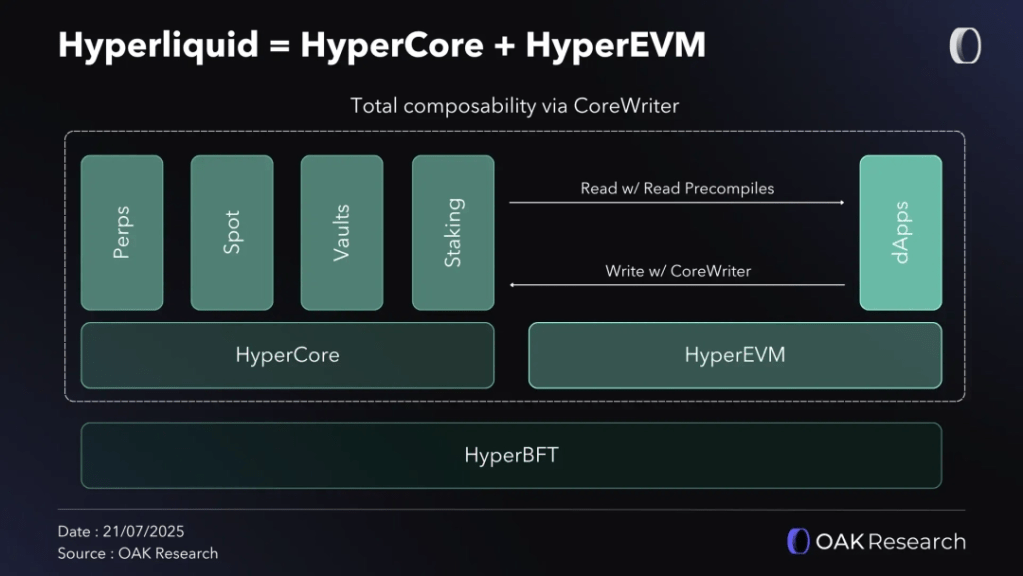
The impact becomes clear through applications like Kinetiq, which demonstrates CoreWriter’s practical value. Before CoreWriter, staking HYPE from smart contracts required wrapping mechanisms similar to how Bitcoin becomes WBTC on Ethereum—users had to send HYPE to an EVM contract, which then relied on a trusted externally owned address to perform the actual staking on HyperCore. This created unnecessary custody risk and complexity.
With CoreWriter, Kinetiq can directly stake HYPE on HyperCore’s validator layer without any trusted human intermediaries. The smart contract seamlessly executes native staking operations, just as if it were operating within HyperCore itself. This represents a fundamental shift from bridged interactions to native composability, where EVM applications gain direct access to HyperCore’s financial primitives—staking, trading, and liquidity provision—as first-class operations rather than external dependencies. With countless unexplored opportunities still ahead, builders remain extremely excited to continuously discover new ways to leverage CoreWriter, fundamentally revolutionizing how DeFi applications interact with institutional-grade infrastructure.
Builders First: The Hyperliquid Way
“If something can be built by someone else, it should be built by someone else.” This is what Jeff Yan, the main spokesperson behind the Hyperliquid Foundation states, when asked about the role of community in the ecosystem expansion.
Unlike traditional ecosystems that lure builders with grants and subsidies, Hyperliquid has fostered the most organic builder movement in crypto by offering what no other platform can: unprecedented revenue sharing where spot deployers keep up to 50% of total trading pair fees, UI builders capture more fees per trade than the protocol itself, and HIP-3 perpetual market creators can share trading fees directly with their LST backers—economics so generous that “no exchange, even centralized ones, would ever offer.” This combination of hands-off foundation philosophy, clear monetization pathways, and genuine infrastructure gaps has created “critical mass” demand where builders naturally flock to solve obvious problems like portfolio margin and cross-collateral lending, resulting in what industry observers describe as an unprecedented “outpour of support” and collaborative spirit that makes integration coordination feel effortless despite zero financial incentives from the foundation.

All of this has resulted in a remarkably vibrant Hyperliquid ecosystem emerging in an extraordinarily short timeframe, composed primarily of Hyperliquid-native teams laser-focused on ecosystem-specific opportunities.
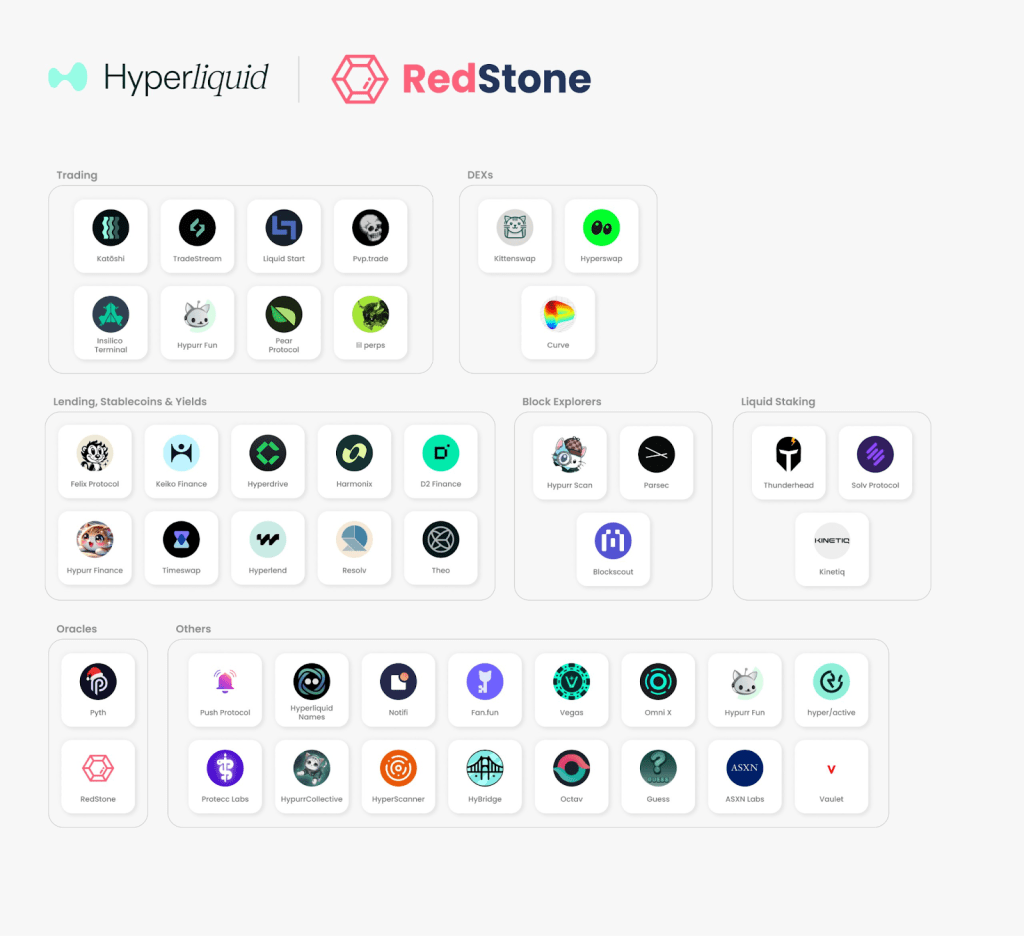
Now let’s take a deeper look at the major Hyperliquid projects building across different verticals.
Felix
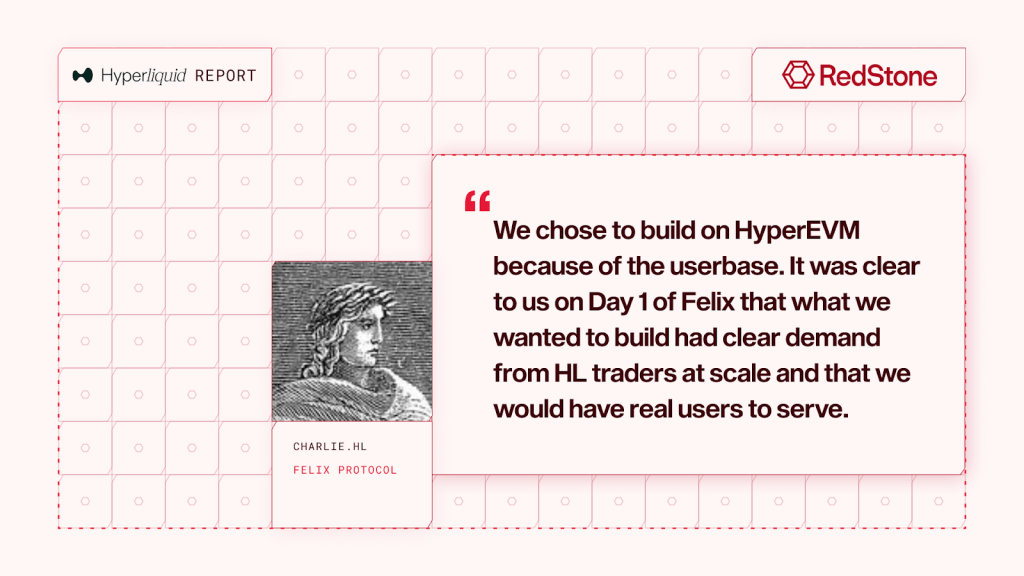
Felix Protocol emerges as the MakerDAO of Hyperliquid with its core CDP offering, establishing itself as a DeFi powerhouse simultaneously developing multiple product lines across the ecosystem. Built on a licensed Liquity V2 fork for its feUSD stablecoin system, Felix also integrates Morpho’s lending infrastructure to power its Vanilla Markets money market functionality, offering direct asset-native borrowing without redemption mechanics. Beyond feUSD, Felix has launched USDhl—a Treasury-backed stablecoin designed to redirect yield back into ecosystem growth through HYPE buybacks and builder rebates.
Hyperbeat
Hyperbeat is a native protocol within the Hyperliquid ecosystem, built by early Hyperliquid users turned dedicated native builders. Hyperbeat operates through non-custodial smart contract vaults that optimize liquidity and deliver higher base yields across varying risk profiles. These vaults interact with Hypercore and HyperEVM to offer a streamlined user experience while providing greater capital flexibility through sophisticated yield strategies.
The protocol’s comprehensive suite includes Morpho-powered money markets that facilitate lending and borrowing for all major spot assets on HyperEVM. Additionally, Hyperbeat contributes to network security by running a mainnet validator node—originally one of the earliest testnet validators—in collaboration with P2P.org exclusively for Hyperliquid.
Another key component of protocol’s staking strategy is beHYPE, Hyperbeat’s LST protocol developed in partnership with EtherFi utilizing CoreWriter technology. The beHYPE pre-deposit phase has already attracted over $150M in commitments, demonstrating strong market confidence.

HyperLend
HyperLend is the biggest decentralized lending protocol built on HyperEVM, designed for capital efficiency and optimized for traders, quants, and market makers. The protocol offers flexible, multi-asset lending through both core and isolated pools, with core pools providing shared-risk lending across multiple assets for higher capital efficiency, while isolated pools mitigate risk by limiting each market to two tokens with customizable LTV ratios.
In February 2025, the Aave DAO recognized HyperLend as a “friendly fork,” granting it the right to use Aave’s codebase in exchange for 10% of HyperLend’s protocol revenue, 3.5% of token supply allocation to the DAO treasury, and a 1% token airdrop to stkAAVE holders. The protocol launched on mainnet in March 2025, hitting the first supply caps of $4.42 million in under one hour.
HyperLend’s key innovation includes tokenized HLP vaults that allow users to deposit USDC into Hyperliquid’s HLP vault and receive ERC20 vault shares (wHLP or hHLP tokens) that can be used as collateral in isolated pools, enabling capital-efficient looping strategies. The protocol also features flash loans toolkit and plans to introduce liquid perpetual positions, unlocking strategies like yield-on-margin, basis trade leverage, and delta-neutral risk transfers across the Hyperliquid ecosystem.
HyperLend recently unveiled its Unified Trading Account (UTA), automating the complex process of borrowing against collateral for trading with a single wallet signature. This positions HyperLend as the portfolio margin engine for the entire Hyperliquid ecosystem, including builder codes and HIP-3 markets.
HypurrFi
HypurrFi is a complete debt servicing infrastructure. In addition to enabling users to borrow and lend, the protocol provides a comprehensive framework to manage, refinance, restructure, or optimize on-chain debt, while leveraging Hyperliquid’s growing liquidity.
Currently, HypurrFi offers pooled and isolated markets covering a wide range of assets (HYPE and its main LSTs, assets listed on Hyperliquid’s spot market, stablecoins etc.). HypurrFi is also the issuer of USDXL, an overcollateralized synthetic dollar backed by user deposits and partially secured by U.S. Treasury bonds purchased with the protocol’s revenues.

At the time of writing, HypurrFi has $300 million in TVL (including borrowings) and approximately $2.7 million USDXL in circulation.
HypurrFi’s ambition for the second half of 2025 is clear: to become the leading debt servicing infrastructure on Hyperliquid. To achieve this, the protocol plans to deploy all the necessary tools to allow users to optimize their debt management (collateral swaps, refinancing at better rates, risk management, additional functionalities, etc.).
For a deeper dive into HypurrFi, check out OAK Research’s Hyperliquid (HYPE): S1 2025 Activity Report.
Liminal
Liminal is a delta-neutral yield protocol on HyperCore that lets users deposit USDC and earn sustainable yield from combined spot and perpetual positions. The protocol pairs long spot positions with short perpetual positions to capture funding rates while eliminating price risk exposure. Liminal charges no token-based rewards—profits come purely from funding rate arbitrage and PnL
From a HIP-3 perspective, Liminal demonstrates how permissionless perpetual market creation could enable protocols to access Hyperliquid’s extensive liquidity network and capture amplified returns. By leveraging the base fee structure with potentially 50% of fees from trades on deployed HIP-3 markets, Liminal could generate significant additional revenue streams even after accounting for HYPE security costs, creating an extremely attractive growth vertical for the ecosystem.

Liminal recently announced its expansion into tokenized delta-neutral strategies, introducing xTokens ($xHYPE, $xBTC, $xETH) that represent pooled delta-neutral positions and can be used as composable DeFi primitives across HyperEVM and other EVM networks. This marks Liminal’s first HyperEVM integration, transforming its yield streams into portable, self-compounding assets that can serve as collateral in lending markets and AMMs throughout the broader DeFi ecosystem.
Also, it’s worth shouting out the Valantis that is a modular DEX on Hyperliquid that lets developers create custom, capital-efficient liquidity pools tailored to specific assets or ecosystems, and Project X that is a user-friendly AMM on HyperEVM that combines a Uniswap-style interface, strong incentive design, and optimized routing across HyperEVM and HyperCore.
RWA on Hyperliquid
As the second-fastest growing vertical in the broader DeFi market, RWA tokenization is now finding a firm footing within the Hyperliquid ecosystem, and with the platform’s rapid expansion in trading and user adoption, its role in this segment is set to grow further.
Hyperliquid’s user base has historically been dominated by crypto-native participants, rather than traditional financial institutions. According to the Real-World Assets in Onchain Finance Report, that narrative began to shift in May 2025, when Hyperliquid’s core contributors submitted formal comment letters to the U.S. Commodity Futures Trading Commission (CFTC), advocating for clear regulatory frameworks that would legitimize perpetual derivatives and enable true 24/7 trading. This marked a strategic pivot from DeFi’s typical stance of regulatory avoidance, signalling a recognition that institutional adoption requires proactive engagement. The timing was notable: within weeks, Nasdaq-listed Lion Group Holding and Eyenovia Inc. committed $600 million and $50 million, respectively, to HYPE token strategies, the first documented corporate treasury allocations into a DeFi-native asset.
The RWA landscape on Hyperliquid is being shaped by a growing roster of ecosystem projects. Ventuals is developing a pre-IPO marketplace aimed at bringing private equity–style exposure onchain. Felix Protocol has launched USDhl, a Treasury bill–backed stablecoin designed to channel yield into ecosystem growth via HYPE buybacks and builder rebates. Theo Network has launched its T-bills product on HyperEVM, and credit market makers such as Maple Finance are beginning to explore opportunities within the ecosystem.

On the institutional side, the Token2049 conference in Singapore will feature an exclusive, closed-door event on tokenization co-hosted by RedStone – RWA Singapore. While not an official Hyperliquid event, the platform’s growing role in RWAs is expected to feature in discussions among funds, corporate treasuries, and tokenization leaders.

Apply here
This momentum is further amplified by major DeFi players entering the space: Ethena and Pendle are exploring and implementing ways to package and leverage HYPE-related yield streams, further blurring the lines between traditional and onchain markets. Additionally, crypto-native initiatives like The Hype Engine are building strategic HYPE reserves.
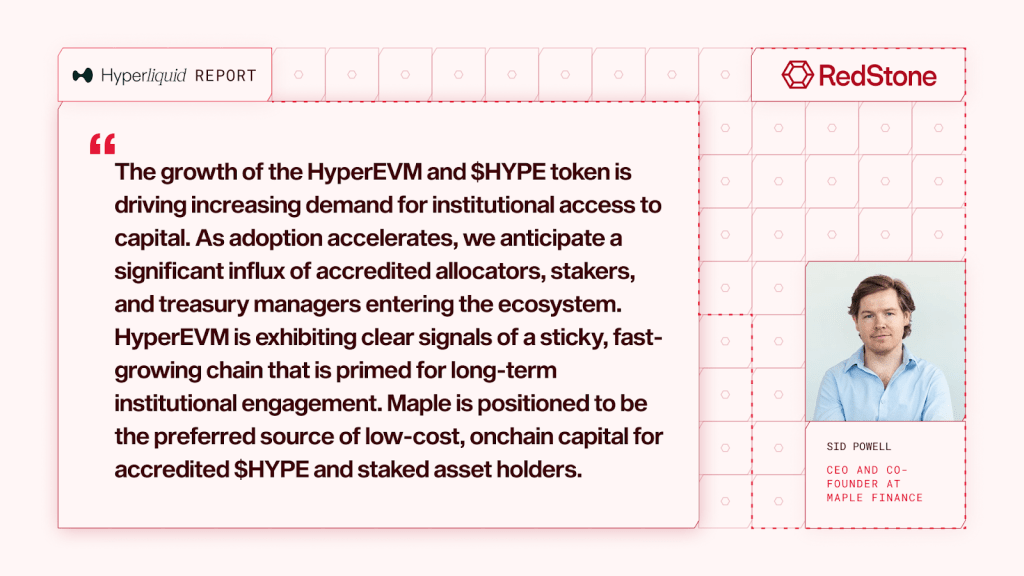
If Hyperliquid’s early stage was defined by rapid growth in the onchain derivatives market, the next could see it solidify its position as a premier onchain hub for finance, and a leading venue for Real-World Asset markets to take shape at scale.
Solving the Blockchain Oracle Dilemma: Hyperliquid’s Approach
Blockchain oracle services like RedStone form the foundational infrastructure of DeFi’s economy, delivering critical price feeds that enable protocols to accurately value assets and liabilities while maintaining system-wide equilibrium. But Hyperliquid’s innovative dual-layer architecture—combining a high-performance perpetual DEX with a permissionless HyperEVM DeFi ecosystem—creates a unique challenge: how do you serve oracle needs across such different and distinct operational environments?
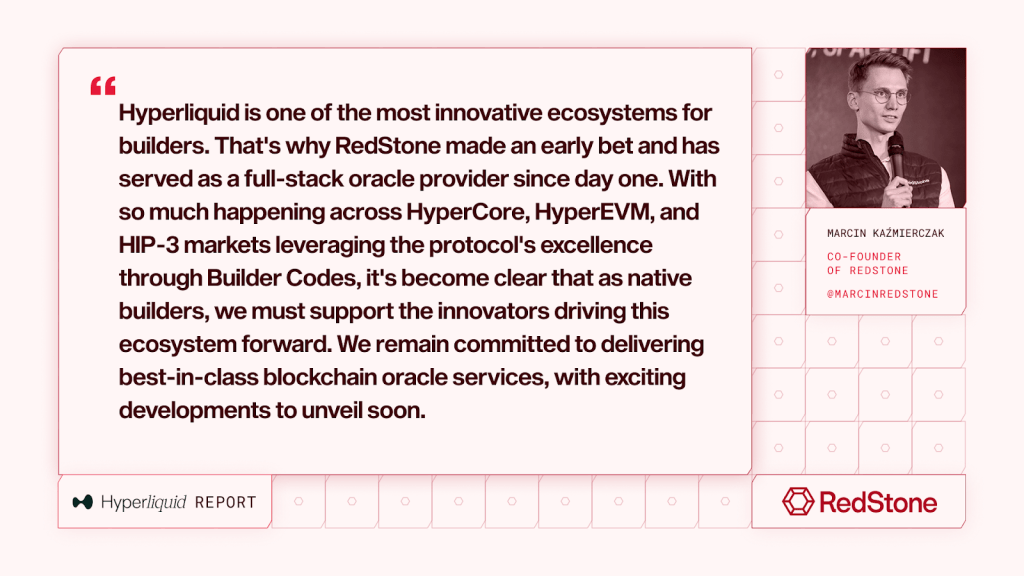
The answer lies in Hyperliquid’s multi-tier oracle architecture. As of August 2025, we can distinguish 3 main oracle segments. The first category supports standard perpetual markets on HyperCore, while the second will serve the upcoming HIP-3 markets launching on HyperCore as well. Meanwhile, the third operates within HyperEVM’s permissionless DeFi ecosystem.
Let’s explore how each segment addresses different requirements and functionalities.

Native HyperCore Oracle
HyperCore’s native oracle system embeds price feeds directly into validator infrastructure, creating strong alignment between validators and network health since all validators contribute to price aggregation functions that determine onchain prices. This approach is notably decentralized, with the entire validator set participating in price discovery rather than relying on external parties. However, scalability becomes a significant constraint as adding new markets requires introducing new asset pricing at the validator level.
While this works well for standard crypto markets, Hyperliquid’s ambitions to expand into an all-finance hub face exponential complexity when validators must handle traditional finance markets such as equities, FX, or private credit that require much more bespoke integration work, and sophisticated DeFi primitives requiring specialized data like proof-of-reserves or fundamental contract rates. Thus, the HIP-3 Builder-Deployed Perpetuals specification came to solve this very need.
Builder-Deployed Oracles (HIP-3): Where Builders Shine
HIP-3 revolutionizes market creation by enabling builders to deploy custom perpetual markets for any assets requiring a 1 million HYPE token stake (~$44M at the time of writing). This flexibility allows markets to be created for virtually any tradeable asset. However, this power comes with complete oracle responsibility on deployers, creating trust concerns since oracle updaters could theoretically manipulate prices. Unlike native HyperCore markets that rely on validator consensus, HIP-3 markets depend entirely on the chosen oracle provider as the sole price authority. Success requires top-tier security, specialized HyperCore integration expertise, and the ability to match native oracle speeds of 3-second updates. Critically, oracle providers need architectures flexible enough to deliver data in HyperCore’s unique API format while maintaining sufficient decentralization and redundancy across multiple data sources to ensure reliable price feeds that can withstand networking issues and other stability challenges.
HyperEVM: Permissionless DeFi Oracles
While HyperEVM supports standard EVM oracle integrations, Hyperliquid’s dual-structure blockchain architecture creates unique opportunities and complexities. The distinct connection between HyperEVM and HyperCore through CoreWriter functionality enables builders to create novel DeFi synergies that bridge both environments. This architectural advantage could lead to sophisticated cross-layer applications that require bespoke oracle integrations beyond typical EVM solutions, as protocols seek to leverage the unique capabilities that emerge from Hyperliquid’s dual-blockchain design.
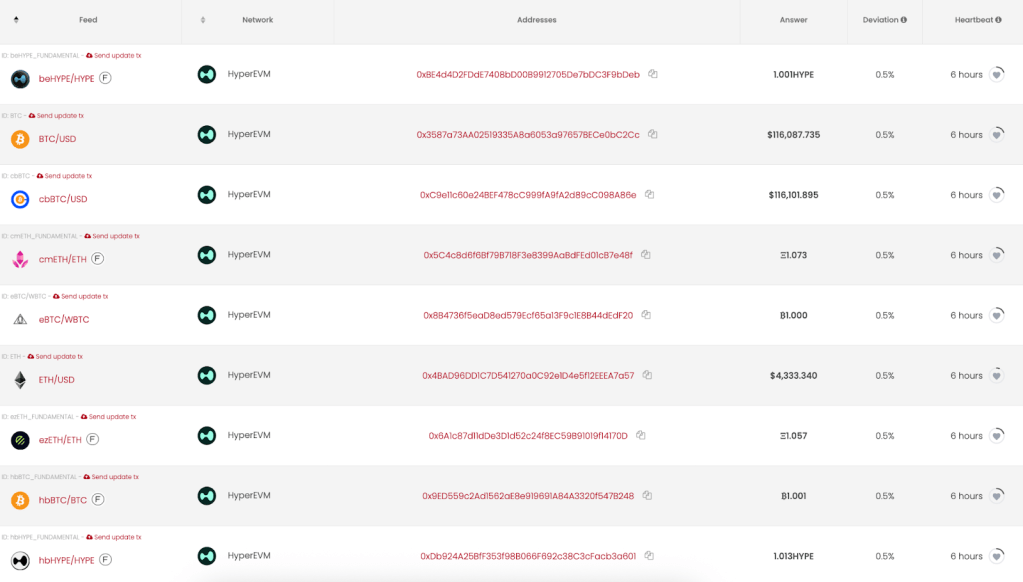
RedStone has been supporting every oracle need of the HyperEVM ecosystem from day one and is now leveraging its expertise to deliver the most comprehensive oracle coverage for HIP-3 markets. Hyperliquid’s vision of bringing all finance onchain is what RedStone has been striving toward since inception.
HyperEVM builders need flexible oracle solutions, while HIP-3 deployers require battle-tested infrastructure capable of delivering extremely low latency performance and operational expertise for high-stakes markets. RedStone provides the technical capabilities and builder-focused approach across Hyperliquid’s multi-tier architecture.
The Future is Hyperliquid
Hyperliquid represents one of the most intriguing developments in DeFi today—a project that has evolved far beyond its perp DEX origins into something approaching financial infrastructure. The scope of ambition here is remarkable.
Jeff Yan’s vision extends well beyond crypto trading, aiming to bring all of finance onchain through what he describes as “a 10x upgrade on legacy financial systems.” But rather than pursuing this through traditional scaling, Hyperliquid is betting on decentralized coordination—thousands of people across hundreds of companies building together through thoughtfully designed protocols.
The builder empowerment approach feels genuinely different. With generous economics that let developers capture more fees than the protocol itself, and a core philosophy focused purely on infrastructure, Hyperliquid is creating unprecedented space for innovation. The organic, community-driven growth, where users advocate from genuine belief rather than financial incentives, suggests this strategy is working.
Significant challenges remain ahead. Moving all of finance onchain remains a monumental undertaking. But perhaps the smart approach is exactly what Hyperliquid is doing—dominating the crypto trading landscape first as a proving ground before tackling the broader vision. Their rapid evolution, powered by both cutting-edge technology and authentic community engagement, represents a fascinating case study in how crypto platforms might develop beyond current paradigms. As Yan puts it: “Smart people naturally are attracted to hard problems and we’ll solve them all.”
And if you want to try your hand at solving one of these hard problems, there’s no better place than the first in-person Hyperliquid Hackathon during Korean Blockchain Week, September 21-22, 2025. Hyperliquid Builders, top-tier ecosystem projects, the Hyperliquid Foundation, and RedStone Oracles will be judging and helping you bootstrap your idea into production on Hyperliquid!
Whether you’re interested in Programmable Trading with HyperEVM & CoreWriter, building HIP-3 Builder-deployed Perps, developing Builder Codes, or creating Monetizable Integrations, Developer Tools & Public Goods – there’s a track for every type of builder ready to push the boundaries of onchain finance.

Apply here!
References
- Hyperliquid Foundation – Official Documentation and Communication Channels
- Official Documentation and Communication Channels of All Mentioned Projects
- OAK Research – “Hyperliquid’s Vision: The AWS of Liquidity (Builder Codes, CoreWriter and HIP-3)”
- OAK Research – “What is Hyperliquid’s HIP-3? How it Works and Use Cases“
- OAK Research – “HyperUnit: The Hidden Engine Powering Hyperliquid“
- Hypeflows
- HypurrScan
- Defillama
- Bell Curve Podcast – “Hyperliquid’s Bold Vision for DeFi” featuring Jeff Yan (Season 9, Episode 3)
- 0xResearch – “Kinetiq Deep Dive: Liquid Staking, HIP-3 and the Launch Model” featuring Greenz & Omnia
- Sealaunch – “Hyperliquid: On-chain Perps Volume, Revenue and TVL“