RedStone and Securitize are proud to introduce a transformative new standard for oracles delivering Proof of Reserve price feeds: the Trusted Single Source Oracle (TSSO) — a cryptographically verifiable oracle architecture purpose-built for Real World Assets.
This announcement marks the publication of a whitepaper co-authored by the teams behind RedStone and Securitize.
The Challenge: When Asset Valuation Comes from Outside the Market
The global securities market, estimated at nearly $400 trillion, is increasingly looking toward public blockchains as a more transparent, composable, and efficient alternative to traditional financial infrastructure. Blockchains offer real-time settlement, programmable logic, and global accessibility — qualities that legacy systems built on custodians, clearing houses, and reconciliation processes can’t match.
This is why TradFi giants like BlackRock, Apollo, VanEck, Hamilton Lane, and KKR are actively pursuing the tokenization of real-world assets (RWAs), from credit and treasuries to private equity, using partners like Securitize. A growing appetite for RWAs in DeFi is proven by numbers. As of June 2025, the tokenized RWA market sits at $24B, with treasuries alone growing +85% in 6 months.
However, while tokenization solves the representation of assets on-chain, it leaves one critical problem unresolved: how do we derive a fresh, accurate, and robust price for an asset that doesn’t trade and has only a single source of valuation?
In DeFi, oracles serve as the verification layer for price data. They aggregate information from multiple sources — exchanges, liquidity pools, market makers — to arrive at a consensus price. This model works well for liquid assets, like ETH or BTC. But it becomes inadequate for non-traded instruments, such as tokenized private funds, where the price is expressed as a Net Asset Value (NAV) calculated by a single fund administrator.
These NAVs are derived from the fund’s underlying holdings, audited methodologies, and are published at periodic intervals. By nature, they’re not discoverable through open markets; they come from a single, centralized source.
This creates a paradox.
DeFi is built on trust minimization. Yet, tokenized RWAs often rely on off-chain, centralized NAVs as their pricing anchors, and that introduces a single point of trust into a permissionless system. Billions in on-chain value depend on values that cannot be verified through aggregation or external consensus.
Traditional oracle frameworks, which excel at sourcing prices from multiple feeds, don’t directly translate to this setup. It’s not a shortcoming of those systems, but a signal that a different kind of oracle is needed.
Recognizing this challenge, Securitize and RedStone co-designed the Trusted Single Source Oracle (TSSO) to introduce a new standard: one that allows a single-source NAV to be made as cryptographically robust, operationally transparent, and verifiably consistent as a decentralized price feed.
Instead of forcing non-traded assets into infrastructure designed for real-time markets, TSSO builds a model that respects the unique trust dynamics of tokenized funds, while wrapping that centralized trust in a chain of verifiable cryptographic proof.
What is TSSO?
The Trusted Single Source Oracle (TSSO) architecture, co-developed by RedStone and Securitize, is a purpose-built oracle framework that brings cryptographic integrity, operational flexibility, and data freshness to tokenized non-tradable assets.
TSSO introduces a dual-key cryptographic model tailored for single-source NAV data:
- The Secure Root Key is used for manually signing initial NAV values or significant updates. It is protected by secure operational practices such as multi-signature wallets, cold storage, or smart account controls.
- The Derivative Chain Key enables automated signing of incremental NAV changes within predefined thresholds and performs scheduled re-signing of unchanged values, preventing data staleness without requiring manual intervention.
A dual-key cryptographic model
| The Secure Root Key | The Derivative Chain Key |
| Stored in cold, secure environments (e.g., multisig, smart accounts)Used for initial NAV entries or significant updatesImplies strong manual oversight | Authorized to perform automated updates within a deviation threshold (e.g., 0.1%)Periodically re-signs static NAVs to prevent data stalenessEnables timely, low-friction data flow |
Every NAV update under TSSO contains a full cryptographic payload: asset ID, price, timestamp, sequence number, previous record hash, and previous record signature. These records are chained together, with each new message referencing the cryptographic fingerprint of the last. This structure transforms the feed into a tamper-evident, auditable sequence of updates, where each value is mathematically linked to the previous one.
You can think of it like Git for NAV data — each update is a signed commit in an immutable history, allowing oracles, smart contracts, and auditors to verify not only the latest value but its entire provenance.
By fusing advanced cryptographic trust foundations with dynamic automation, TSSO redefines NAV verification in DeFi, enabling secure, composable use of tokenized non-traded assets and elevating the oracle standard for a $300T opportunity.
For Builders: DeFi-Grade Trust for Traditional Data
TSSO enables developers to confidently build on top of single-source NAV data, with the same verifiability and composability expected from decentralized oracle systems, but optimized for the inherent trust model of non-traded assets.
Whether you’re:
- Designing NAV-based lending or structured credit protocols,
- Launching tokenized fund marketplaces that need deterministic value updates,
- Building vaults or rebalancing strategies that depend on NAV precision and sequencing,
TSSO offers a structured, cryptographic framework tailored for these use cases.
Each NAV record under TSSO is not just a datapoint; it’s part of a cryptographically linked sequence. Every new message includes the hash and signature of the previous record, creating an immutable audit trail that smart contracts and oracle nodes can verify independently. This ensures not only data integrity but also temporal and contextual consistency, which is a vital requirement for risk management, compliance, and governance logic built around NAV behavior.
From an implementation standpoint, TSSO defines clear algorithms for both signing and verification:
- NAV Signing Flow:
Builders integrating with a fund administrator can implement signing logic that determines whether a price update qualifies for Secure Root signing (manual, major updates) or Derivative Chain signing (automated, within threshold ε). If no price change occurs, the derivative key re-signs the last NAV at regular intervals, preserving on-chain freshness and avoiding oracle desyncs. - On-Chain Verification Flow:
Oracle nodes reconstruct the signed message using the current NAV fields, the previous signature, and the hash. They validate cryptographic integrity (Verify(message, signature, PublicKeyRoot/Derivative)) and ensure sequential linkage to the prior record. This process ensures that no data can be spoofed, skipped, or tampered with without breaking the chain — a key property for building robust DeFi primitives.
In practice, oracles leveraging TSSO can publish attestations directly on-chain, either transparently for any protocol to consume or in a permissioned setup, e.g., visible only to whitelisted lending vaults or regulators. This attestation layer makes it easy to balance compliance requirements with on-chain interoperability.
TSSO is more than a feed; it’s a framework that turns centralized financial reporting into a cryptographically verifiable utility, enabling developers to bring real-world assets into DeFi with precision, provenance, and security baked in.
Zooming Out: A Framework Beyond NAV
While TSSO was architected to solve the specific challenge of Net Asset Value (NAV) verification for tokenized funds, its design is fundamentally modular, making it adaptable to a broad class of periodically priced, non-tradable assets that require cryptographic assurance without full market-based price discovery.
Think beyond NAV:
- Tokenized insurance reserves with actuarial or regulatory valuations
- Private debt instruments priced by third-party credit administrators
- Institutional LP shares in yield strategies or venture capital funds
- Structured finance products with infrequent rebalancing and complex valuation methodologies
What these asset classes share is a reliance on centrally calculated, time-dependent value updates, often gated by regulation, internal audit cycles, or legal disclosure requirements. These are not streaming price feeds, but episodic declarations of value. TSSO is uniquely suited to this domain.
Final Thoughts: From Oracle to Infrastructure
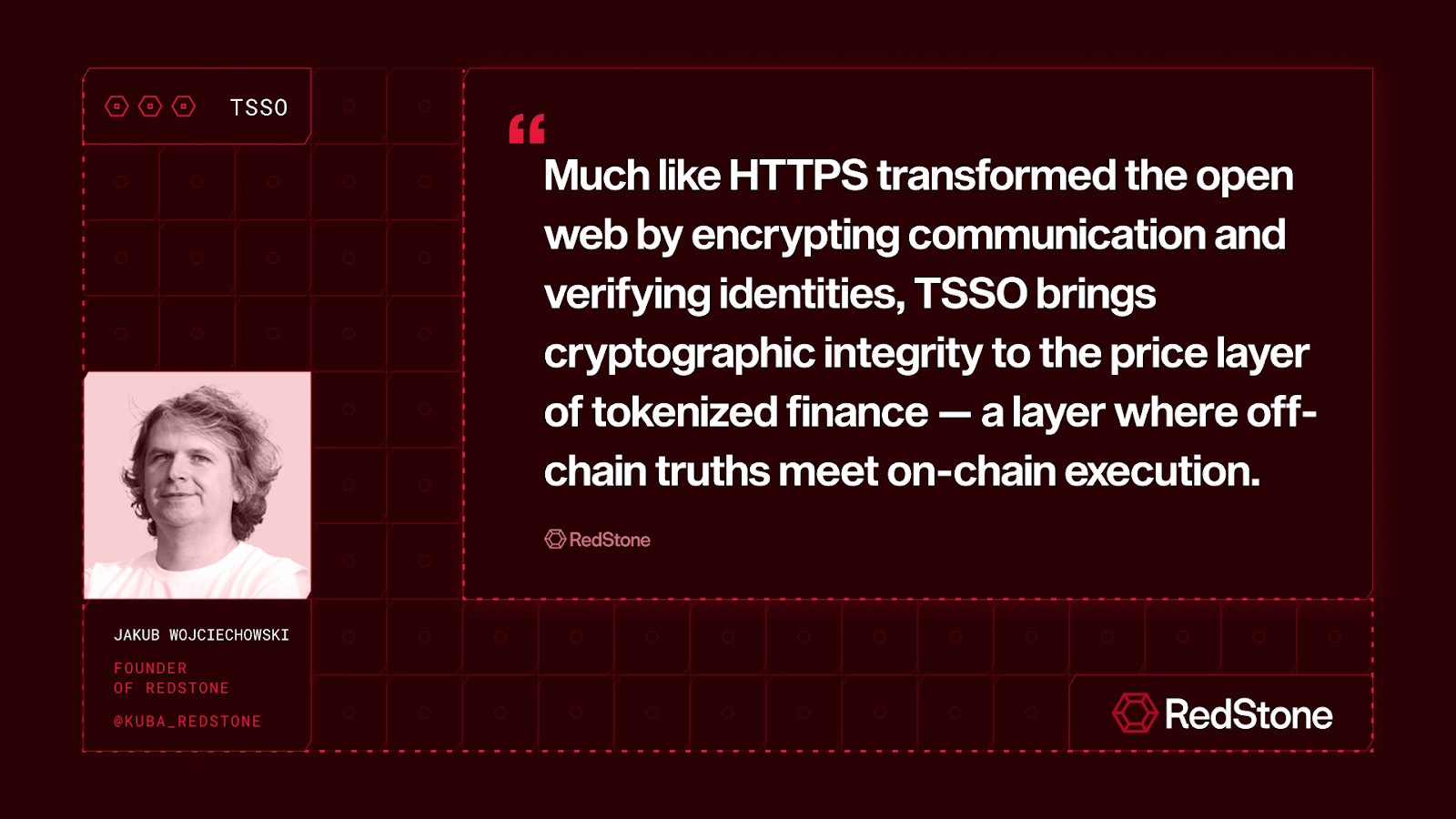
Much like HTTPS transformed the open web by encrypting communication and verifying identities, TSSO brings cryptographic integrity to the price layer of tokenized finance, a layer where off-chain truths meet on-chain execution.
It doesn’t attempt to decentralize what is inherently centralized, like a fund administrator’s NAV, but instead wraps that single point of trust in a framework of verifiable cryptography, time-sequenced attestations, and operational guardrails. This makes the data not just usable, but provably secure, auditable, and compatible with DeFi’s composable logic.
With TSSO, Securitize and RedStone aren’t merely solving an edge-case oracle problem; we’re laying the groundwork for a broader class of financial infrastructure, where institutional-grade data can integrate seamlessly into open systems.
The destination isn’t just price feeds. It’s trust-minimized capital markets — composable, transparent, and global by design.
About RedStone
RedStone is a modular blockchain oracle specializing in yield-bearing assets for DeFi and on-chain finance, especially value-accruing stablecoins, Liquid Staking, and Restaking Tokens. It offers secure, reliable, and customisable data feeds across 60+ chains. Trusted by Ethena, Securitize, Morpho, ether.fi, Lombard, and more.