The Apollo Diversified Credit Securitize Fund (ACRED) is a tokenized feeder fund that allocates assets into Apollo’s flagship Diversified Credit Fund (ADCF), one of the fastest-growing private credit instruments managed by Apollo, one of the largest firms in the sector, with $500B in Assets Under Management. Launched in partnership with Securitize in January 2025, ACRED holders can now participate in DeFi by minting sACRED, potentially generating returns beyond the standard 5-11% of private credit, by tapping into decentralized finance. It is already deployed across leading money markets like Morpho and Drift Institutional on multiple blockchains, including Polygon, Solana, Ethereum, all secured by RedStone Oracles.
Summary
- Tokenizing private credit unlocks broader access, greater transparency, secondary liquidity, and institutional DeFi integration. It can unlock greater yield composition, allowing funds to outperform competitors and attract new investors.
- With RedStone’s accurate ACRED price feeds, investors can amplify returns via sACRED looping strategies on Polygon and Solana, using Morpho and Drift Institutional.
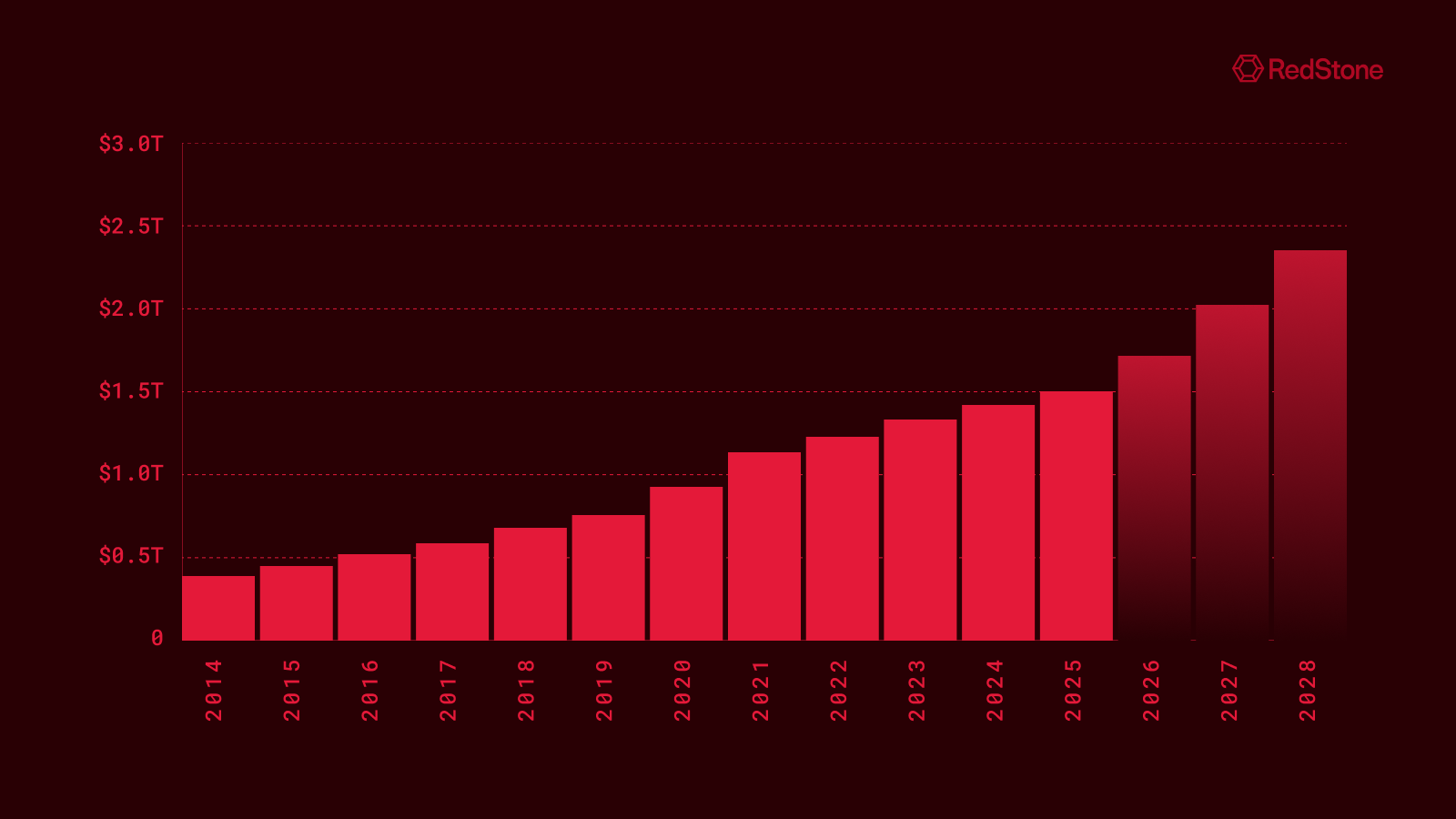
- As the private credit market heads toward $2.8 trillion by 2028, tokenized funds like ACRED by Apollo and Securitize are set to transform onchain finance—bridging traditional yield with DeFi-native infrastructure, secured by RedStone price feeds.
Private Credit Explosion: 10x since 2008
Private credit, sometimes called private debt, is essentially lending that happens outside the usual banking and public markets. Instead of banks or bonds, institutional investors like specialized funds make private loans directly to companies. These loan contracts aren’t traded on stock exchanges and are typically used by mid-sized or sponsor-backed businesses to fund growth, refinancing, or large-scale projects like property development or critical infrastructure.
Here’s a quick, simplified example illustrating the idea behind private credit in the real world:
- A manufacturing company wants to build a private railway to connect its factories but doesn’t qualify for a bank loan.
- It approaches a private credit fund, which offers a $50M loan with custom terms, secured by the new rail assets.
- The fund’s investors earn ~9% annual yield from the interest paid by the company.
- The loan isn’t traded on public markets—it’s held privately until maturity.
Since the 2008 financial crisis, private credit has become one of the fastest-growing asset classes in traditional finance. What was once a few hundred billion-dollar market in 2009 has ballooned roughly 10x to nearly $2 trillion by the end of 2023, according to McKinsey & Company.
Why Has Private Credit Been Growing So Fast?
One of the biggest drivers of private credit’s growth was the pullback of banks from lending to mid-sized companies after the 2008 crisis, creating a huge gap that needed to be filled. Private credit funds stepped in, offering leveraged loans, mezzanine capital, and other types of financing that companies needed to finance their operations. Over the 2010s, what started as a niche asset class quickly became mainstream. The number of private debt funds skyrocketed—from around 100 in 2011 to over 1,000 by 2023—and annual fundraising hit hundreds of billions of dollars.
Even with the challenges of the pandemic and recent interest rate swings causing some fundraising slowdowns between 2022 and 2024, private credit kept growing. By 2024, private debt made up about 6% of all corporate lending. That might still sound small, but it’s been steadily growing and most experts predict it to keep growing strongly in the years ahead.
Source: Prequin, Moody’s Ratings
Why Will Private Credit Grow Exponentially On Blockchains
Private credit stands out for its strong return profile, often offering higher yields than public debt thanks to the illiquidity premium and greater borrower risk. According to the CAIA Association, in 2023, U.S. private credit returns averaged around 10 to 12 percent, while comparable high-yield corporate bonds returned closer to 7 to 8 percent. That extra yield comes with trade-offs. Borrowers are typically smaller, more leveraged companies, and when things go south, lenders recover much less, on average just 33 cents on the dollar, compared to over 50 cents in public markets according to the Federal Reserve. Still, many investors are willing to accept a premium on risk in exchange for a steady income with higher returns and low short-term volatility.
As Apollo CEO Marc Rowan said in 2023, private credit is “the future of the asset management industry.” With blockchain solving its biggest constraint — liquidity — by enabling real-time trading and DeFi-powered yield enhancement, private credit is now positioned not only for accelerated growth, but also to help propel the on-chain finance industry into its next phase.
The Push Toward Tokenization by The Financial Market Giants
Lately, a wave of leading investment firms, including Hamilton Lane, KKR, and Apollo have launched tokenized feeder funds for some of their investment products. Though still early, this shift to tokenization could be transformative. It promises to unlock a new investor base—think global accredited investors able to buy in with smaller amounts through digital tokens—and to bring greater transparency to private markets.
According to analytics platform rwa.xyz, there are over $23 billion in tokenized assets on public blockchains as of 4 June 2025. Private credit is the primary driver of this recent growth, accounting for a massive 60% of the entire real-world asset (RWA) sector. It’s important to note that rwa.xyz separates institutionalized funds and private credit into different categories, so a fund like ACRED, whose NAV includes diversified private credit exposures, is classified under institutionalized funds rather than private credit itself. Because of this categorization, the reality is that onchain private credit makes up even more than 60% of the RWA sector.

Source: rwa.xyz
ACRED: Apollo’s Feeder Fund Tokenized by Securitize
ACRED is a tokenized feeder fund that offers a digital entry point into Apollo’s flagship Diversified Credit Fund (ADCF). With its daily NAV calculation and subscription capabilities, ADCF is an ideal candidate for tokenization, making it a pioneer in tokenizing private credit on public blockchain. With Securitize’s tokenization infrastructure and RedStone’s institutional-grade oracle services, the traditional fund is supercharged with new possibilities. Tokenization can tackle one of private credit’s biggest challenges: illiquidity. It could enable the development of secondary markets where, over time, tokens deposited into sToken vaults powered by the leading ERC-4626 DeFi standard—and indirectly tokenized funds—can trade more freely. Additionally, tokenization makes DeFi-compatible versions of these assets usable as collateral in money markets, allowing investors to borrow against them up to a safe loan-to-value (LTV) ratio to meet short-term liquidity needs.

Source: Securitize
By outsourcing much of the complexity to smart contracts, ACRED dramatically lowers costs, charging just a 1.5% management fee with no carry. This sharply contrasts with traditional benchmarks of a 2% management fee with 20% carry. Automation also speeds up settlement and reduces paperwork, making investing simpler and more efficient. Apollo Partner Christine Moy, who leads digital asset strategy, explained that tokenizing ACRED allows Apollo to “pave the way for broader access to private markets through next-generation product innovation, greater secondary liquidity, and efficiency over time.”
Private Credit Meets DeFi
Note: ACRED tokens themselves can not be directly utilized within DeFi protocols. To enable DeFi functionality, tokens must first be deposited into the sACRED vault, which then makes them eligible for on-chain activity.
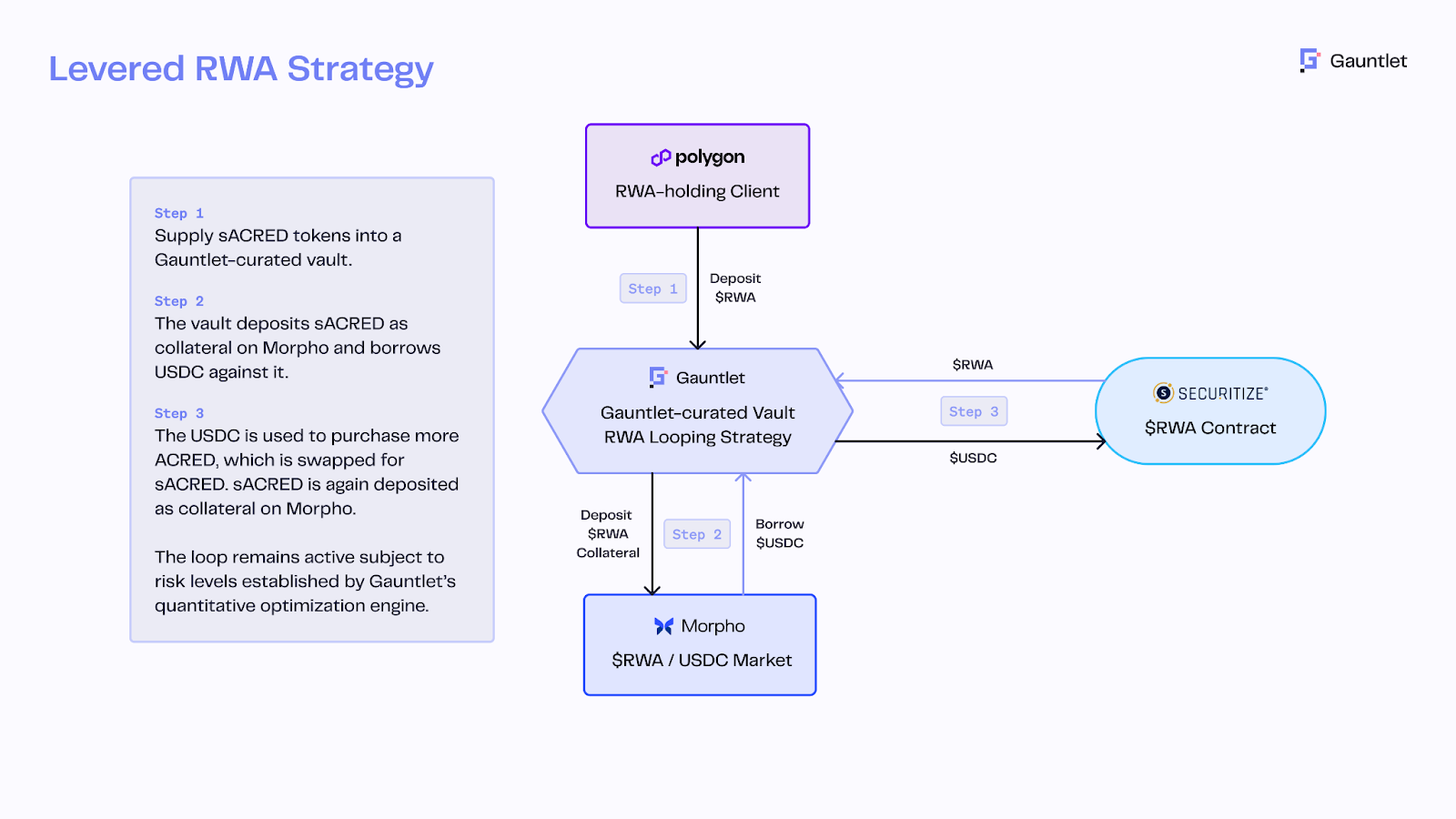
Tokenizing a private credit fund not only improves efficiency but more importantly opens the door to higher yield opportunities. Once tokenized, these assets can be actively used in DeFi, where they’re put to work through strategies like leverage looping to amplify returns while staying within safe risk parameters. Risk managers like Gauntlet play a key role in modeling and managing these risks, ensuring responsible use of leverage and long-term system stability.
Source: Gauntlet
For example, Gauntlet’s vault leveraging the Morpho sACRED market on Polygon can generate returns of up to 16%, compared to the standard 8–9% yield from ACRED. This is achieved through leverage looping. Here’s how it works in a simplified example:
- An investor deposits $1M into ACRED, which is converted into sACRED and deposited into a looping strategy on Polygon, leveraging Morpho, operated by Gauntlet and secured by RedStone price feeds.
- Using $1M worth of sACRED as collateral, the vault’s automated strategy borrows USDC—let’s assume a 60% Loan-to-Value ratio and a $500K USDC loan.
- That $500K is used to purchase more ACRED, converted again into sACRED, and deposited as additional collateral.
- This allows another round of borrowing—say $250K—repeating the process to safely amplify exposure.
The number of loops and borrow amounts are dynamically optimized by Gauntlet’s risk engine, which adjusts to current market conditions and risk parameters. This mechanism allows investors to safely capture the yield spread between ACRED’s higher returns (8–9%) and the lower cost of borrowing stablecoins like USDC (3–4%), effectively amplifying yields without excessive risk.
ACRED Fund is live across multiple EVM chains like Ethereum, Polygon, Avalanche, and Ink. With its sToken standard, it can tap into DeFi on all of them—bridging the best of traditional credit and onchain finance.
RWA DeFi on Solana
RedStone has recently expanded to the high-performance Solana blockchain—an environment that’s not only built for speed but increasingly primed for regulated digital assets. With this move, Solana builders can now tap into Securitize’s powerful sToken vault technology to unlock DeFi use cases for tokenized assets, fully secured by RedStone Oracles – the official oracle provider for Securitize. One of the first live integrations is with Drift Institutional, a white-glove service from one of Solana’s leading DeFi platforms, built to help institutions seamlessly bring real-world assets (RWAs) on-chain.

Source: RedStone adoption of Drift graphic
Tokenization is opening exciting new doors for institutional firms by cutting costs, making underwriting smoother, and improving liquidity for funds. It also helps boost returns for investors who are ready to take on a bit more risk. On the flip side, it’s a big opportunity for DeFi, which is finally ready to move beyond crypto-native assets and start working with traditional finance products.
As Marcin Kaźmierczak, COO and Co-founder of RedStone Oracles, puts it:
“If just 10% of the global private credit market goes on-chain, that could mean around $200 billion in assets. That’s a huge inflow that could change the way both finance and blockchain work together.”
Sources
- McKinsey & Co. – “The next era of private credit” (2024)
- U.S. Federal Reserve (Berrospide et al.) – “Bank Lending to Private Credit…” (2025)
- IMF – Global Financial Stability Report (2024)
- Preqin – Global Report: Private Debt 2025
- Apollo Global Management – Fund materials for Apollo Diversified Credit Fund (2025)
- CoinDesk – “Apollo Unveils Tokenized Private Credit Fund…” (2025)
- S&P Global Market Intelligence – “Top 20 Private Credit Managers…” (2025)
- CAIA – “Listed Private Credit” (2024)
- Moody’s – “Private Credit 2025”
- Securitize & Apollo media & press statements (2024 & 2025)
About RedStone
RedStone is a modular blockchain oracle specializing in yield-bearing assets for DeFi and onchain finance, especially value-accruing stablecoins, Liquid Staking and Restaking Tokens. It offers secure, reliable and customisable data feeds across 100+ chains. Trusted by Securitize, Ethena, Morpho, Drift, Compound, ether.fi, Lombard and more.